

Table of contents
- Why your living room deserves great design
- Common living room mistakes to avoid
- Styles that work best for a living room
- Color palette and materials
- Lighting: the rule of 3 sources
- Essential furniture
- 7 concrete tips for your living room
- The anti-cold checklist: warm up a living room in 10 minutes
- Test your living room on Shopia
Living room ideas: design a warm, welcoming space
The living room is the central room of any home. It is where you host, where you unwind in the evening, where the family gathers for a film, where a friend drops by for coffee. No other room is used as often, and none is as exposed to visitors. Getting it right sets the tone for your entire interior.
In this guide, we cover everything that matters to decorate a living room well: why the space deserves real attention, the classic mistakes that wreck the vibe, the styles that work best, the right palette, the rule of three light sources, the essential furniture, and 7 concrete tips to avoid mistakes. At the end, you can test these ideas on a photo of your own living room with Shopia.
Why your living room deserves great design
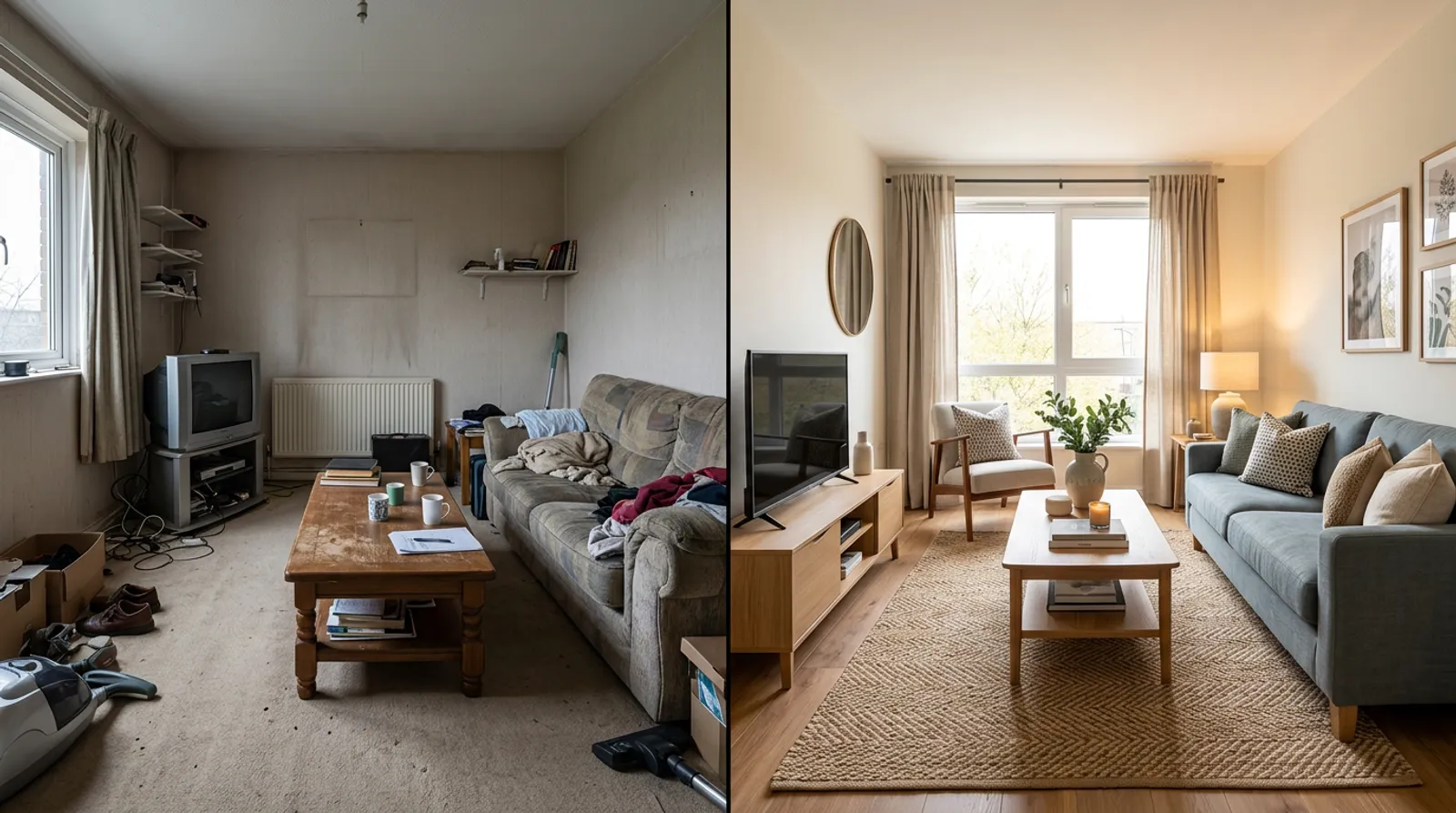 Design idea: a living room redesigned
The living room is the space you inhabit most, after the bedroom. You spend on average 3 to 5 hours a day there: meals in front of the TV, reading, conversations, evenings with friends. A poorly designed living room creates a quiet daily discomfort, an unconscious urge to leave the room. A well-designed living room, on the other hand, makes you want to stay, put your things down, breathe.
The living room is also the social showcase of your home. When a guest steps in, this is often the first room they see. The way you arranged it tells who you are, what you love, the rhythm you give to your home. It is not about showing off, it is about coherence.
Finally, it is the most flexible space. Unlike the kitchen or the bathroom, the living room does not depend on plumbing or fixed appliances. A new sofa, a fresh rug, three well-placed lamps: the mood shifts without major work. It is the room where decorating investment pays off the most.
Common living room mistakes to avoid
Before we talk about what works, let us look at what almost always fails.
- A sofa that is too large for the room. The single most common mistake. A 280 cm sectional in an 18 m² living room eats all the space and blocks circulation. Measure the room before buying, keep 70 to 90 cm clear around the sofa.
- A poorly placed TV. Too high, facing a window (reflections), too far from the sofa. Ideal height: the center of the screen at seated eye level, about 100 to 120 cm from the floor.
- A single ceiling light. The lone overhead light flattens the room, creates harsh shadows, kills the atmosphere. It is the most widespread lighting mistake.
- An overloaded coffee table. Fifteen decorative objects on 80 cm²: no room for a mug, no visual breathing room. Three objects maximum.
- A rug that is too small. A 120x170 cm rug squeezed between sofa and coffee table, never touching the furniture legs, gives a postage stamp effect. The rug should at least slide under the front legs of the sofa.
- No visual anchor. No focal point (fireplace, bookcase, large artwork), just scattered furniture. The eye does not know where to land.
Styles that work best for a living room
The living room welcomes almost any style, but some shine particularly well.
The Scandinavian style works particularly well for dim or small living rooms. Its light palette, blond wood and clutter-free layout give a sense of space and calm, perfect for urban apartments.
The Japandi style (Japanese-Scandinavian fusion) is ideal for a calm, grounded, almost meditative living room. Low lines, noble materials, earthy palette: you exhale the moment you walk in.
The Bohemian style suits generous square-meterage living rooms, where you can layer textiles, ethnic rugs, plants and vintage finds. It is the warm cocoon style by excellence.
The Industrial style elevates loft living rooms: tall volumes, exposed brick, black metal, raw wood. Perfect for adding character to a big open plate.
The Contemporary style is the most flexible. Clean lines, neutral palette, occasional statement pieces: it suits family living rooms that need to evolve over time without a full repaint.
If you hesitate between several moods, the Minimalist style remains a safe bet for a living room that is easy to maintain and easy to evolve.
Color palette and materials
A successful living room palette rests on three levels.
- Dominant color (60%): walls, large furniture, floor. Choose neutral and soothing tones: off-white, beige, pearl gray, taupe. These colors age well and let you change accents without redoing everything.
- Secondary color (30%): sofa, curtains, armchair. A more pronounced tone that structures the room: terracotta, sage green, petrol blue, warm brown.
- Accent touches (10%): cushions, throw, vase, wall art. This is where you allow yourself bold colors or strong patterns.
For materials, always mix matte and tactile: wood (oak, walnut), textile (washed linen, corduroy velvet, bouclé wool), ceramic, a touch of metal for structure. Avoid all-lacquer or all-leather, which make the room cold and impersonal.
Lighting: the rule of 3 sources
A living room should have at least three independent light sources, switchable separately. This is the secret of an atmosphere that adapts to the time of day.
- General light: central pendant or dimmable ceiling fixture. For evenings when you need clean light (cleaning, games, structured dinners).
- Task light: corner floor lamp or reading light behind the sofa. For reading, puzzles, laptop work on the couch.
- Ambient light: table lamp on a console, wall sconce, discreet string lights. This is what creates the cocoon at night, when the ceiling fixture is off.
All bulbs should be warm (2700 K). Modern white LEDs (4000 K and above) ruin the mood in a flash, giving an office or hotel lobby feel. If you can, add a dimmer to the ceiling fixture: it is the most rewarding decorating investment in the living room.
Bonus: a mirror facing the window doubles natural light for free. Worth testing first in north-facing living rooms.
Essential furniture
A functional living room rests on a few key pieces, well chosen.
- The sofa: the centerpiece. Measure before you buy, choose a removable-cover fabric if you have kids or pets, prefer visible legs (visually lighter).
- One or two armchairs: to break the sofa-TV front-on layout and create a conversation corner. Even a small armchair changes everything.
- The coffee table: scaled to the sofa (about two-thirds of its length). Height 35 to 45 cm. With storage if you are short on space for remotes and magazines.
- A console or TV unit: to store without crowding. Not too tall, to stay below the visual horizon line.
- A rug: it defines the living zone. Choose it large (at least 200x290 cm in a standard living room), it must slide under the front legs of the sofa.
- Vertical storage: bookcase, wall shelves. They lighten the floor and let you display what you love without overloading low surfaces.
7 concrete tips for your living room
- Measure everything before buying. Sofa, coffee table, rug, armchair. A tape measure avoids 90% of mistakes.
- Keep 70 to 90 cm of circulation between sofa and coffee table, and around furniture. If you bump into things, it is too tight.
- Place the rug under the front legs of the sofa. Not as a solo island in front of the sofa: it gives an unpleasant floating effect.
- Install 3 warm light sources switchable separately. This is the number one decorating lever.
- Add a mirror facing the window in a dark living room. You gain the equivalent of half a window.
- Limit objects to 3 maximum per surface (coffee table, console, end of shelf). Empty space has value.
- Find a focal point: fireplace, large framed artwork, full bookcase, color wall. The eye must be able to land somewhere.
The anti-cold checklist: warm up a living room in 10 minutes
Your living room looks good but feels visually "cold"? The cause is almost always a chilly trio: all white, all gray, all metal. The fix comes down to three warm materials to combine in every room.
- Wood (the anchor): coffee table, shelf, a photo frame in light or medium wood. Wood visually anchors a room, and without it the space stays cold. Aim for at least 2 visible wood elements per room. A simple wooden tray on a metal table is already enough to warm things up.
- Textile (the softness): a throw on the sofa, velvet or linen cushions, a thick rug. Textile absorbs sound and softens the mood. Aim for at least 3 different textiles in the living room, and vary the textures (velvet, linen, wool): all-smooth reads as a room with no soul.
- Low light (the warmth): candles, a table lamp, discreet string lights. This low level, below the ceiling fixture, is what creates the cocoon at night.
For color, the tones that warm a space are terracotta, beige, caramel, sage green and mustard. A single terracotta cushion can already shift the whole mood. The most rewarding first move: a throw and a table lamp. Around twenty dollars, five minutes, and the effect is immediate.
Test your living room on Shopia
Reading a guide is one thing; seeing the result on your own room is another. With Shopia, you upload a photo of your living room, pick a style (Scandinavian, Japandi, Bohemian, Industrial, Contemporary), and our tool delivers a realistic rendering in a few minutes. You can then compare before and after, adjust the furniture, test several moods before committing to a purchase or to renovation work.
Frequently asked questions
How much does it cost to decorate a 200 sq ft living room?
Budget $1,800 to $4,500 to redecorate a 200 sq ft living room at a mid-range level. The biggest line item is the sofa ($900 to $2,200 for a quality 3-seater). Add $250 to $600 for an 8x10 ft rug, $350 to $700 for three lighting sources (ceiling fixture, floor lamp, table lamp) and $250 to $500 for curtains and accessories. Smart move: keep what you have and swap just three key pieces (sofa, rug, lighting) to transform the room.
Sectional or straight sofa for a 200 sq ft living room?
A straight 3-seater sofa (78 to 86 inches wide) fits comfortably in a 200 sq ft room and preserves traffic flow. A sectional (102+ inches on the long side) only makes sense if the space exceeds 270 sq ft or if you host often. Simple rule: leave 28 to 36 inches of clearance around the sofa. If unsure, go with a straight sofa plus an accent chair, more flexible than a fixed sectional.
Should the TV be wall-mounted or sit on a media console?
Wall-mounting the TV frees up 24 to 32 inches of floor depth and looks more modern. Ideal height: center of the screen at 40 to 48 inches from the floor, eye level when seated. A media console still helps if you have a cable box, console and streaming device to hide: pick a low unit (14 to 18 inches tall) with built-in cable management. Avoid placing the TV opposite a window, glare ruins the picture.
Related articles

Dining room decor: dinners done right
Everything about dining room decoration: table, chairs, pendant, styles that work and 7 tips to host with style.

Entryway ideas: welcoming and functional
Everything about entryway decoration: storage, mirror, console, styles that work and 7 tips for a great first impression.

Scandinavian style: decorating like the Nordics
Everything about Scandinavian style: hygge, light wood, clean palette and 7 tips to nail a bright, warm Nordic interior.

Which indoor plants to choose and where to place them
Which indoor plants to choose, at what size and where to place them, room by room, without mistakes and without complicated upkeep.