

Table of contents
Industrial style: the New York loft look
The Industrial style is probably the most instantly recognizable of all contemporary interior looks. Born in former New York warehouses turned into lofts, it embraces raw matter without apology: exposed beams, bare brick, blackened metal and reclaimed wood. If you love generous volumes, a touch of rock attitude, and pieces that carry a story, this style is most likely for you.
In this guide, we walk through everything you need to know to nail an Industrial decoration: its origin, its palette, the materials to favor, the typical pitfalls, and concrete tips to transform your living room, kitchen or loft. At the end, you will be able to test this style directly on a photo of your room with Shopia.
Origin of the Industrial style
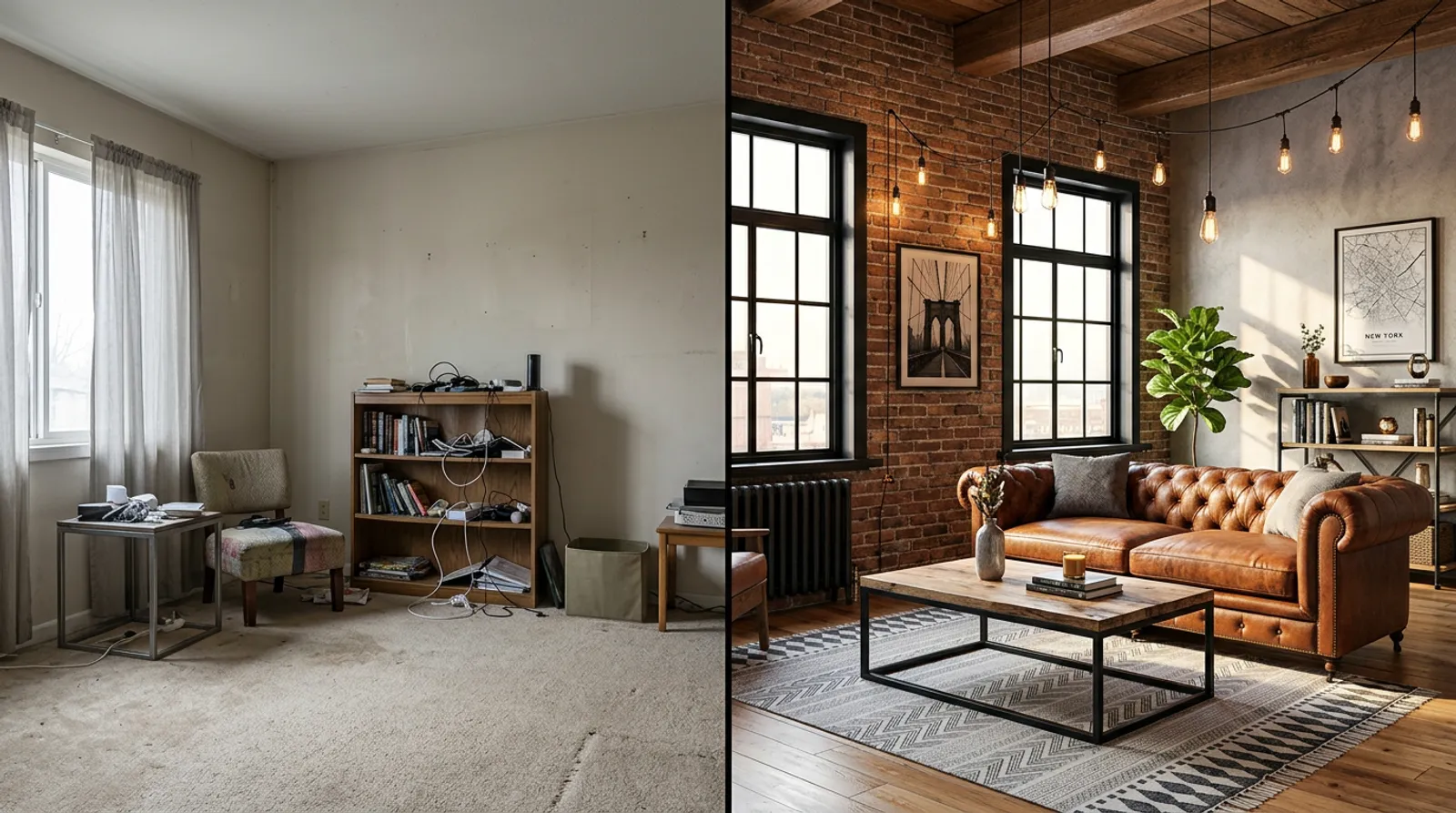 Design idea: a living room restyled in industrial style
The Industrial style emerged in 1950s New York, when artists and creatives moved into abandoned warehouses in SoHo, Tribeca and later the Meatpacking District. With no budget to renovate these huge volumes, the first occupants kept everything that was already there: concrete floors, exposed pipes, steel beams, bare brick walls. An aesthetic was born almost by accident.
Three principles still shape this aesthetic today:
- Authenticity: never hide the structure of the building; own it.
- Robustness: a piece of furniture should last thirty years and proudly wear its scars.
- Repurposing: a factory locker, a workshop lamp, an old school chair all get a second life in the living room.
This philosophy has spread far beyond the New York loft: Haussmann apartments in Paris, former workshops, converted garages and even brand-new homes now borrow its codes.
And this style, in your room?
18 free credits on signup. No credit card needed.
See this style in my roomIndustrial color palette
An Industrial decoration relies on an earthy, mineral palette dominated by grays, blacks and warm browns.
- Dominant colors: concrete gray, charcoal black, off-white.
- Accent touches: rusted brown, terracotta of bare brick, cognac leather, aged brass.
- Patinated metal: blackened steel, wrought iron, cast iron, oxidized zinc.
Avoid pastels, sharp acidic tones or overly pure whites: they break the raw soul of the style. Black, on the other hand, is your friend here: it structures, anchors, and dramatizes the volumes.
Materials and textures
The Industrial style celebrates matter in its most honest state. The idea is to let dents, welds, knots in the wood and irregularities in the concrete remain visible.
- Raw metal: blackened steel, wrought iron, plumbing pipes turned into shelving, exposed beams.
- Exposed brick: left bare or just sealed, ideally on one wall only so it does not overwhelm.
- Concrete: polished on the floor, raw on a kitchen counter, or painted across the walls.
- Reclaimed wood: pallets, old barn planks, railway sleepers, aged parquet.
- Aged leather: a patinated Chesterfield sofa, a cognac club armchair, saddle straps on chairs.
- Industrial glass: artist studio-style partitions, Edison bulb pendants.
Surfaces are textured, uneven, alive. A scratch on a wooden piece is not a defect; it is an asset.
Characteristics of Industrial layouts
Beyond materials, an Industrial interior is recognizable through a few very signature layout choices.
Visible structure, fully owned
Heating pipes, ventilation ducts, steel beams, electrical conduits: everything stays exposed, sometimes painted matte black so it blends in, sometimes left fully raw. Far from being a flaw, this visible plumbing becomes a decorative element in its own right.
Ceiling height put to work
The style thrives when volumes are generous. The tall ceilings typical of lofts allow for oversized pendant lights, full-height wall shelving, and steel-framed glass walls that separate spaces without fully closing them off.
Workshop-grade lighting
Industrial lighting has its own vocabulary: exposed Edison bulb pendants, cinema spotlights on tripods, articulated Jielde metal lamps, enameled vintage pendants from the 1930s. Bulbs are visible, sometimes copper-tinted, with warm light and a clearly drawn filament.
Mixing vintage and contemporary
Industrial style thrives on contrast. A solid wood and steel dining table can welcome original Tolix chairs or more recent reissues. A flea-market locker stands next to a contemporary linen sofa. The dialogue between eras is the soul of the genre.
7 concrete tips to nail an Industrial decoration
- Keep at least one raw surface: a brick wall, a polished concrete floor or exposed beams. Without this authentic foundation, Industrial rings false.
- Invest in one iconic piece: a Tolix chair, a Jielde lamp, a solid wood and iron table, a cognac leather club armchair. One strong piece is enough to define the room.
- Favor workshop-grade lighting: Edison bulb pendants, articulated metal desk lamp, tripod floor spotlight. Always with warm light (2700 K).
- Soften the hardness with textiles: a Berber rug, a chunky wool throw, washed linen cushions. Without this counterweight, metal and concrete chill the room instantly.
- Repurpose professional furniture: factory lockers as wardrobes, workshop tables as desks, lab metal stools at the bar.
- Limit the palette to three tones: one gray, one black, one warm wood. Beyond that, the whole becomes confused.
- Add graphic greenery: monstera, fiddle-leaf fig, dried eucalyptus in a tall metal vase. The green slices through the mineral and softens the atmosphere.
Who is the Industrial style ideal for?
Industrial works particularly well in certain contexts:
- Lofts and large volumes: the style was designed for these spaces and reigns there unchallenged.
- Renovated former buildings: artist studios, former print shops, converted manufactures, urban garages turned into homes.
- Flea-market lovers: if you enjoy hunting for objects with a story, this style rewards you.
- Urban creative profiles: architects, photographers, designers often feel at home here.
If you live in a small, very bright apartment, full Industrial may crush the room. Consider a softer version, for example a Chic Industrial style that keeps the blackened metal and Edison bulbs but pairs them with light marble and more refined textiles.
Common mistakes to avoid
- Too much cold metal: without wood, leather and textiles, Industrial turns into a parking garage. A thick rug and a large patinated leather sofa are enough to warm the whole.
- Cold white lighting: 4000 K LEDs kill the soul of the style. Stay between 2200 and 2700 K, warm light with visible filaments.
- Overplaying the construction-site cliché: cables left everywhere, neon signs piled up and wooden crates as side tables turn Industrial into a streaming-show parody.
- Mixing too many shiny metals: polished brass, chromed steel and lustrous stainless clash. Prefer matte and oxidized patinas; they sing together.
Test the Industrial style on your room
Reading a guide is one thing; seeing the result on your own room is another. With Shopia, you upload a photo of your living room, kitchen or loft and our tool delivers an Industrial rendering in a few minutes. You can then compare before and after, fine-tune the furniture, and even find similar products online.
Frequently asked questions
Does industrial style work in a regular apartment?
Yes, as long as you dose it. In a standard two-bedroom or a brownstone, avoid overdoing it: one industrial statement piece is enough (Tolix pendant, metal and wood shelving, steel-trestle dining table). Pair it with white or pale grey walls, existing hardwood floors and 2 or 3 plants to soften the look. You don't need exposed beams or 13-foot ceilings: the raw spirit matters, not the loft set design.
How much does an industrial room cost?
Budget $900 to $3500 per room. Structural pieces cost more than bohemian or Scandinavian items: a black metal foundry-style pendant ($180 to $500), a solid wood and steel dining table ($700 to $1800 at West Elm or CB2), authentic Tolix chairs ($220 each). Save big with industrial second-hand: estate liquidations, salvage yards and workshop closeouts.
How do I add an exposed brick wall without major construction?
Three options that skip the demolition. First, brick veneer panels (Home Depot, $3 to $7 per sq ft) glued on an existing wall in 2 or 3 hours. Second, high-definition brick wallpaper ($35 to $90 per roll): convincing from 3 feet away. Third, a large charred wood or corten steel panel as a wall accent. The most authentic finish stays the veneer panels.
And this style, in your room?
18 free credits on signup. No credit card needed.
See this style in my roomRelated articles

Contemporary style: a modern, evolving interior
Everything about Contemporary style: current design, neutral palette, noble materials and 7 tips for an evolving interior.

Bohemian style: a warm, free-spirited interior
Everything about Bohemian style: terracotta, macramé, rattan, ethnic textiles and 7 tips for a warm, free-spirited interior.