

Table of contents
Which indoor plants to choose and where to place them
Do your plants look lost in the room? The problem is almost never the plant itself, it comes down to proportions and choosing by room. A plant that is too small in a large living room disappears, a toxic plant in a bedroom becomes a risk, and a fragile species in a hot kitchen will not last. Placed well, at the right size, a single plant can change the mood of a room in a few minutes.
In this guide you will see how to choose your plants by light level and by room, what height to aim for at each spot, which easy plants to favor, and which ones to avoid depending on the room.
The sizing rule that changes everything
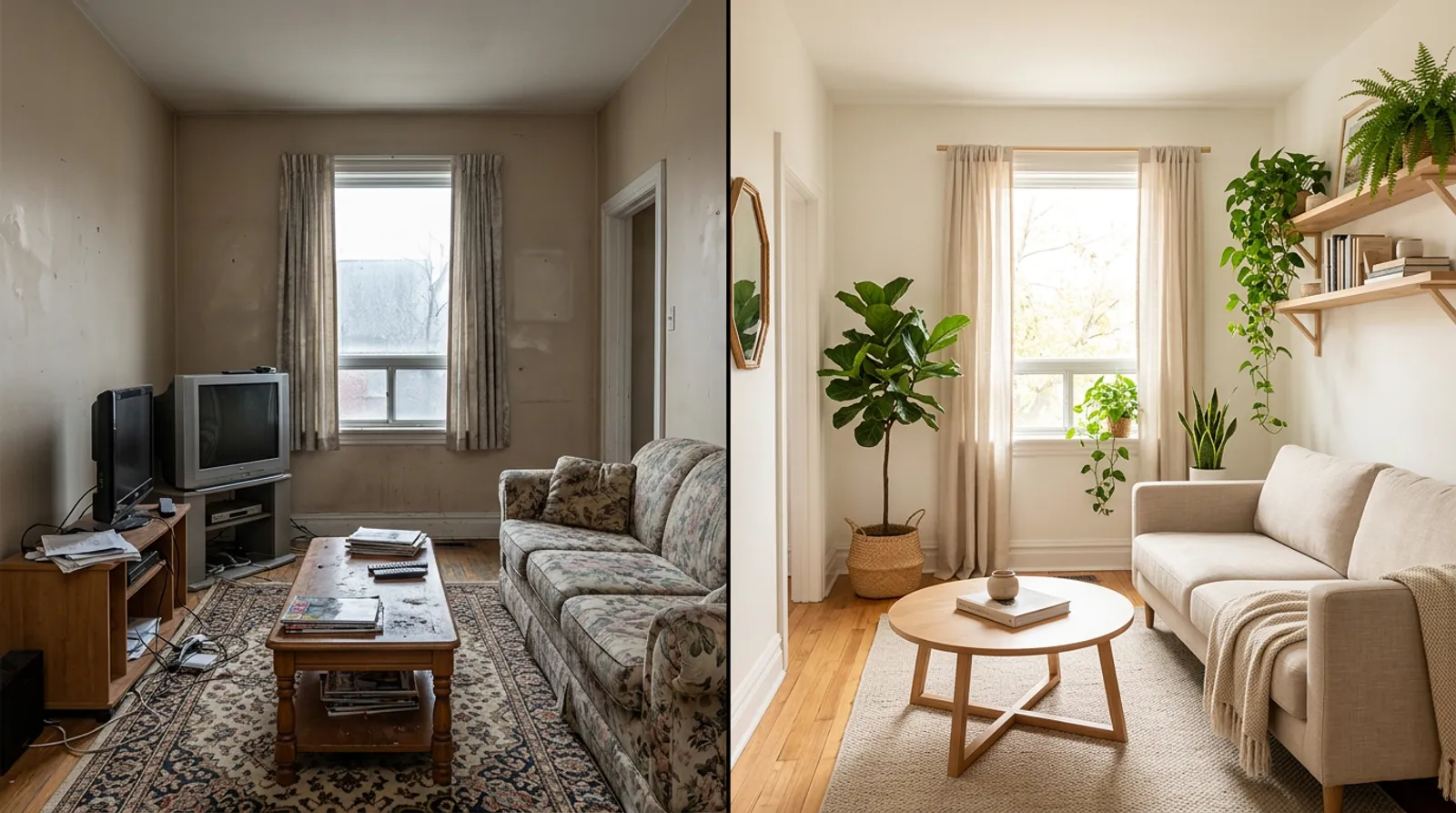 Design idea: a room brought to life with indoor plants
The first mistake is going too small. In a living room, count on 80 cm minimum: below that, the plant gets forgotten. To dress an empty corner, go up to 120 or 150 cm with a statement piece. Next to a sofa, plan for 100 to 120 cm and leave 50 cm between the plant and the furniture for circulation.
Two simple cues work for every room. The pot diameter should be about one third of the width of the nearby furniture, that is the right visual proportion. And the ultimate test: if your plant gets forgotten, it is too small.
The living room: creating impact
This is the room where a large plant makes all the difference. The safe, easy-care choices:
- Monstera deliciosa: 120 to 180 cm, easy, medium light.
- Strelitzia (bird of paradise): 120 to 150 cm, easy, good light.
- Kentia (palm): 150 to 200 cm, easy, tolerates low light.
- Yucca: 100 to 150 cm, easy, good light.
- Dracaena marginata: 120 to 180 cm, easy, medium light.
The Ficus lyrata (fiddle-leaf fig) looks stunning at 150-200 cm but is more demanding: save it for when you already have a green thumb. Avoid in the living room: trailing plants set on the floor (you step on them), cacti if you have children, and anything under 60 cm.
The bedroom: oxygen and calm
Here, the Sansevieria (snake plant), 40 to 80 cm, and the Aloe Vera, 30 to 50 cm, are the classics: very little care and a little oxygen released at night (a slight plus, more symbolic than truly measurable). The Pothos (40 cm trailing) and the Chlorophytum (spider plant), 30 to 40 cm, stay discreet and are said to freshen the air. Important if you have a pet: the Sansevieria, Aloe Vera and Pothos are toxic to cats and dogs if eaten. In that case, the Chlorophytum is the only one on this list that is genuinely safe.
For placement, a nightstand takes 30 to 40 cm maximum (no taller than the lamp), a floor corner 60 to 80 cm, and you avoid anything over 100 cm so the space does not feel crowded. Forbidden in the bedroom: the Ficus (releases CO2 at night), Lily and Jasmine (too strongly scented), Azalea and Philodendron (toxic, especially around pets).
The kitchen: useful and compact
In the kitchen, the plant must handle steam and heat, and stay out of the way. On a worktop, keep to 20 to 30 cm; on a high shelf, 40 to 60 cm in a trailing version. The good picks:
- Culinary herbs (basil, mint): 20 to 30 cm, useful for cooking, low budget.
- Pothos: 40 cm trailing, said to freshen the air, very easy.
- Aloe Vera: 30 to 40 cm, handy for minor burns.
Good to know: the Pothos and Aloe Vera are not edible and are toxic if eaten (only the culinary herbs are safe to eat). Keep them out of reach of children and pets, and steer clear of species that are fragile in heat.
The bathroom: room for tropicals
The bathroom is humid, which makes it perfect for plants that love it. Three simple options: the Boston fern (40 to 60 cm), bamboo (60 to 100 cm) and the orchid (30 to 40 cm). All enjoy high humidity, which makes them natural companions for this room, where other plants would struggle.
The office and the entryway
At the office, the plant should never block the screen. On the desk, aim for 40 to 60 cm and keep 30 cm away from the screen; on the floor, go up to 80 to 120 cm. The Sansevieria (40 to 80 cm) and the Zamioculcas (ZZ) (50 to 80 cm) are easy and tough; a small cactus (10 to 20 cm) makes a minimalist decorative touch.
In the entryway, play the first impression with 100 to 140 cm (up to 180 cm under a high ceiling): a Monstera, a Yucca or a Dracaena sets the tone. Leave 80 cm of clear passage and choose a stable pot, since there is a lot of traffic in this spot.
What budget to plan for
No need to overspend. A plant usually costs between 15 and 80 euros, and the smart rule fits in one sentence: one large plant at 60 euros has more impact than five small ones at 10 euros. As a guide, count on 80 to 150 euros for a living room (a Monstera plus a Pothos), 30 to 50 euros for a bedroom (two Sansevierias), 15 to 30 euros for a kitchen, 20 to 40 euros for a bathroom, 25 to 45 euros for an office and 40 to 80 euros for an entryway.
To go further on finishes and styling, see our guide to the showroom look and the one on the size of vases and decor objects.
The checklist before buying
- Measure the available space, height and width.
- Check the room's light: good, medium or low.
- Choose a stable pot if the area sees a lot of traffic (entryway, hallway).
- Pick a non-toxic plant if you have pets or children.
- Make sure the care level matches your pace.
- Plan the full budget: pot, plant and potting soil.
Test your plants on your room
Imagining a large plant in a corner is one thing; seeing it in place is another. With Shopia, you photograph your room, choose the elements to add, and get a realistic render in a few minutes. You can compare before and after, try a tall plant near the sofa or a trailing one on the shelf, and find the right size before buying anything.
Frequently asked questions
Which indoor plants are the easiest to care for?
The easiest are the Sansevieria (snake plant), Aloe Vera, Pothos and Zamioculcas (ZZ). They tolerate missed waterings, handle medium to low light and stay good-looking for a long time. One thing to note if you have a pet: all four are toxic to cats and dogs if eaten; in that case go for the Chlorophytum (spider plant) or the Kentia, which are safe. The Kentia and the Yucca are also very forgiving for large formats. If you are starting out, pick one of these safe choices before trying a Ficus lyrata, which is more demanding.
Which plants should go in a bedroom?
In a bedroom, the Sansevieria or Aloe Vera release a little oxygen at night (a real but modest effect). The Pothos and the Chlorophytum (spider plant) are said to freshen the air and stay compact. If you have a pet, be aware that the Sansevieria, Aloe Vera and Pothos are toxic to cats and dogs: in that case go for the Chlorophytum, which is non-toxic. Also avoid the Ficus, which releases CO2 at night, along with Lily, Jasmine, Azalea and Philodendron, which are toxic or too strongly scented. Keep sizes under 100 cm so the room does not feel crowded.
What plant size should I pick for a living room?
In a living room, aim for at least 80 cm tall, otherwise the plant goes unnoticed. To fill an empty corner, go up to 120 or 150 cm with a statement piece like a Monstera or a Strelitzia. Next to the sofa, count on 100 to 120 cm minimum and leave 50 cm of distance. The pot diameter should be about one third of the width of the nearby furniture.
Related articles

How to give your home a showroom look
A showroom look comes down to two things: visual relief across three heights and clean finishing touches. The pro method, for under 100 euros.

What size vases and decor objects to choose
The simple rule for choosing the height of your vases and decor objects: one third of the furniture height, groups of three, and the right dimensions per room.

Living room ideas: design a warm, welcoming space
Everything about living room decoration: palette, furniture, lighting, styles that work and 7 tips for a warm, inviting space.