

Table of contents
Japandi style: Scandinavian-Japanese serenity
The Japandi style is the meeting, obvious and surprising at once, of two everyday cultures: the warm restraint of the Nordic countries and the Japanese art of less. Emerging around 2018-2020 on social platforms and quickly adopted by design magazines, it pairs the comfort of Danish hygge with the wisdom of Japanese wabi-sabi, the philosophy that finds beauty in imperfect, modest things shaped by time.
In this guide you will find everything needed to nail a Japandi interior: its origin, its palette, the materials to favor, a typical layout and the mistakes to avoid. At the end you will be able to test this style directly on a photo of your room with Shopia.
Origin of the Japandi style
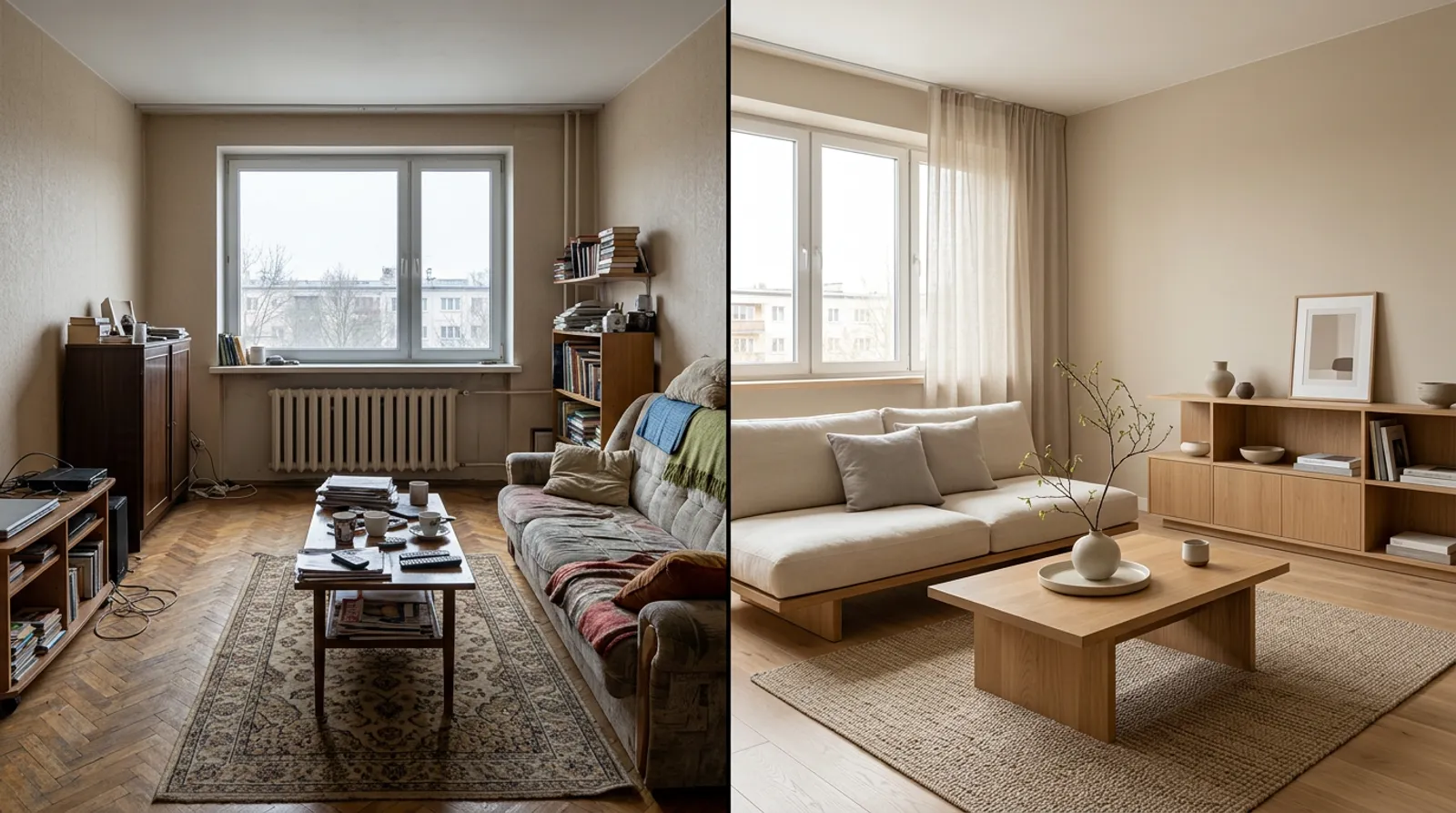 Design idea: a living room restyled in Japandi style
Japandi is not a historical movement like Scandinavian design or the Bauhaus: it is a contemporary synthesis that emerged naturally because the two cultures share a common root. In Japan as in the Nordics, daylight is precious, craft is respected, furniture is built to last and empty space carries real value.
Three notions sit at the heart of this aesthetic:
- Wabi-sabi: the acceptance of imperfection, of marks left by time, of nature left unsmoothed.
- Lagom: the Swedish principle of just-enough, never too much, never too little.
- Ma: the Japanese concept of negative space, the idea that the void between objects is part of the composition.
From this fusion comes a decoration that is clean yet never cold, calm yet never sterile, and deeply rooted in materials.
And this style, in your room?
18 free credits on signup. No credit card needed.
See this style in my roomJapandi color palette
A Japandi decoration relies on an earthy, softened palette, warmer than the classic Scandinavian look but quieter than Bohemian.
- Dominant colors: sand beige, off-white, warm taupe gray.
- Accent touches: soft black (never lacquered), heavily diluted terracotta, moss green.
- Wood: light oak, ash, paulownia, sometimes charred wood (shou sugi ban) to add structure.
The point is never violent contrast. Everything happens in the nuances: a slightly pink beige against a slightly gray beige, a softened black next to honey wood. Avoid pure white and acidic pastels, which belong to other styles.
Materials and textures
Japandi is above all a style of materials: you do not decorate with objects, you decorate with surfaces that age well.
- Natural wood: oak, ash, paulownia, bamboo. In an oiled or simply sanded finish, never varnished.
- Matte ceramics: artisan stoneware, glazed terracotta, raw porcelain. Prefer unique pieces over industrial sets.
- Natural textiles: washed linen, raw cotton, bouclé wool, sisal for rugs.
- Paper: rice paper for shoji screens, paper lamps, parchment shades.
- Stone: pebbles, slate, raw granite, used sparingly to anchor a composition.
Every surface is matte, slightly irregular, pleasant to the touch. Golden rule: if a material shines, it has no place in a Japandi room.
Characteristics of Japandi layouts
Beyond materials, a Japandi interior is recognizable through several very specific layout choices.
Low furniture, light silhouettes
Japandi furniture is low, slim, grounded. A deep sofa on short legs, a rectangular coffee table at futon height, a solid wood bench without armrests. The idea is to lower the horizon line to free the space above and create a sense of openness, even in a small room.
Embraced negative space
In a Japandi living room you will often see an entire wall left bare, a shelf with only two objects, or a corner deliberately left empty. This ma is not an oversight: it is a decision. The void lets the chosen objects breathe and gives the eye a place to rest.
Diffused, warm light
No aggressive ceiling spot. Japandi multiplies low, softened sources: a paper table lamp, a discreet wall sconce, a woven bamboo pendant. Bulbs are warm (2700 K) and often filtered by a paper or linen shade to soften the diffusion.
Nature woven in
A cherry branch in a stoneware vase, an ikebana of three stems, a minimalist bonsai, a succulent on a pale shelf: greenery is present but always within a logic of restraint, never in abundance.
7 concrete tips to nail a Japandi decoration
- Choose a light wood with a matte finish for your main piece. Oiled oak or raw ash are safe bets.
- Limit your palette to four shades at most: a light background, a wood, a soft dark accent, a plant touch.
- Invest in one artisan signature piece: a stoneware vase, a washi paper lamp, a hand-carved stool.
- Lower the furniture line. A coffee table 30 cm off the floor, a platform bed, a short-legged sofa change the feel of the room dramatically.
- Leave at least one wall completely bare. No frame, no shelf, no clock. Just a surface that breathes.
- Prefer paper to thick fabric for light sources. Light passing through a rice paper shade has a quality nothing else delivers.
- Accept imperfection: a cracked bowl, a knotty plank, a slightly creased linen. This is what separates a living Japandi from a showroom set.
Who is the Japandi style ideal for?
Japandi works particularly well for several profiles:
- People seeking calm: the soft palette and negative space soothe immediately.
- Urban apartments: low furniture and decluttering visually enlarge small surfaces.
- Craft lovers: this is a style that rewards unique, handmade, imperfect pieces.
- Couples without clutter: Japandi does not tolerate bric-a-brac, it demands real visual discipline.
If you love the zen spirit but want even more warmth, consider the classic Scandinavian style. If on the contrary Japandi feels too restrained, the Bohemian style lets you bring in more colors and materials.
Common mistakes to avoid
- Confusing Japandi with cold minimalism: Japandi is warm. Without rich natural materials it becomes a sterile loft.
- Mixing too many woods: two species maximum in a single room, otherwise coherence falls apart.
- Overloading surfaces: three objects on a console beat ten. Ma is not negotiable.
- Choosing glossy black lacquer: Japandi black is matte, soft, almost velvet. Glossy belongs to art deco, not here.
- Multiplying patterns: Japandi lives in solids and textures, never in prints.
Try the Japandi style on your room
Reading a guide is one thing; seeing the result on your own room is another. With Shopia, you upload a photo of your living room, bedroom or kitchen and our tool delivers a Japandi rendering in a few minutes. You can then compare before and after, fine-tune the furniture, and even find similar products online.
Frequently asked questions
What is the difference between Japandi and Scandinavian style?
Japandi blends Japanese minimalism with Nordic function: warmer palette (sand beige, taupe grey, soft black), lower furniture, raw ceramics and wabi-sabi influence. Scandinavian feels brighter and more colorful, with pastel accents, crisp white and chunky textiles (wool, sheepskin). Japandi pushes restraint further and embraces imperfection as beauty, while Scandinavian focuses on hygge coziness and Nordic light.
What does wabi-sabi actually mean?
Wabi-sabi is a Japanese philosophy that celebrates the beauty of the imperfect, impermanent and incomplete. In decor, it translates to raw ceramics with uneven rims, patinated wood that shows its grain, naturally crumpled linen and handmade objects that wear their craft marks. The idea: prefer a cracked Hasami vase over a flawless industrial one. It's the soul of Japandi.
What essential furniture do I need to start a Japandi room?
Three anchor pieces structure the space: a low linen sofa in ecru or taupe ($900 to $2200), a solid dark wood coffee table (fumed oak, walnut) around $500, and an Akari-style washi paper lamp by Noguchi ($250). Add 2 or 3 raw ceramics, a woven jute rug and one plant (bonsai or monstera). Avoid clutter: 5 carefully chosen objects beat 15 random ones.
And this style, in your room?
18 free credits on signup. No credit card needed.
See this style in my roomRelated articles

Scandinavian style: decorating like the Nordics
Everything about Scandinavian style: hygge, light wood, clean palette and 7 tips to nail a bright, warm Nordic interior.

Minimalist style: living with the essentials
Everything about Minimalist style: less is more, clean palette, pure lines and 7 tips for living with the essentials.

What Is Provençal Style? Colors, Materials and Decor Tips
What Provençal style is and how to get it: lavender, ochre, wrought iron, terracotta floors and 7 tips to bring the South of France home.