

Table of contents
Minimalist style: living with the essentials
The Minimalist style rests on a simple and radical idea: less, but better. Born from the meeting of Japanese aesthetics of emptiness (the ma) and German functionalism led by Dieter Rams, it invites you to let go of everything non-essential so that space, light and the few remaining objects can breathe. If you want to soothe your home, gain mental clarity and make room for calm, Minimalism is most likely your path.
In this guide, we dive into everything you need to know to nail a Minimalist decoration: its origin, its color palette, the materials to favor, the pitfalls to avoid (especially the confusion between minimalism and cold emptiness), and concrete tips to transform your living room, bedroom or office. At the end, you will be able to test this style directly on a photo of your room with Shopia.
Origin of the Minimalist style
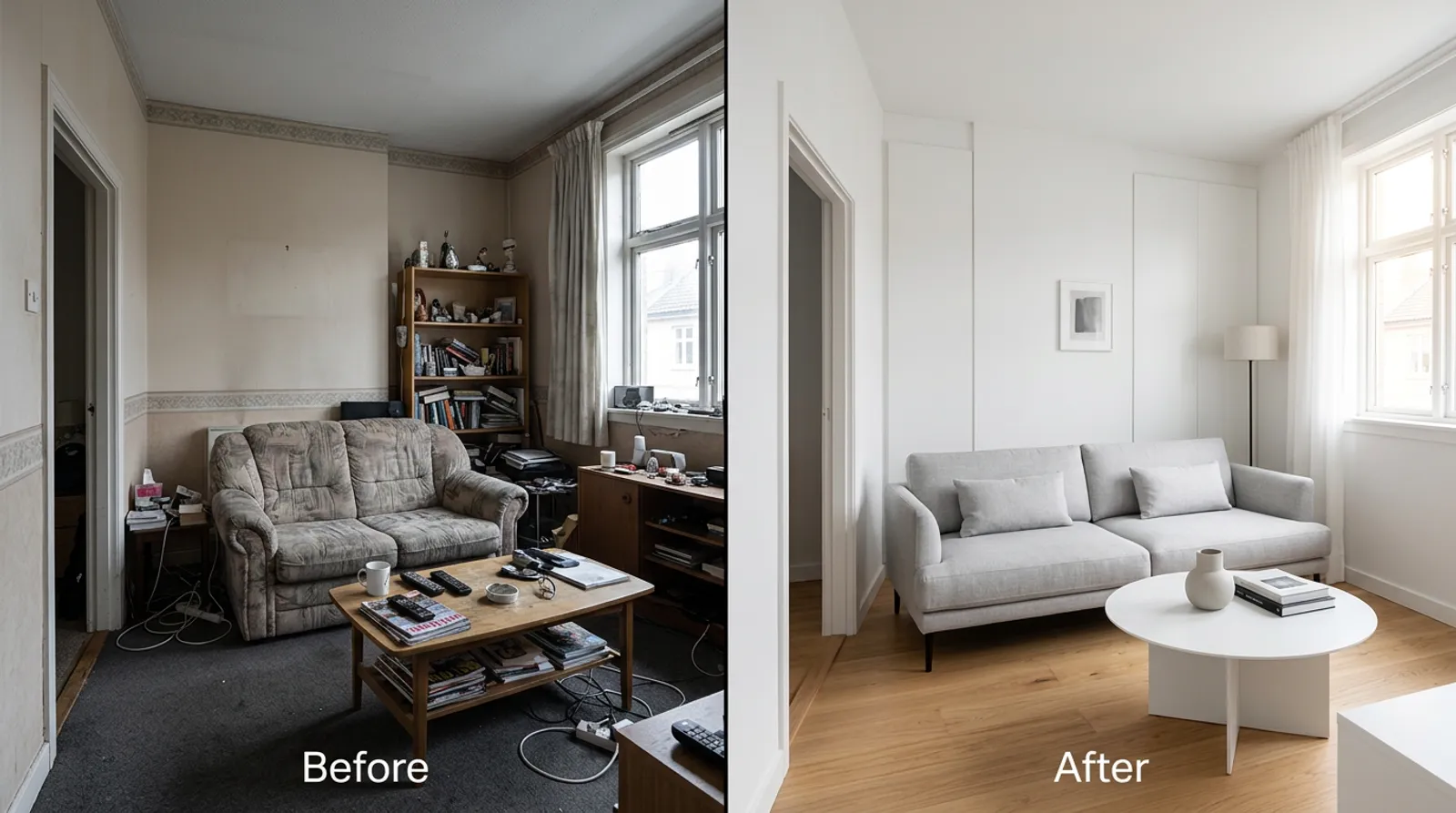 Design idea: a living room restyled in minimalist style
Contemporary Minimalism emerges from the convergence of two 20th-century currents. On one side, Japanese minimalism embodied by architects Tadao Ando and Naoto Fukasawa, heir to a Zen tradition where emptiness carries as much weight as fullness. On the other, the functionalism of the Bauhaus and later of Dieter Rams at Braun, who summed up his philosophy in ten principles, the most famous being "Less, but better". Mies van der Rohe captured it in a now-legendary formula: "Less is more".
The movement exploded in the 1990s and 2000s with a new generation looking to escape accumulative consumption. Marie Kondo brought it to mainstream audiences by linking decluttering to psychological well-being. Three principles still guide this aesthetic today:
- Essentials only: every object must serve a purpose or be deeply loved. Otherwise, it goes.
- Quality over quantity: few pieces, but carefully chosen.
- Space as material: emptiness is not a lack, it is a composition element in its own right.
This philosophy aligns both an ecological stance (consume less) and a mental comfort (less visual noise).
And this style, in your room?
18 free credits on signup. No credit card needed.
See this style in my roomMinimalist color palette
A Minimalist decoration relies on a monochrome, neutral palette that lets volumes and light speak without interference.
- Dominant colors: dominant white, sand beige, light cement gray. Walls, ceilings and floors stay in the same family to erase boundaries.
- Graphic accent: a deep black used very sparingly (a frame, a lamp, a handle) to anchor the eye.
- No saturated color: no red, no bright blue, no yellow. Color, if it shows up, comes from the materials themselves (the honey of oak, the gray of concrete).
Avoid strong contrasts, multiple poorly coordinated neutrals, or patterns: they break the visual unity that drives the whole style.
Materials and textures
The Minimalist style celebrates raw, honest, finely crafted materials. Since few objects remain, every texture counts and must be flawless.
- Light wood: oak, ash, maple. Always in a matte oiled or waxed finish, never glossy lacquer.
- Polished or waxed concrete: on floors, on countertops, sometimes on a wall. Provides a raw, contemporary base.
- Matte metal: brushed brass, black steel, anodized aluminum. For legs, handles, light fixtures.
- Glass and ceramic: transparent for partitions, matte for tableware. Always simple, never ornate.
- Linen and ecru cotton: for textiles. Tactile, natural, never shiny or synthetic.
Surfaces are flat, wide, sometimes entirely bare. A single solid oak top beats ten little melamine shelves every time.
Characteristics of Minimalist layouts
Beyond colors and materials, a Minimalist interior is recognizable through several highly radical layout choices.
Hidden, flush storage
The Minimalist secret: you still have to store things, but no one should see them. Floor-to-ceiling closets, push-to-open without handles, recessed niches, pivot doors that disappear into the wall. The eye only sees smooth planes.
Straight lines and large bare surfaces
No decorative curves, no mouldings, no ornament. Furniture is geometric (rectangular table, straight sofa, slim shelf). Large wall surfaces stay entirely bare, which is exactly what gives the style its breathing room.
A few iconic statement pieces
Since you keep little, what remains must carry weight. A Mies Barcelona chair, a Saarinen Tulip table, a Vipp pendant, an Anglepoise lamp, a String shelving system. One signature piece alone is enough to spine the whole room.
Lighting that sculpts the void
In a stripped-down interior, light becomes the decor. Multiply your sources: linear pendants, recessed LED strips, discreet wall sconces, sleek floor lamps. Favor indirect lighting that reveals volumes over flat ceiling lights that flatten everything.
7 concrete tips to nail a Minimalist decoration
- Declutter before decorating. Take everything out, put back only what serves a purpose or what you truly love. The rest goes to donation or storage.
- Pick a single material family: all light wood, or all concrete, or all off-white. Coherence makes the style.
- Invest in an iconic piece: a chair, a table, a designer pendant. Just one, but the right one.
- Hide your storage: floor-to-ceiling closets, push-to-open without handles. The eye should never see clutter.
- Take care of textiles: a large thick wool throw, two ecru linen cushions, a jute rug. Otherwise Minimalism turns cold.
- Multiply light sources: at least three per room, indirect. Light is your only decor.
- Leave emptiness. A fully bare wall, an empty shelf, a corner with nothing. That is where Minimalism stands apart from simple tidiness.
Who is the Minimalist style ideal for?
Minimalism works particularly well in certain contexts:
- Small spaces: few pieces of furniture visually frees up volumes.
- Lovers of calm and order: zero visual stimulation, less mental fatigue.
- Nomadic lifestyle: fewer objects, easier moves, more mobility.
- Remote workers: few visual distractions, better focus on screen.
If you love warm vibes or own many sentimental items, pure Minimalism can feel austere. Look instead at the Japandi style, which marries Minimalism with Scandinavian warmth, or slow living, which shares the same philosophy while allowing more materials and softer colors.
Common mistakes to avoid
- Confusing minimalism with cold emptiness: without textiles, without wood, without warm light, the interior turns into a hospital waiting room. Minimalism stays sensory.
- Generic personality-free furniture: an entry-level white lacquered sideboard does not make a successful Minimalist room. Choose few, but choose well.
- Neglecting lighting: in a stripped-down room, a single ceiling bulb instantly kills the style. Light sculpts empty volumes.
- Mixing too many neutrals: a poorly matched off-white, beige and gray look dirty. Stick to two tones max in the same family.
Test the Minimalist style on your room
Reading a guide is one thing; seeing the result on your own room is another. With Shopia, you upload a photo of your living room, bedroom or office, and our tool delivers a Minimalist rendering in a few minutes. You can then compare before and after, fine-tune the furniture, and even find similar products online.
Frequently asked questions
What is the difference between minimalism and cold emptiness?
Minimalism keeps few objects, but picks them with care: warm materials (oiled oak, washed linen, wool), varied textures and worked light. Cold emptiness, on the other hand, stacks smooth glossy surfaces (gray polished concrete, glass, brushed metal) with no tactile warmth at all. The simple rule: at least three natural materials in a minimalist room, otherwise you slide into a clinical look.
Is Minimalist style compatible with kids?
Yes, and it actually makes daily life lighter. Lean on closed storage (floor-to-ceiling built-in wardrobes, bench-chests), a dedicated wicker basket for toys in the living room, and an evening rule: everything goes back in its place before bedtime. Pick resilient materials (solid oiled oak, pre-washed linen, thick wool rugs) that forgive bumps and washing. Avoid pure white on sofas.
What is the first piece of furniture to buy when starting a Minimalist decoration?
The sofa. It takes the most visual volume and sets the tone for the rest. Favor a 3-seat model in washed linen, beige or pearl gray, straight lines, light wooden legs, with no large decorative cushions. Plan 1,200 to 2,500 euros for solid quality (West Elm, Article, Made.com, MUJI). Once that sofa is in place, you will immediately see which other pieces to remove or add.
And this style, in your room?
18 free credits on signup. No credit card needed.
See this style in my roomRelated articles

Scandinavian style: decorating like the Nordics
Everything about Scandinavian style: hygge, light wood, clean palette and 7 tips to nail a bright, warm Nordic interior.

Japandi Style: A Guide to Scandinavian-Japanese Serenity
Everything about Japandi style: Japanese × Scandinavian fusion, beige and grey palette, light wood, serenity and craft.