

Table of contents
Contemporary style: a modern, evolving interior
The Contemporary style is probably the most misunderstood of all interior looks. People often confuse it with Modern, when in fact the two are almost opposites. Where Modern is anchored in a precise era (mid-twentieth century, from the Bauhaus to mid-century American designers), Contemporary moves with its time: it absorbs current trends, blends mid-century, Scandinavian and minimalist influences, and produces an interior that evolves without being torn down every three years.
In this guide, we dive into everything you need to know to nail a Contemporary decoration: its origin, its palette, the materials to favor, the typical pitfalls, and concrete tips to transform your living room, bedroom or kitchen. At the end, you will be able to test this style directly on a photo of your room with Shopia.
Origin of the Contemporary style
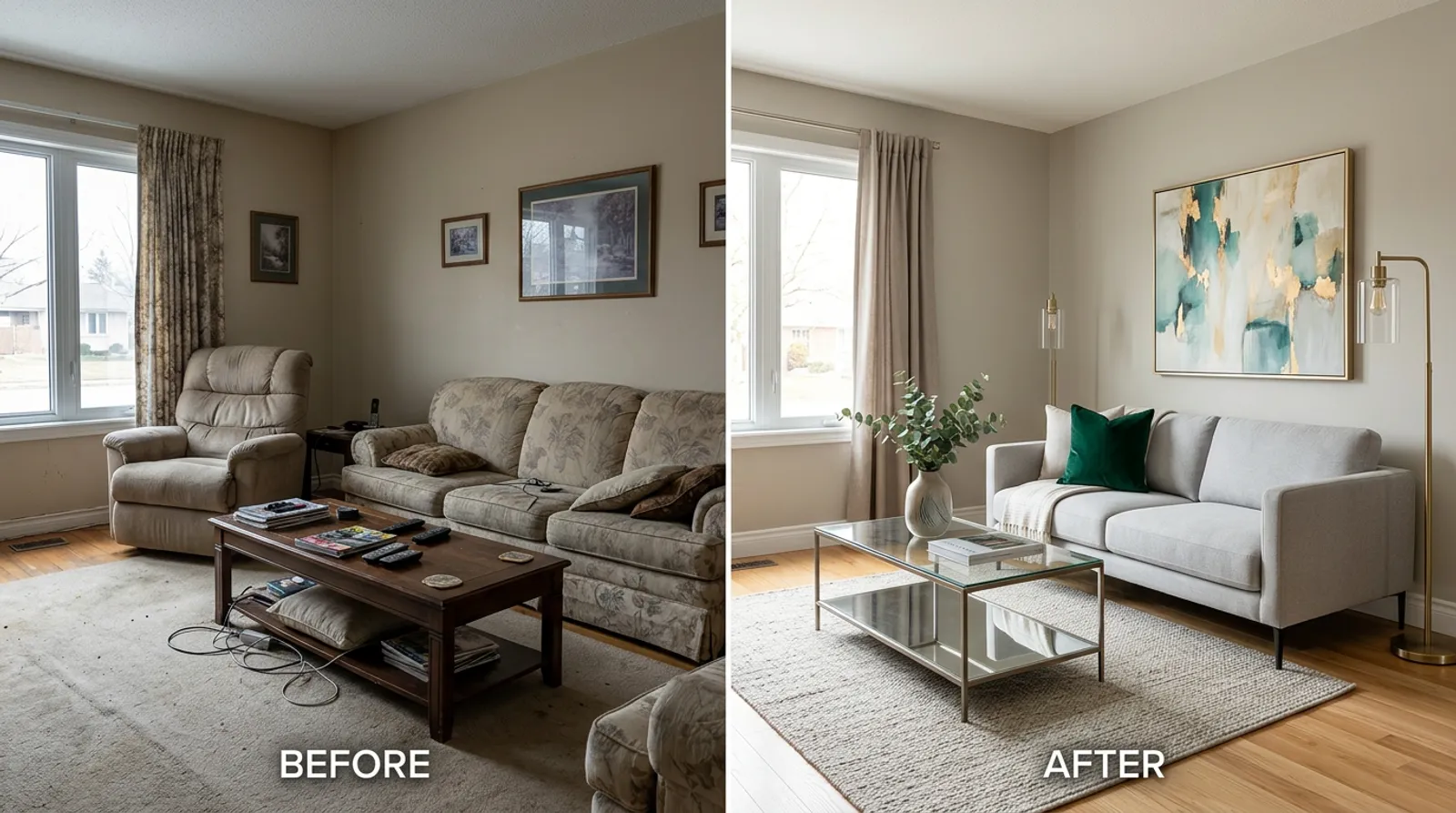 Design idea: a living room restyled in contemporary style
The Contemporary style has no real birth date, and that is precisely what defines it. It is an aesthetic in motion, reflecting the trends of the current year and constantly absorbing fresh influences. Where Modern refers to a precise historical movement, Contemporary refers to what is being made now.
Three principles guide this living aesthetic:
- Evolution: a Contemporary interior is never frozen; it accepts small adjustments year after year.
- Functional comfort: form follows use, and use follows current ways of living (remote work, flexible spaces, discreet technology).
- Curated mixing: borrowing from Scandinavian, Japandi or Minimalist references is welcomed, as long as none is copied wholesale.
This flexibility explains its popularity in new builds and contemporary renovations: it ages well precisely because it never freezes.
And this style, in your room?
18 free credits on signup. No credit card needed.
See this style in my roomContemporary color palette
A Contemporary decoration relies on a calm, neutral foundation, lifted by one or two trend accents that can shift over the seasons.
- Dominant colors: off-white, pearl gray, beige, taupe, ecru.
- Trend accents: sage green, teal blue, terracotta, ochre, chocolate brown (the exact tones vary year to year).
- Graphic notes: a deep black used sparingly to anchor the composition, brushed brass for accents.
The advantage of this neutral base: swapping a sofa, adding a trendy armchair or repainting a single wall is enough to refresh the room. On the other hand, avoid stacking four accent colors at once: the room loses its coherence.
Materials and textures
The Contemporary style loves to pair noble materials with innovative ones. The rule: touch, contrast, but always in measured doses.
- Worked woods: smoked oak, walnut, ash, more often oiled than varnished.
- Stones and minerals: veined marble (on a worktop or coffee table), terrazzo, travertine, matte ceramic.
- Brushed metals: brushed brass, satin stainless steel, matte black. Glossy chrome feels dated.
- Natural and technical textiles: washed linen, chunky bouclé, corduroy velvet, alongside performance fabrics (water-repellent, stain-resistant).
- Glass and translucents: smoked glass, fluted glass, tinted plexi for light partitions.
The point is not to line up all these materials in the same room, but to pair two or three to create a dialogue of textures. A veined marble countertop next to a smoked oak backsplash: that tension is what produces the Contemporary effect.
Characteristics of Contemporary layouts
Beyond colors and materials, a Contemporary interior is recognizable through several very current layout choices.
Modular, evolving furniture
The modular Togo-style sofa, low movable furniture, extendable tables: everything is designed to adapt to a lifestyle that changes (working from home, hosting more, scaling down). Thin-legged pieces keep an impression of visual lightness.
Discreet technology integration
Contemporary embraces technology but never flaunts it. The television blends into a wood panel, speakers are recessed, cables disappear into hidden trunking. Smart-home features (blinds, lights, heating) are controlled from an app, without intrusive wall switches.
Multi-source, sophisticated lighting
The single ceiling pendant is over. Contemporary multiplies sources: a decorative pendant above the dining table, a wall sconce in the reading nook, a corner floor lamp, an LED strip under a shelf, a swing-arm reader above the sofa. Each zone has its own light, dimmable on demand.
Clean lines, with curves making a comeback
Where Modern piles up right angles, Contemporary brings the curve back: rounded seats, oval mirrors, disc-shaped ceiling lights, round coffee tables. Mixing angles and curves creates a pleasant visual rhythm, warmer than a strictly geometric look.
7 concrete tips to nail a Contemporary decoration
- Set a solid neutral foundation: off-white walls, oiled light oak floor, taupe or ecru sofa. This is the backdrop that will last ten years.
- Pick one strong accent of the year: a sage green armchair, terracotta curtains, a teal rug. One accent per room, not three.
- Pair two or three noble materials: marble plus smoked oak plus brushed brass works. Avoid stacking five at once; the result becomes noisy.
- Layer your lighting by zones: at least three sources per room, all warm (2700 K), with dimmers to tune the mood.
- Hide the technology: TV behind a frame, speakers built in, cables tucked away. The tech is there; it just does not show.
- Invest in one statement piece: a high-quality modular sofa, a signature armchair, or a bold pendant. The rest can be more standard.
- Refresh in small touches: changing cushions, curtains or a lamp is enough to evolve the room without redoing everything. That is Contemporary at its core.
Who is the Contemporary style ideal for?
Contemporary works particularly well in certain contexts:
- New interiors: recent apartments, architect-designed houses, full renovations. The style sits naturally in current volumes.
- People who follow trends without razing everything: you enjoy updating your home but refuse to redecorate every three years. The neutral base lets you do that.
- Couples or families with mixed tastes: the neutrality of the base leaves room to weave in everyone's preferences via the accents.
- Open-plan spaces: living-and-kitchen, lofts, decompartmentalized floors. Contemporary handles open volumes very well.
If you love richly layered, very warm atmospheres, look at a Boho style or an Industrial style instead. Contemporary remains, by nature, more measured.
Common mistakes to avoid
- Following every trend at once: terrazzo plus sage green plus fluting plus brass plus curves plus seventies revival in the same living room is a traffic jam. Pick two or three trends and stick to them.
- Stacking shiny materials: polished marble, glossy brass, mirror-finish smoked glass and lustrous stainless on the same room create a flashy showroom effect. Prefer matte and brushed finishes.
- Flat lighting: a single central ceiling light without a dimmer instantly kills the Contemporary mood. Multiply sources and treat the shadow zones.
- A mismatched mix without a thread: piling trend pieces without color or material coherence produces an awkward showroom feel. Set your palette before you buy.
Test the Contemporary style on your room
Reading a guide is one thing; seeing the result on your own room is another. With Shopia, you upload a photo of your living room, bedroom or kitchen and our tool delivers a Contemporary rendering in a few minutes. You can then compare before and after, fine-tune the furniture, and even find similar products online.
Frequently asked questions
What is the difference between Contemporary and Modern style?
Modern refers to a precise historical period: mid-twentieth-century movements, from the Bauhaus to American designers of the 1950s through 1970s. Contemporary refers to what is being made right now. It evolves every year, absorbs Scandinavian, Japandi and Minimalist trends, and allows small adjustments without a full redo. In short: Modern is frozen in time, Contemporary is alive and 2026.
How do you integrate technology in a Contemporary interior?
The rule is simple: tech should serve, not dominate. Favor a recessed TV or art-mode display (Samsung Frame, from 1,000 euros), in-ceiling speakers, and USB outlets flush in the baseboards. For smart-home controls, pick sober switches (Lutron Caseta or Legrand). Hide internet boxes inside a closed media cabinet and run cables through wall-painted conduits or behind furniture.
How well does a Contemporary interior age over time?
Very well if the base is neutral. Put 70 percent of your budget on long-lasting pieces (sofa, dining table, quality rug) in off-white, pearl gray, beige or taupe. Keep 30 percent for trend accents (vases, cushions, one colored armchair) that you can refresh every 3 to 5 years. This strategy avoids full renovations and keeps the room feeling current for ten years on a modest budget.
And this style, in your room?
18 free credits on signup. No credit card needed.
See this style in my roomRelated articles

Minimalist style: living with the essentials
Everything about Minimalist style: less is more, clean palette, pure lines and 7 tips for living with the essentials.

Industrial Style: A Guide to the New York Loft Look
Everything about Industrial style: New York loft, black metal, exposed brick, reclaimed wood and 7 tips for a raw interior.