

Table of contents
Bohemian style: a warm, free-spirited interior
The Bohemian style, often shortened to boho, is arguably the freest, warmest and most personal of all decoration styles. Born from a way of living rather than a design movement, it celebrates travel, mixing, earthy colors and textiles that carry a story. If you love interiors that say something, where every object looks like it was picked up at a distant market, boho is probably your home.
In this guide we cover everything you need to nail a Bohemian decoration: its origin, its palette, the materials and textiles to favor, a typical layout and the classic traps. At the end you will be able to test this style directly on a photo of your room with Shopia.
Origin of the Bohemian style
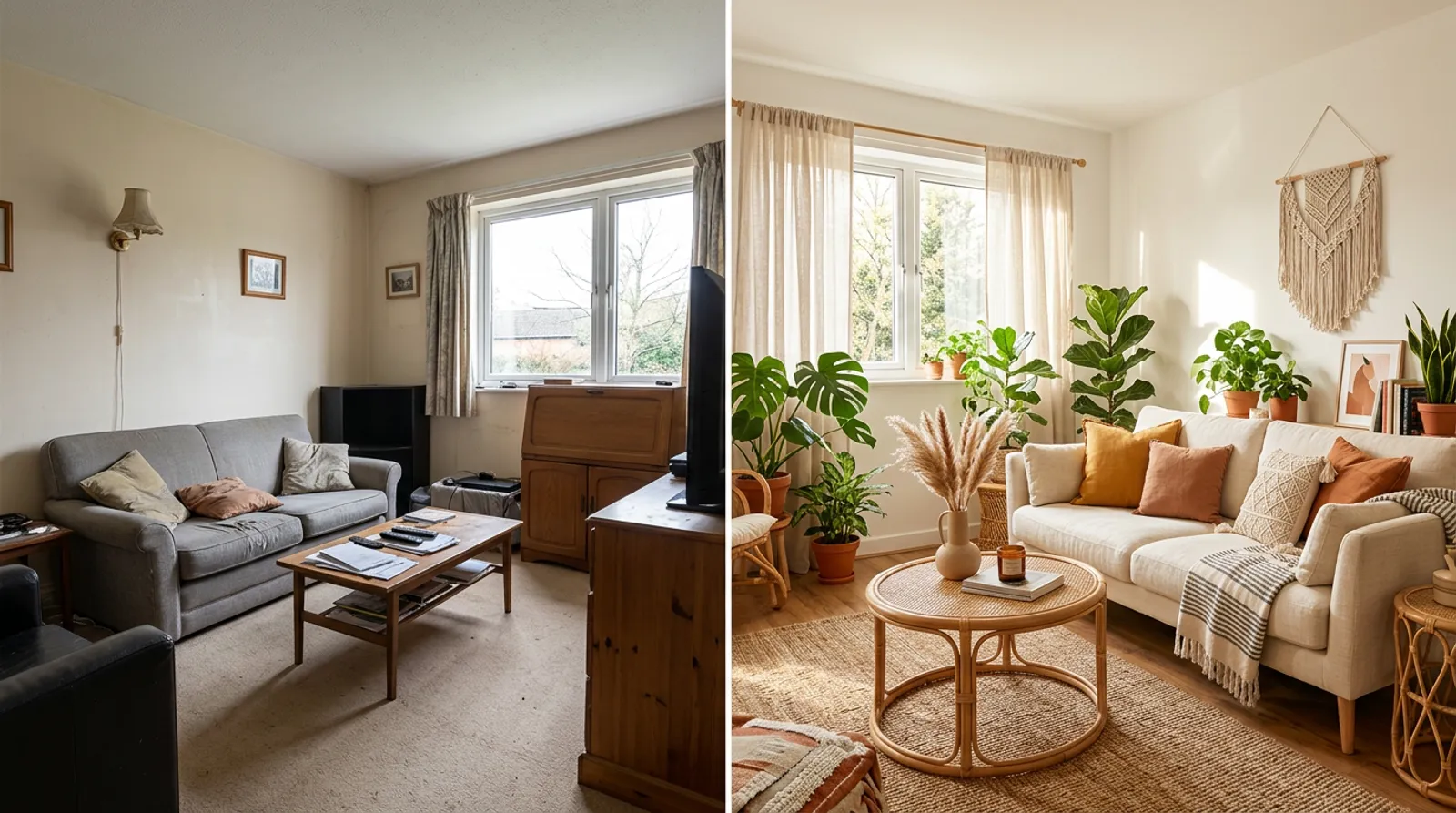 Design idea: a living room restyled in bohemian style
The word bohemian goes back to the 19th century. In Paris, the term bohémiens described artists, writers and musicians who lived on the margins, rejecting bourgeois comfort for creative freedom. Their Montmartre studios, crowded with fabrics, paintings and travel souvenirs, laid the first visual ground for the style.
Boho has lived several revivals since: the 1970s hippie movement and its woven rugs, macramé and cascading plants, then the contemporary comeback of the 2010s carried by design blogs and a renewed love of natural materials.
Three principles still structure boho today:
- Freedom: no strict rules, no mandatory symmetry, no imposed palette.
- Controlled accumulation: you mix, you layer, but you stop short of chaos.
- Authenticity: pieces have a story, whether thrifted, inherited or brought back from a trip.
And this style, in your room?
18 free credits on signup. No credit card needed.
See this style in my roomBohemian color palette
A Bohemian decoration relies on an earthy, warm, saturated palette, the exact opposite of Scandinavian minimalism.
- Dominant colors: terracotta, ochre, sand, dusty pink.
- Accent touches: burgundy, sage green, mustard yellow, indigo blue.
- Wood: dark or weathered, often in a waxed finish, to anchor the warm palette.
Boho is not afraid of color, but it stays away from modern acidic shades. The point is natural pigments, the kind once obtained from earth, plants or oxides. A single living room can combine five or six colors as long as they share that earthy logic.
Materials and textures
Boho celebrates handmade, woven, braided, embroidered materials. This is a style where touch matters as much as sight.
- Macramé: hanging plant holders, curtains, headboards in hand-knotted cord.
- Rattan and bamboo: peacock chairs, pendant lamps, round mirrors, baskets.
- Ethnic textiles: kilims, Beni Ouarain Berber rugs, embroidered suzanis, ikats.
- Crumpled linen: curtains, sofa covers, tablecloths. Always with a lived-in finish, never ironed.
- Raw cotton: woven throws, pom-pom cushions, bed runners.
- Jute and sisal: natural rugs, storage baskets, dressed plant pots.
Surfaces are alive, textured, sometimes irregular. A visible weave, an exposed knot, a slightly undone fringe: all of this is part of the charm.
Characteristics of Bohemian layouts
Beyond materials, a Bohemian interior is recognizable through several distinctive layout choices.
Layered rugs
This is almost a signature: a large neutral jute rug on the floor, then a colorful kilim placed on top at an angle. Layering creates depth, breaks the flatness of the floor and lets you play with patterns without committing an entire surface.
Cushions, throws, textile accumulation
A boho sofa overflows with cushions. Five, seven, sometimes more, in different fabrics, patterns and sizes. Add one or two fringed woven throws, casually draped. Comfort is visual as much as tactile.
Plants everywhere
Greenery is central to boho: monstera, fiddle-leaf fig, pilea, trailing plants in macramé hangers, succulents on shelves, banana plant in a tall jute basket. A boho room without a plant feels incomplete.
Mixing eras and cultures
A hammered copper Moroccan coffee table, a 70s rattan chair, a thrifted limed-wood dresser, a contemporary abstract canvas: boho blends origins and eras. Coherence comes from the palette and the materials, not from uniformity of furniture.
7 concrete tips to nail a Bohemian decoration
- Start with a large natural rug (jute, sisal) as a base, then layer a kilim or a Berber rug on top to set the tone.
- Invest in one iconic rattan piece: a peacock chair, a globe pendant, an arched headboard. One alone is enough to define the room.
- Multiply plant sources: large floor specimens (monstera, fig), macramé hangers, small succulents on shelves.
- Pile on cushions on the sofa and the bed, in 3 or 4 different patterns that share a common palette (ochre, terracotta, burgundy, for instance).
- Thrift your main pieces. A flea market or a secondhand shop offers what industrial stores never will: real patina.
- Soften the lighting with low lamps, thin string lights, candles. Boho hates harsh ceiling lights.
- Frame the mix with the palette. You can blend everything as long as everything shares 4 or 5 colors at most. The palette is what keeps boho from drifting into a jumble.
Who is the Bohemian style ideal for?
Boho works particularly well for several profiles:
- Creative personalities: artists, freelancers, anyone who likes to watch their space evolve.
- Travelers: people who bring back a Moroccan rug, a Marrakech lamp or a Balinese hanging already have the raw material.
- Long-term renters: the style works without major renovation, just with textiles and objects.
- Families who love warmth: a boho interior forgives daily wear and ages beautifully.
If you love the warmth of boho but want more visual discipline, consider the Japandi style. If on the contrary you want even more color and pattern, the Oriental or Gypset styles can extend your exploration.
Common mistakes to avoid
- Accumulating without a palette: mixing five colors without logic turns boho into visual chaos. Stick to one chromatic family.
- Too much plastic and synthetic fiber: a shiny synthetic velvet sofa breaks the style instantly. Prefer linen, cotton, rattan.
- All new, all from the same store: boho lives on thrifting and mixing. Buying everything from one retailer produces a frozen look.
- Neglecting plants: without greenery, boho loses half of its soul.
- Rigid symmetry: two identical armchairs facing each other, a perfectly centered console. Boho breathes in slight asymmetry.
Try the Bohemian style on your room
Reading a guide is useful; seeing the result on your own room is better. With Shopia, you upload a photo of your living room, bedroom or kitchen and our tool delivers a Bohemian rendering in a few minutes. You can then compare before and after, fine-tune the furniture, and even find similar products online.
Frequently asked questions
How do I avoid making bohemian decor look kitsch?
Follow the rule of 3: maximum 3 different patterns per room, 3 main textures (rattan, linen, wool) and 3 dominant colors (terracotta, beige and sage green for example). The classic trap is piling up every travel souvenir at once. One strong centerpiece (large macramé wall hanging, Berber rug) beats ten small trinkets. Leave breathing room too: bohemian decor exhales, it isn't cluttered.
Which colors should I avoid in bohemian decor?
Avoid dominant black (too cold), clinical pure white (use off-white or ecru instead) and neon or loud colors. Candy pink and electric blue break the earthy spirit. Stick to a warm desert-inspired palette: terracotta, ochre, mustard, sage, rust, sand beige. A touch of matte black on a rattan pendant is fine for structure.
How much does a complete bohemian room cost?
Budget $600 to $2500 per room. Bohemian is one of the most accessible styles because it celebrates thrifting and handmade pieces. Key items: a large Berber or kilim rug ($250 to $700), a macramé wall hanging ($60 to $180), 2 or 3 rattan pendants (IKEA Sinnerlig at $70, or artisan pieces at $250) and washed linen cushions. Flea markets and estate sales are your best friends.
And this style, in your room?
18 free credits on signup. No credit card needed.
See this style in my roomRelated articles

What Is Provençal Style? Colors, Materials and Decor Tips
What Provençal style is and how to get it: lavender, ochre, wrought iron, terracotta floors and 7 tips to bring the South of France home.

Industrial Style: A Guide to the New York Loft Look
Everything about Industrial style: New York loft, black metal, exposed brick, reclaimed wood and 7 tips for a raw interior.