

Table of contents
Dining room decor: dinners done right
The dining room is one of the most social rooms in the home. It is where everyday meals are shared, where friends gather on Saturday nights, where conversations stretch around a well-chosen bottle. Often open onto the living room or the kitchen, it has become a true heart of the home and deserves real attention.
In this guide, we go through everything that matters when decorating a dining room: the choice of table, chairs, pendant, the styles that work, and 7 concrete tips to host with style. At the end, you will be able to test a new layout directly on a photo of your room with Shopia.
Why your dining room decoration matters
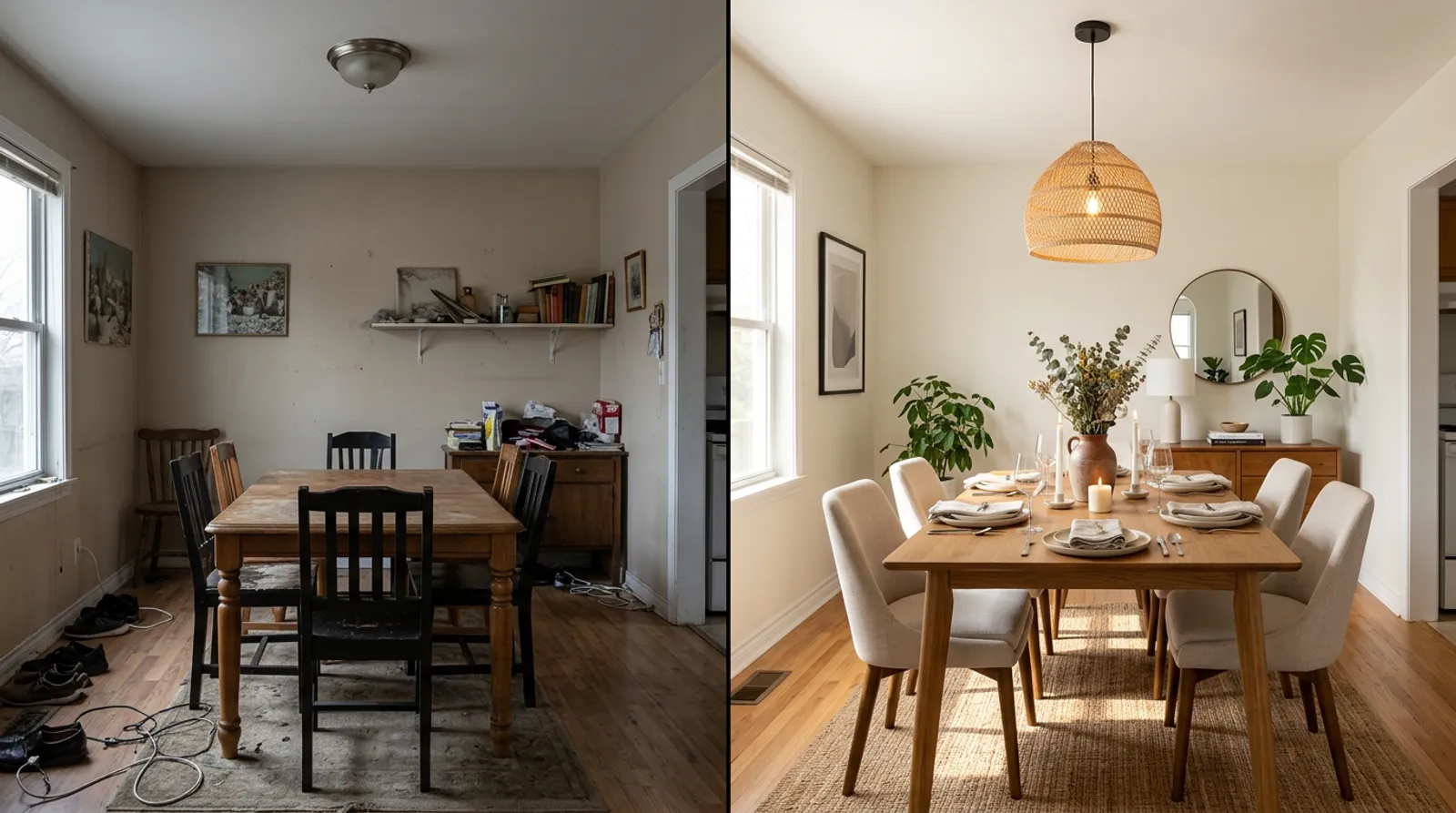 Design idea: a dining room redesigned
A dining room is not just a utility space. It is the room that structures hospitality in a home. Three reasons to invest as much care as in your living room.
- The social function: this is where memories form. Birthdays, family dinners, evenings with friends. The room's atmosphere directly shapes the quality of the moment.
- A central spot in the home: with open kitchens and decompartmentalized spaces, the dining room often becomes a thoroughfare between rooms. It is seen from several angles and cannot be neglected.
- Daily meal comfort: a wobbly chair or a badly placed pendant turns every dinner into a small ordeal. Ergonomics matter as much as in a home office.
Well designed, your dining room makes people want to linger after the meal. Poorly designed, it pushes everyone to rush dinner in front of the TV.
Common mistakes in a dining room
Before we talk styles and colors, here are the classic traps that weigh down a dining room.
- A table too large for the room: you cannot pull out the chairs without hitting the wall or the sideboard. Plan for at least 60 cm of free space around the table for movement and comfortable seating.
- A pendant too high or too low: too high, it loses its effect and no longer lights the table; too low, it blocks the view between guests facing each other. The ideal height is 70 to 80 cm above the tabletop.
- Mismatched chairs without logic: mixing three styles of chairs without a common thread (color, material, backrest height) looks like a chaotic flea market, not a successful mix.
- A rug too small: if the chairs come off the rug as soon as someone sits down, the effect breaks. The rug should extend at least 60 cm beyond the table.
- Lighting too white: a cold white LED pendant instantly kills the mood of a meal. Use warm bulbs (2700 K), ideally with a dimmer.
Spotting these mistakes at home is already half the work.
Styles that work best for a dining room
Not all styles fit a dining room equally well. Here are the five that work particularly well.
- The classic style brings timeless French elegance with a chandelier, a polished wood table and upholstered chairs.
- The contemporary style pairs a solid wood table with designer chairs, perfect for a clean yet warm effect.
- The Scandinavian style leans on a light oak table, wooden chairs and a geometric pendant for a bright meal.
- The bohemian style allows a vintage mix of thrifted chairs, a woven tablecloth and rattan pendants for a relaxed vibe.
- The industrial style offers a metal-and-wood table, Tolix-style chairs and a black metal pendant for assertive character.
The choice depends on the tone you want for your meals: refined, clean, warm, relaxed or bold.
Color palette and materials
A dining room benefits from balancing warmth and neutrality. Too much bright color saturates the senses during the meal; too much cold white kills the mood.
- Dominant colors: warm beige, off-white, soft gray, sage green. Bases that flatter food and tableware.
- Accent touches: a teal wall, a terracotta sideboard, burgundy chairs. One strong accent is enough.
- Materials: solid wood for the table (oak, walnut, mango), matte black metal or brushed brass for the pendant, natural textiles (linen, jute) for curtains or rug, artisan ceramics for the tableware.
Avoid ultra-glossy surfaces (lacquered glass, waxed plastic) that reflect the pendant light and tire the eyes during meals.
Lighting: the rule of 3 sources
Dining room lighting plays out first and foremost on the pendant above the table. But you need at least two other sources to dress the room.
- The central pendant: the centerpiece, 70-80 cm above the tabletop. Choose a wide shade or several aligned smaller pendants if the table is rectangular. Warm 2700 K bulb is a must.
- Ambient lighting: a wall sconce, a corner floor lamp, or indirect lighting on the sideboard. The room must not fall into darkness around the table.
- Accent lighting: candles on the table, a soft string light on a shelf, a small spotlight on a painting. This is what turns a dinner into a moment.
Ideal: a dimmer on the pendant to switch from a family dinner (stronger light) to a candlelit one (dim light) without changing the bulb.
Essential furniture
Five pieces structure a functional dining room.
- The table: proportional to the room, plan 60 cm per guest minimum. Solid wood for longevity, round for small rooms (better flow), rectangular for large gatherings.
- The chairs: seat at 45 cm from the floor, backrest at least 40 cm tall, stable structure. If you mix several models, keep a common thread (wood tone, backrest height).
- The sideboard or buffet: essential for storing serving dishes, tablecloth and cutlery. Prefer a low model that does not overwhelm the room.
- The pendant: the visual centerpiece. Minimum 50 cm diameter for a 4-6 seat table, more for larger tables.
- The rug under the table: it defines the dining zone and adds warmth. Plan at least 60 cm of overhang around the table so chairs stay on the rug when pulled out.
A bench on one side of the table is an excellent option: a space-saver, a warmer feel, and the ability to squeeze in one more guest when plans change.
7 concrete tips to nail your dining room
- Measure before you buy: your table must leave at least 60 cm of free space around it. Lay the dimensions on the floor with masking tape before ordering.
- Hang the pendant 70-80 cm above the top: that is the sweet spot, neither too high to light properly nor too low to block the view between guests.
- Pick a rug that overhangs: at least 60 cm around the table. Chairs pulled out must stay on the rug.
- Add a dimmer: it turns the same room into a lunchtime canteen and an evening romantic table without changing the bulb.
- Mix chairs with a common thread: if you mismatch, keep the same wood tone, the same backrest height, or the same family of materials.
- Add a bench on one side: a space-saver, a more convivial vibe, and one more guest when plans change.
- Style the table even on ordinary days: a linen runner, a candle, a small bouquet. Three objects turn dinner into an occasion.
Try your dining room on Shopia
Reading a guide is one thing; seeing the result on your own room is another. With Shopia, you upload a photo of your dining room, you pick a style and a budget, and our tool delivers a rendering in a few minutes. You can then compare before and after, fine-tune the furniture and find similar products online to take action.
Frequently asked questions
Round or rectangular dining table: which shape works best?
A round table (44 to 52 inches across for 4 to 6 people) makes conversations easy, removes head-of-table seats, and fits small or square rooms better. A rectangular table (72 to 88 inches) seats more guests (6 to 10), anchors a long room, and makes it easier to place serving dishes down the middle. Rule of thumb: under 130 square feet with family meals, go round. Over 160 square feet with bigger gatherings, go rectangular.
How high should a pendant hang above a dining table?
Aim for 28 to 32 inches between the table top and the bottom of the pendant. It lights the faces without blocking the view across the table. For rectangular tables over 70 inches, use two or three smaller pendants in a row rather than a single oversized one. Pick a 2700K to 3000K bulb, dimmable if possible, so you can shift from weeknight dinners to long evenings with guests without swapping fixtures.
Bench or chairs around the dining table: which to choose?
A bench on one side (usually against a wall) saves about 30 percent of the footprint, squeezes in an extra kid when needed, and gives a bistro or Scandinavian feel. Downsides: less comfortable for long meals and awkward to get out of from the far end. Chairs (you can mix up to 8 styles if the table is plain) offer better comfort and full flexibility. A bench on one side plus chairs on the other is often the right compromise for families.
Related articles

Living room ideas: design a warm, welcoming space
Everything about living room decoration: palette, furniture, lighting, styles that work and 7 tips for a warm, inviting space.

Kitchen decor: functional and beautiful
Everything about kitchen decoration: palette, countertop, lighting, styles that work and 7 tips for a well-designed kitchen.

Classic style: timeless French elegance
Everything about Classic French style: moldings, parquet, patinated furniture and 7 tips for timeless Haussmann elegance.