

Table of contents
Entryway ideas: welcoming and functional
The entryway is the first room you see when coming home, and the first your guests discover. It is a transition between outside and inside, an in-between space that deserves as much attention as a living room. Yet it is often the most neglected room in the home: an overloaded coat rack, scattered shoes, a cold ceiling light, and the sense of welcome vanishes within seconds.
In this guide, we dive into everything you need to know to nail your entryway: the essential pieces, common mistakes, styles that work, the color palette, the lighting and 7 concrete tips to turn this passage into a true calling card. At the end, you will be able to test the rendering directly on a photo of your own entryway with Shopia.
Why you should care about your entryway
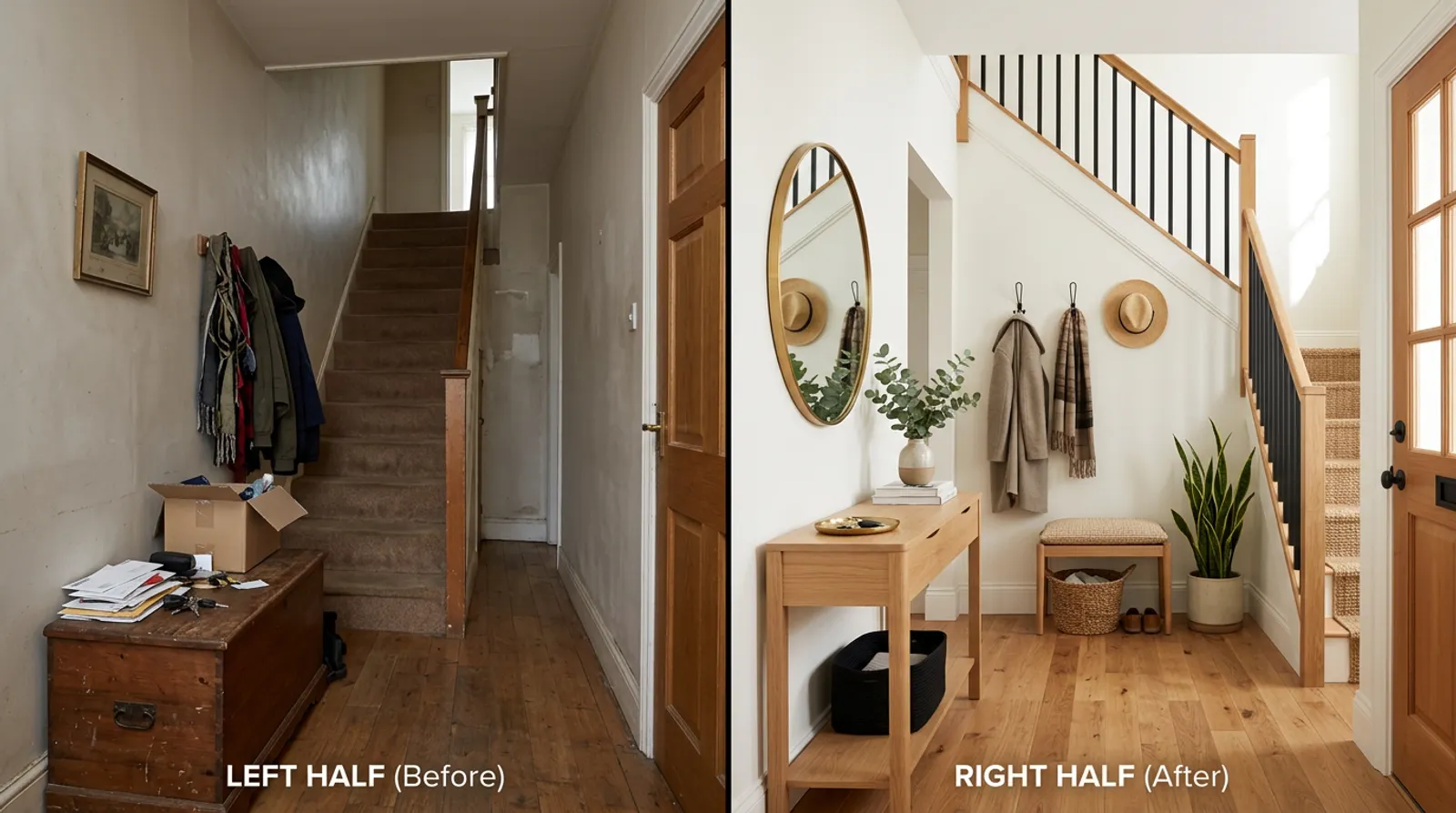 Design idea: an entryway redesigned
A well-designed entryway has three precise functions. First, it welcomes: it sets the tone of your home the moment you cross the threshold. Second, it organizes: this is where you drop your keys, mail, bags and coats. Third, it protects the rest of the home by absorbing dirt, moisture and the noise of the door.
Caring for this space, however small, changes your daily routine. You save time in the morning because everything has a place. You stop looking for your keys. You arrive home and drop your things on a console rather than throwing them on the sofa. And visually, you turn a bottleneck into a real room.
Common mistakes in an entryway
Many failed entryways fall into the same traps:
- Overloaded coat rack visible at first glance: 8 coats, 3 scarves, 2 bags and a bike helmet hanging in a heap. Visually, it is instant chaos.
- No "empty your pockets" zone: without a catch-all tray, keys, mail and coins end up everywhere (coffee table, kitchen counter, windowsill).
- Mirror too small or missing: without a mirror, the entryway feels narrower and darker. A 30x40 cm mirror hung high is not enough.
- A single ceiling light: one overhead fixture creates harsh shadows on faces and gives a hospital-corridor vibe.
- A rug too large that blocks the door: the classic. You pick a nice rug, install it, and realize you have to push it every time you come in.
- Too many frames or decorative objects: an entryway is not a gallery. The more elements, the more your eye feels trapped in an already small space.
Styles that work best for an entryway
The right style depends on the size of your entryway, the natural light and the mood of the rest of your home. Here are the looks that work best:
- The Scandinavian style is unbeatable for dark entryways. Its light palette and blond wood compensate for the dim feel typical of this often window-less space.
- The Japandi style bets on a low console, a light wood bench and very few objects. Ideal if you want a zen entryway that soothes the moment you walk in.
- The industrial style brings instant character with black metal hooks, a steel-framed mirror and a raw wood console. Perfect for modern entryways or lofts.
- The classic style elevates Haussmann-era entryways with a marble console, a gilded trumeau mirror and a crystal chandelier. Very effective in old buildings.
- The bohemian style warms up colder entryways with a rattan basket, a macrame wall hanging and a Berber rug. The warmest option of all.
Color palette and materials
For an entryway, favor a palette that expands and brightens:
- Dominant colors: off-white, sand beige, very light gray. Dark walls deepen the shadow in a space often deprived of natural light.
- Accent touches: sage green on an interior door, deep blue on the back wall if the entryway is well lit, brushed brass for hooks and handles.
- Materials: light wood (oak, ash) for the console and bench, rattan or wicker for storage baskets, matte ceramic for the catch-all tray, matte black metal for hooks and the mirror frame.
Avoid glossy varnished floors that show every wet footprint. Prefer matte tiles, oiled parquet or stone-look vinyl. The entry rug must be durable: this is the most trafficked zone in the home.
Lighting: the 3-source rule
Like any room, an entryway deserves several light sources to avoid the "hospital corridor" effect:
- Main source: a ceiling fixture with diffused light, ideally with a fabric or rattan shade to soften the direct beam.
- Welcome source: a wall sconce near the mirror or a small lamp on the console. This warm light (2700 K) lights the face and makes you want to come home.
- Accent source: a spotlight aimed at a frame, a plant or a decorative object to structure the room and create depth.
All bulbs should be warm (2700 K to 3000 K), never icy white. A motion sensor on the welcome lamp is a real bonus at night.
Essential furniture
A functional entryway relies on 4 to 5 pieces, no more:
- A console or a bench: a console lets you drop a bag, a bench lets you sit to put on shoes. Choose based on your dominant use.
- A mirror: large, placed opposite the front door to amplify space and check your outfit before leaving.
- Hooks or a coat rack: 5 visible hooks maximum. Beyond that, it always overflows. The rest goes in a closet.
- A rug: large enough to cover the traffic zone, but allowing the door to open freely.
- A catch-all tray: a small bowl, a tray, a basket on the console. It is the detail that changes everything daily.
7 concrete tips to nail your entryway
- Apply the "one of each" rule: 1 console, 1 mirror, 1 rug, 1 hook bar, 1 lamp. Not two of each, not three, just one. It is enough.
- Place the mirror opposite the front door: it doubles the space visually and reflects the natural light coming in when you open the door.
- Pick a console with low storage: a drawer or a discreet shelf hides the catch-all, phone chargers and spare keys.
- Limit visible hooks to 5: beyond that, you saturate instantly. The rest of the coats go in a closed closet or in the bedroom.
- Lay a durable rug: shoe traffic zone, so short fibers (jute, sisal, polypropylene). No long-pile rugs that trap dirt.
- Add a plant: pothos, monstera, ZZ plant. It softens the hard angle of a console and brings life into an often cold space.
- Care about lighting: at least 2 light sources, all warm. A lamp to turn on when you come home radically changes the arrival experience.
The right measurements: heights and proportions
A successful entryway often comes down to a few well-chosen centimeters. Here are the benchmarks that make the difference.
For the console, aim for a width equal to two thirds of the wall: a 32-inch (80 cm) console on a 47-inch wall is perfectly balanced, neither lost nor overwhelming. The ideal height sits between 30 and 33 inches (75 to 85 cm), the level where you naturally drop your things without bending down. As for depth, 10 to 14 inches (25 to 35 cm) maximum: beyond that, the console blocks the path in a narrow hallway.
The mirror should be at least as wide as the console, never smaller, or it looks lost above it. Center it 61 to 63 inches (155 to 160 cm) from the floor, which is eye level for most adults.
For hooks and pegs, mount them at 59 to 63 inches (150 to 160 cm) from the floor, at hand height, not at the 71 inches (180 cm) people often default to. If hanging a coat means reaching up, the gesture is not automatic and the coat ends up on a chair.
To store shoes without cluttering the floor, a slim cabinet 11 inches (28 cm) deep fits almost any hallway. And when floor space is tight, use the height: a shelf above eye level holds seasonal items (hats, gloves) and frees the lower surfaces for daily use.
Try your entryway on Shopia
Reading a guide is one thing; seeing the result on your own entryway is another. With Shopia, you upload a photo of your entryway or hallway and our tool delivers a decorated rendering in a few minutes. You can test several styles (Scandinavian, Japandi, industrial), compare before and after, fine-tune the furniture and find similar products online to order.
Frequently asked questions
How do you create an entryway when the apartment has no proper foyer?
Visually mark off the first 6 feet behind the front door. Three things work well: a rug (at least 2 x 3 feet, washable) to anchor the zone, a slim low piece (storage bench, 10-inch-deep console) pushed against the wall, and a visual shift on the floor or wall (a different floor plank, a 3-foot-high paint band, an accent wallpaper panel). Wall hooks (5 pegs) replace a bulky coat rack. Total budget: $180 to $500 to turn a hallway corner into a real entryway.
Do you actually need a piece of entryway furniture?
Not strictly, but you need three functions covered: somewhere to drop keys and mail, somewhere to hang coats and bags, somewhere to store shoes. A narrow console with a key dish and hooks above it does the job in 80 percent of cases. If there is room, a 32 to 40 inch bench with a built-in storage compartment adds the comfort of sitting down to put shoes on and tucks everything away at once. Avoid bulky solid wood pieces that crush a small entry under 45 square feet.
Is a mirror in the entryway really essential?
Strongly recommended for three reasons: it visually enlarges the space (about 30 percent perceived gain), it bounces natural light deeper into the home, and it lets you check yourself before leaving (hair, collar, scarf). Best format: tall vertical mirror (at least 20 x 55 inches) hung at face level. Skip a mirror placed directly facing the front door if you follow feng shui principles, which advise against it.
Related articles

Living room ideas: design a warm, welcoming space
Everything about living room decoration: palette, furniture, lighting, styles that work and 7 tips for a warm, inviting space.

Bedroom ideas: design a restful, restorative space
Everything about bedroom decoration: palette, furniture, lighting, styles that work and 7 tips to create a sleep sanctuary.

Scandinavian style: decorating like the Nordics
Everything about Scandinavian style: hygge, light wood, clean palette and 7 tips to nail a bright, warm Nordic interior.