

Table of contents
Bedroom ideas: design a restful, restorative space
The bedroom is the most intimate room of the home. No one but you (and your partner) really steps inside. And yet, it is also the most neglected when it comes to decoration: we imagine it "secondary" because it is invisible to guests. Mistake. The bedroom is where you sleep 7 to 9 hours a night, a third of your life. Its atmosphere directly affects your sleep, your recovery, your mood in the morning.
In this guide, we cover everything that turns a dull bedroom into a cocoon: why this room truly deserves attention, the mistakes that quietly ruin sleep, the styles that soothe the most, the ideal color palette, soft lighting, essential furniture, and 7 concrete tips. At the end, you can test these ideas on a photo of your own bedroom with Shopia.
Why your bedroom deserves great design
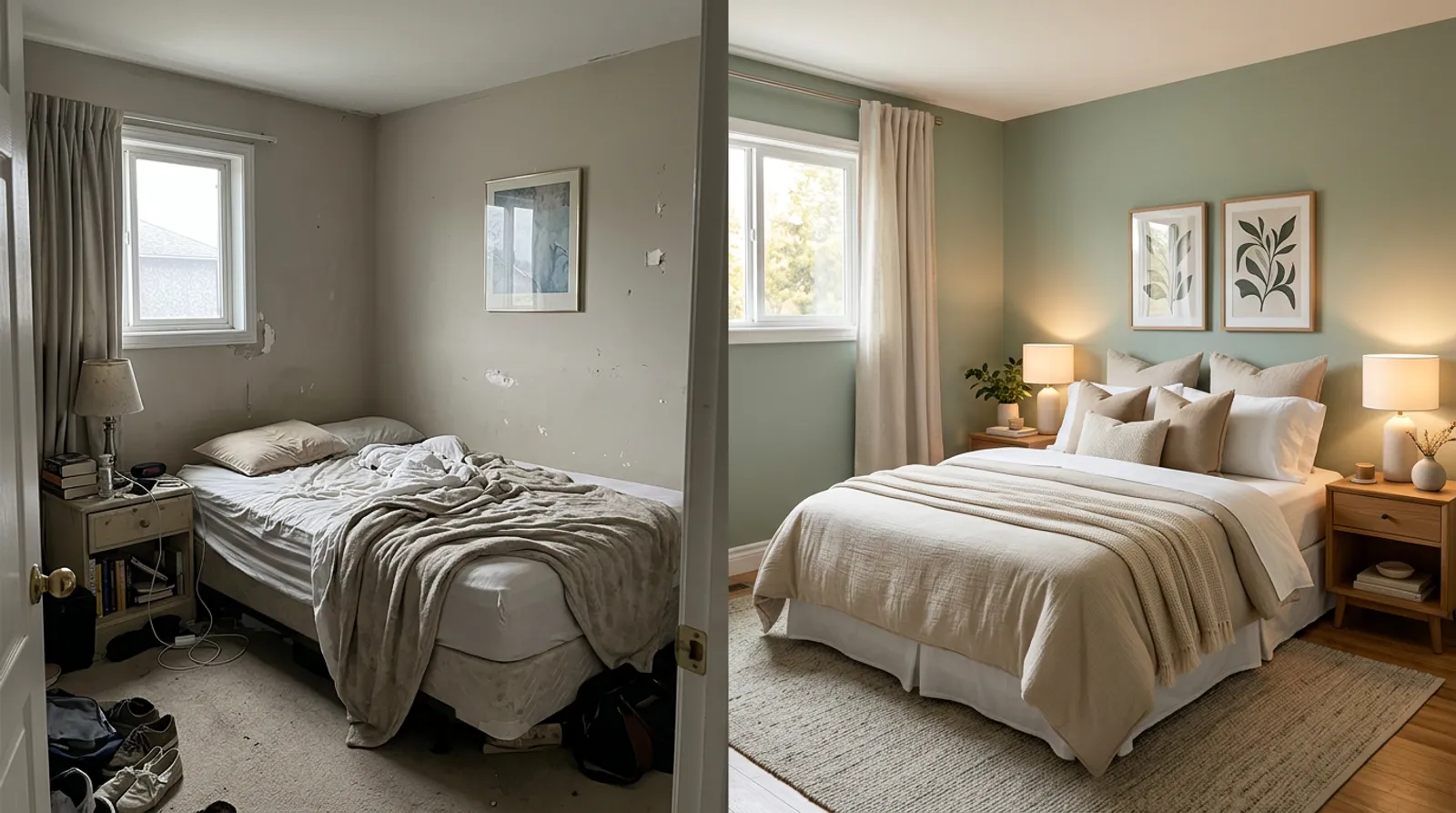 Design idea: a bedroom redesigned
The bedroom is a sleep sanctuary. Its primary role is not to impress, it is to put you to sleep fast and keep you asleep long. The human brain is extremely sensitive to visual and sensory cues just before bedtime: light that is too bright, a color too stimulating, visual clutter, all of these can push back sleep onset by 30 to 60 minutes.
Beyond sleep, it is also an intimate space. Evening reading, hushed conversations, simply getting dressed in the morning: the bedroom concentrates moments protected from the rest of the house. A bedroom you love means a calmer couple and a day that starts better.
Finally, it is the room where decorating investment has the biggest sensory impact for the least money. Quality bed linen, two well-chosen bedside lamps, blackout curtains: three modest purchases that change your night. Nothing close to the price of a kitchen or bathroom renovation.
Common bedroom mistakes to avoid
Here are the traps you will find almost everywhere, often unconsciously.
- A bed pushed against the wall without a headboard. Visually weak, acoustically poor (you hear everything through the wall), thermally cold. A headboard (upholstered, wooden, or simply a tall painted panel) radically changes the room.
- Lighting that is too bright or too cold. A 4000 K white ceiling fixture left on until lights-out: your melatonin does not fire, you take 30 extra minutes to fall asleep. Use 2700 K maximum, ideally dimmable.
- Too many visible screens. TV facing the bed, laptop on the desk in the corner, phone charging on the nightstand. The brain ties the bedroom to work and stimulation. Banish, or hide.
- Colors that are too saturated. Bright red, vivid orange, lemon yellow on the walls: these colors are stimulating, the opposite of what we want. Reserve them for a single accent (cushion, framed artwork).
- Open storage that overflows. A shelf piled with messily folded clothes creates permanent visual noise. Prefer closed storage or baskets that structure the look.
- No blackout curtains. A bedroom crossed by car headlights or early morning light wastes the first and last minutes of sleep. Blackout curtains or a blackout lining are non-negotiable.
Styles that work best for a bedroom
Every style works in a bedroom, but some amplify the cocoon feel and the sense of calm.
The Japandi style is probably the best choice for a bedroom. Its earthy palette, low lines and natural materials (linen, light wood, paper) create instant serenity, ideal for sleep.
The Scandinavian style works particularly well in dim bedrooms. Its light palette and blond wood bring softness without overloading the space.
The Bohemian style builds ultra-warm cocoon bedrooms: macrame bed canopy, Berber rug, rattan pendant, plants. Perfect if you love wrapping yourself in a textured world.
The Minimalist style is unbeatable for small bedrooms or anxious sleepers: the fewer objects you see, the less the brain races at bedtime.
The Provencal style brings a calming southern charm: washed linen, fresh-butter tones, lavender, old wood. A bedroom that feels like vacation all year.
If you are looking for a discreet, polished compromise, the Contemporary style remains a solid option that ages well.
Color palette and materials
For a restful bedroom, the rule is simple: cool or neutral palette, never bright and warm.
- Dominant color: off-white, pale beige, pearl gray, soft taupe, sage green, powder blue. All these tones lower the visual temperature and ease sleep onset.
- Secondary color: a slightly stronger tone for the headboard or one wall (seafoam, midnight blue, deeply desaturated terracotta, gray-brown).
- Accent touches: cushions, throw, lampshade. This is where you can afford a pattern or a stronger tone, in moderation.
Avoid: scarlet red, vivid orange, lemon yellow, fuchsia. These colors have their place elsewhere, not in the bedroom.
For materials, favor the soft and absorbing: washed linen for bedding, corduroy or bouclé velvet for the headboard, wool for a rug at the foot of the bed, matte wood (not glossy varnish), paper or rattan for lampshades. Avoid cold metal, glossy glass, lacquered leather, which harden the atmosphere.
Lighting: the rule of 3 sources
The bedroom follows the same rule as the living room: at least 3 light sources, all in warm light (2700 K maximum).
- General light: ceiling fixture or pendant. Ideally on a dimmer. For moments when you need clear visibility (tidying, picking an outfit, cleaning).
- Bedside lamps: one on each side of the bed. Lampshade height at 50 to 60 cm above the mattress. This is the reading light, but also the final signal before falling asleep. 2700 K maximum, ideally 2200 K (amber).
- Ambient light: a swing-arm wall sconce above the headboard, discreet string lights, or a low lamp on a dresser. This is the ritual: cut the ceiling fixture, keep only this gentle source, the brain understands you are entering sleep mode.
No cold white bulb in the bedroom. Ever. That is the room's non-negotiable rule.
Essential furniture
A bedroom works with a small core of pieces, carefully chosen.
- The bed with headboard: indispensable. The headboard is not a luxury, it is a functional element (acoustic, thermal) and a visual one (focal point of the room). Fabric upholstered, wood, cane, or simply a tall panel painted in a different color.
- Two nightstands: even asymmetrical, two nightstands visually balance the room. Ideal height: 5 cm below the mattress. With at least one drawer to hide cables and clutter.
- A dresser or a wardrobe: for folded clothes. Prefer closed storage to open shelving.
- An armchair or a bench at the foot of the bed: if the room is large enough. Useful to drop clothes on, pleasant visually.
- A rug: at the foot of the bed or on both sides. Warms your feet in the morning, absorbs sound, anchors the bed visually.
- Blackout curtains: blackout lining or thick lined linen curtains. Non-negotiable.
7 concrete tips for your bedroom
- Install a headboard. It is the best decorating investment of the room, ahead of everything else.
- Banish any bulb above 2700 K. Check each bulb before you buy.
- Use two symmetrical bedside lamps. The brain loves symmetry around the bed, it feels reassuring.
- Hang blackout curtains, or add a blackout lining to your current ones. Your sleep will change.
- Choose a cool or neutral palette. Bright red and orange, never. Seafoam, powder blue, beige, taupe: the safe bets.
- Hide screens and cables. Tablet in a drawer, phone charging in the next room if possible, TV behind a panel or out of the bedroom entirely.
- One plant, not a jungle. The bedroom is not a living room. A pothos, a sansevieria, that is enough. Too much greenery overstimulates visually and raises humidity.
Where to place the bed: placement rules and clearances
Style matters, but bed placement decides your sleep before any decoration does. A few concrete rules, with measurements.
- The command position: place the bed diagonally from the door, as far from it as possible. You should see the entrance from the pillow without sitting in its direct line. The brain relaxes when it controls who comes in. This is rule number one, everything else follows from it.
- Keep the foot of the bed out of the door axis: never line the bed up directly with the door. Slightly offset or perpendicular, never aligned.
- Headboard against a solid wall, never floating or mid-room. A solid wall behind the head creates a sense of security. If you must place it near a window, keep at least 15 to 20 cm of gap (drafts, noise, light).
- At least 60 cm of clearance on each side of the bed. Below that you can no longer make the bed properly and it frustrates you every morning. A full bed needs a 2.60 m wide room (bed + 2 x 60 cm); a queen needs 2.80 m.
- Narrow room: a single wide 80 cm passage beats two 40 cm ones. In that case push the bed against one wall.
- 90 cm in front of a wardrobe so the doors can open (or switch to sliding doors).
Avoid: a bed wedged into a corner (impossible to make), a bed under the window, and a bed not centered on its wall (an imbalance the brain detects even without naming it).
Test your bedroom on Shopia
Reading a guide is one thing; seeing the result on your own room is another. With Shopia, you upload a photo of your bedroom, choose a style (Japandi, Scandinavian, Bohemian, Minimalist, Provencal), and our tool delivers a restful rendering in a few minutes. You can then compare before and after, test several palettes, and visualize a headboard or a furniture change before any purchase.
Frequently asked questions
Which paint color makes a bedroom restful?
Cool, desaturated tones support easier sleep: deep navy, sage green, warm gray, off-white. Avoid bright reds, oranges and yellows that stimulate the nervous system. You can paint all four walls in the same soft tone, or create an accent wall behind the headboard in a deeper shade (forest green, muted terracotta, teal). Keep the ceiling white to avoid making the room feel smaller.
What bed size fits a 130 sq ft bedroom?
A full bed (54x75 inches) fits comfortably in a 130 sq ft bedroom and still leaves space for a dresser and small desk. A queen (60x80 inches) needs at least 140 to 150 sq ft to breathe. A king (76x80 inches) requires 160 sq ft minimum. Practical rule: leave 24 inches of clearance on each side of the bed to walk past, and 28 inches at the foot if you place a dresser facing the bed.
Built-in closet or freestanding wardrobe: which is better?
A built-in closet uses corners and ceiling height more efficiently, ideal if you have a 13 ft linear wall or an alcove. Budget: $1,000 to $3,000 per linear foot installed. A freestanding wardrobe ($400 to $1,500) stays simpler if the room has straight walls with no nooks. Pro tip: replace hinged doors with sliding doors to gain 24 inches of walking space in front of the storage.
Related articles

Kids room ideas: playful and built to evolve
Everything about kids room decoration: bed, toy storage, play area, styles that work and 7 tips for an evolving bedroom.

Living room ideas: design a warm, welcoming space
Everything about living room decoration: palette, furniture, lighting, styles that work and 7 tips for a warm, inviting space.

Japandi Style: A Guide to Scandinavian-Japanese Serenity
Everything about Japandi style: Japanese × Scandinavian fusion, beige and grey palette, light wood, serenity and craft.

Bathroom ideas: the complete guide to a spa-like bathroom
Everything about bathroom decoration: palette, vanity, shower, lighting, styles that work and 7 tips for a spa-like feel.