

Table of contents
- Why your bathroom deserves great design
- Common bathroom mistakes to avoid
- Styles that work best for a bathroom
- Color palette and materials
- Lighting: the rule of 3 sources
- Essential furniture: vanity, shower and storage
- 7 concrete tips for your bathroom
- Dimensions and clearances: the bathroom down to the centimeter
- Test your bathroom on Shopia
Bathroom ideas: the complete guide to a spa-like bathroom
The bathroom is the most intimate room of the house and the one that frames your mornings and evenings. It must be efficient, hygienic, pleasant to use when you are rushed, and soothing when you finally take your time. Successful bathroom design means finding the balance between functional and spa-like cocoon.
In this guide you will discover how to put together a bathroom that lasts: a palette that does not date, the right choice of vanity and shower, essential lighting, styles that suit this humid room, and seven concrete tips to reach a spa feel without spending a fortune. At the end, you will be able to test a new look on a photo of your own bathroom with Shopia.
Why your bathroom deserves great design
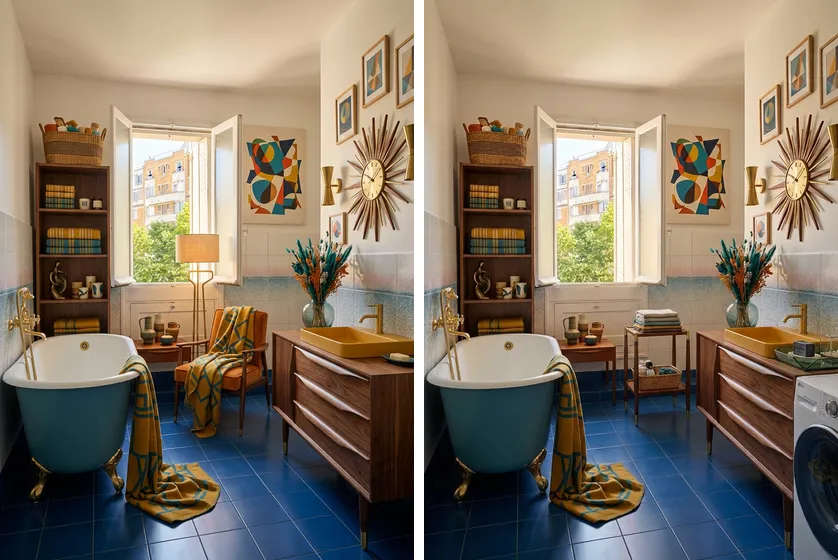 Design idea: a room transformed
The bathroom carries constraints that are invisible from the living room: permanent humidity, water splashes, limescale, slippery floors, ventilation. A poorly designed bathroom quickly becomes uncomfortable, even unhealthy. By contrast, a well-decorated bathroom turns into a daily decompression chamber, and it is the number one argument for a buyer when you sell your home.
It is also the first and last room you see every day. Spending a few hours thinking it through upfront radically changes your comfort over ten or fifteen years. A wider vanity, better lighting, closed storage can save you five minutes every morning.
Common bathroom mistakes to avoid
Before we move to good ideas, here are the pitfalls that come back in almost every bathroom that needs redoing.
- Single ceiling light: it casts shadows on your face at the mirror, making it impossible to shave or apply makeup properly.
- Mirror too small: a cramped mirror above a wide vanity unbalances the room and shrinks it visually.
- Walk-in shower with poor slope: without enough slope toward the drain, water pools and eventually spills onto the floor. Hello puddles.
- Products visible everywhere: bottles, brushes, piled towels. The room feels permanently messy even when clean.
- Glossy white floor: it looks gorgeous in showrooms and is unbearable in real life. Every water drop and footprint shows up instantly.
Styles that work best for a bathroom
The bathroom calls for clean, luminous styles. Here are the ones that work particularly well in this humid and often small space.
- The minimalist style rules here: no handles, vanity-top basin, walk-in shower, closed storage. The spa effect is instant.
- The Japandi style brings softness and light wood, a teak bench, pebbles, a green plant. Zen, calm, contemporary.
- The Scandinavian style plays with natural light and light wood on the vanity unit. Ideal for a small bathroom that needs to feel bigger.
- The contemporary style relies on pure lines, black or chrome fittings and large-format tiles. Architectural and crisp.
- The classic style remains seductive with its pedestal basin, ornate mirrors, moldings and subway tiles. Parisian charm in 5 sq m.
Color palette and materials
In a bathroom, the palette must expand the space and resist humidity. Light tones generally pay off more than dark ones, unless the room is large and well lit by daylight.
- Dominant colors: off-white, sandy beige, pearl gray, soft water green, gentle lagoon blue. Muted hues age better than saturated ones.
- Wall covering: artisan zellige, large-format porcelain, tadelakt, specialist wet-room paint. Avoid wallpaper outside dry zones.
- Floor covering: large-format non-slip tile, terrazzo, exotic wood (teak, ipe) only in areas protected from direct splashes.
- Vanity top: marble, engineered stone, oiled oak, ceramic. Favor matte finishes that mark less.
Limit yourself to two strong materials maximum: one floor covering, one wall covering, the rest in white or neutral. This is what produces that sought-after "magazine bathroom" effect.
Lighting: the rule of 3 sources
A successful bathroom requires three light sources, each with a precise role. This is probably the line item you cannot afford to skimp on.
- Ambient lighting: a diffuse ceiling fixture or evenly spaced recessed spots. Warm light (2700 K to 3000 K), never icy white that drains color from your skin.
- Mirror lighting: two vertical sconces on either side of the mirror, or an LED frame around it. Never a single source above, which hollows the eyes and accentuates dark circles.
- Accent lighting: an LED strip under the vanity or behind the mirror, left on as a night light. Spa atmosphere guaranteed and safety for children.
All your fixtures must be certified for damp rooms (IP44 minimum near the shower, IP65 in direct splash zones). Also plan a dimmer on the ambient lighting.
Essential furniture: vanity, shower and storage
In a bathroom, three elements structure everything: the vanity, the shower or bathtub, and the storage. Here are the tradeoffs.
- Vanity: prefer a wide single basin (60 to 80 cm) over two small ones. A basin that is too small splashes constantly. Deep vanity top (40 cm minimum) so you do not bump your knees.
- Walk-in shower: 1.5 to 2 cm slope per meter toward the drain, clear glass screen (not frosted, which stains), non-slip floor. Depth of 90 cm minimum to move comfortably.
- Bath or shower: if the room is under 5 sq m, choose a wide walk-in shower over a cramped bathtub. Above 6 sq m, a freestanding tub becomes possible.
- Closed storage: vanity unit with drawers, tall closed cabinet, niche inside the shower. Anything open collects dust and looks untidy.
- Mirror: at least as wide as the basin or vanity top. A too-small mirror instantly breaks the perception of the room.
7 concrete tips for your bathroom
- Double up the lighting: one ambient ceiling source and two sconces on either side of the mirror. This is non-negotiable for daily comfort.
- Choose a wide walk-in shower over a bathtub if you are short on space. 90 cm depth minimum, non-slip floor.
- Opt for fully closed storage: drawers, cabinets, niches. Hide products, only display two or three chosen objects.
- Lay a non-slip floor covering: textured tile or brushed stone. Safety beats glossy aesthetics.
- Install proper ventilation: a correctly sized mechanical extract fan. Without it, mold and limescale within months.
- Add warmth: a teak bench, a humidity-tolerant houseplant (pothos, fern), a thick towel. It breaks the coldness of tile.
- Invest in the mirror: wide, framed or not, sometimes backlit. It is the most looked-at decorative element in the room.
Dimensions and clearances: the bathroom down to the centimeter
An elegant bathroom comes down first to precise dimensions. Before aesthetics, circulation is what decides whether the room is pleasant or frustrating day to day.
- Vanity height: 85 cm as the ergonomic standard, 90 cm if you are tall. Lower forces you to stoop, higher gets uncomfortable when washing your hands.
- Basin width: 60 to 80 cm for a single basin, 120 to 140 cm for a double vanity. Below 120 cm, two people cannot stand side by side.
- Shower dimensions: 80x80 cm is the strict minimum (airplane-cabin feel below that), 90x90 cm or 80x120 cm to move your elbows comfortably.
- Clearance in front of the toilet: 60 cm clear in front of the bowl to sit down and get up without gymnastics, plus 20 cm on each side of the bowl.
- Minimum passage between two elements: 60 cm. That is the circulation width that keeps you from bumping into things as you move.
One last detail that changes everything in small rooms: a wall-hung vanity leaves the floor visible underneath, which visually enlarges the space. By contrast, a floor-standing unit in under 5 sq m weighs the whole room down.
Test your bathroom on Shopia
Reading a guide gives you direction, but seeing the result on your own bathroom is incomparable. With Shopia, you upload a photo of your current bathroom, pick a style and our tool delivers a rendering in a few minutes. You can compare before and after, fine-tune the elements, test multiple moods, and even find similar products online.
Frequently asked questions
Walk-in shower or prefab shower stall: which is better?
A walk-in shower (curbless or with a linear drain) creates a spa feel, visually expands the room and is easier to clean: the premium choice for any remodel. Budget: $2,000 to $5,500 installed. A prefab shower stall ($400 to $1,500) still makes sense for a quick replacement or a rental unit. If you go walk-in, plan a 1 to 2% slope toward the drain and a non-slip floor rated COF 0.42 or higher (ANSI A137.1).
What flooring should I pick for a bathroom?
Porcelain tile with a non-slip finish (DCOF 0.42+) is the safe bet: $5 to $15 per sq ft installed, 20-plus years of service life. Click-in LVT vinyl ($4 to $8 per sq ft) feels warmer underfoot, ideal for a quick remodel without tearing out the subfloor. Avoid untreated solid hardwood and carpet: guaranteed moisture damage. In shower zones, choose smaller tiles (12x12 or 12x24 inches) so more grout lines improve traction on wet feet.
Do I really need ventilation in a bathroom?
Yes, an exhaust fan is required by most building codes (IRC R303.3) in any bathroom without an operable window large enough for natural ventilation. Without it, humidity causes mold, peeling paint and blackened grout in less than 2 years. If you have none, install at least an electric exhaust fan ($60 to $250) vented to the outside (not into the attic). Run it for 20 minutes after every shower, ideally with an automatic humidity sensor.
Related articles

Bedroom ideas: design a restful, restorative space
Everything about bedroom decoration: palette, furniture, lighting, styles that work and 7 tips to create a sleep sanctuary.

Home office ideas: a productive workspace at home
Everything about home office decoration: ergonomics, lighting, storage, styles that work and 7 tips for a productive workspace.

Minimalist style: living with the essentials
Everything about Minimalist style: less is more, clean palette, pure lines and 7 tips for living with the essentials.