

Table of contents
Provençal style: decorating like the South of France
The Provençal style is the scent of the South of France laid on furniture. Born in the mas (farmhouses), bastides (manor homes) and hilltop villages of Vaucluse, Bouches-du-Rhône, Var and Alpilles, it combines terracotta, wrought iron, floral fabrics and patinated wood to compose interiors bathed in Mediterranean light. If you dream of a home that smells of fresh linen, lavender and Marseille soap, this style is most likely for you.
In this guide, we dive into everything you need to know to nail a Provençal decoration: its origin, its sunlit color palette, the materials to favor, the pitfalls to avoid (especially the postcard cliché), and concrete tips to transform your kitchen, living room, dining room or bedroom. At the end, you will be able to test this style directly on a photo of your room with Shopia.
Origin of the Provençal style
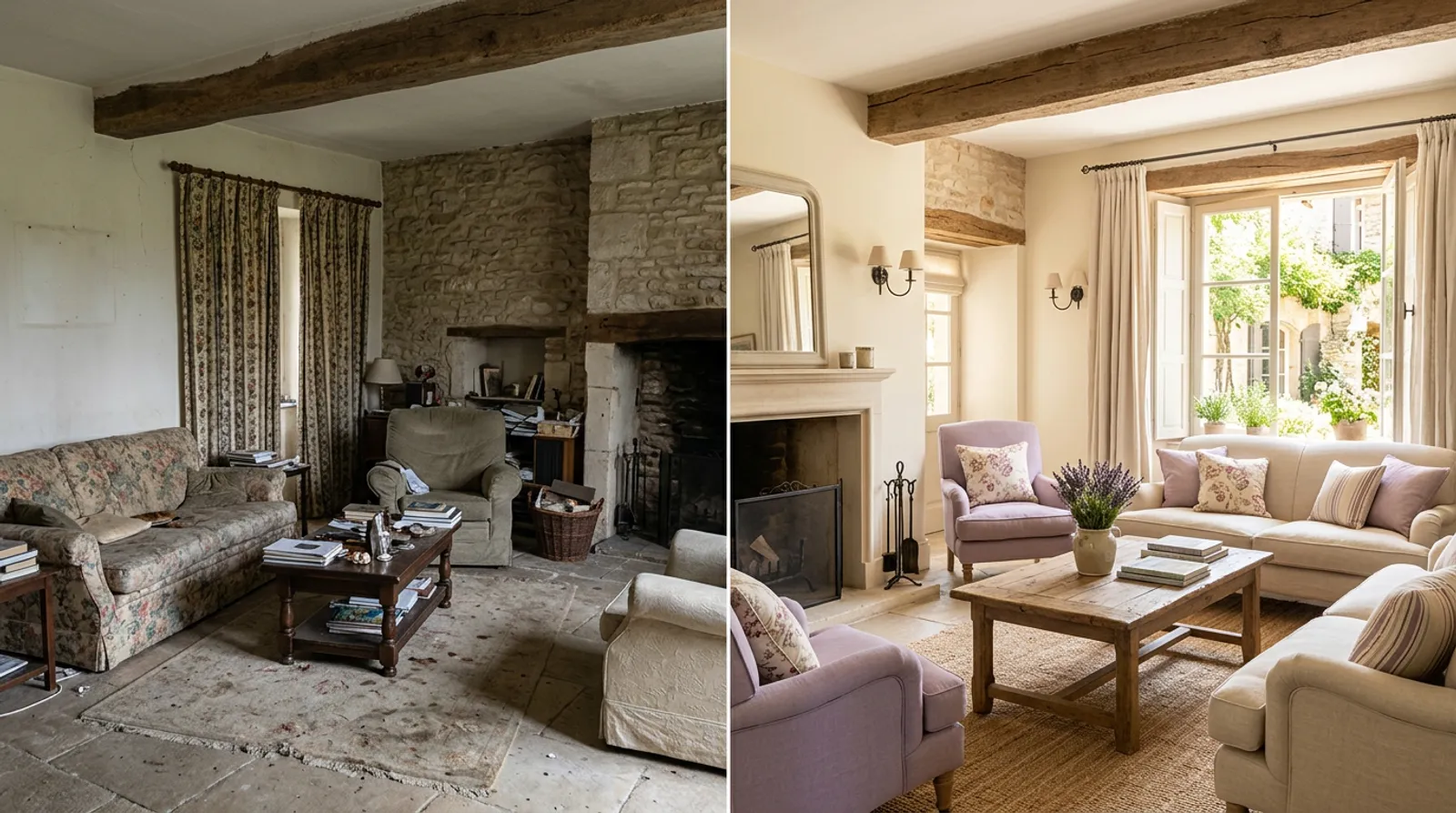 Design idea: a living room restyled in Provencal style
The Provençal style is rooted in the southern French art of living, at the crossroads of rural tradition and country bourgeoisie. The mas, long stone farmhouses, and the bastides, the more comfortable 18th and 19th-century country homes, shaped a use-driven aesthetic: local materials (limestone, terracotta, olive wood), craft textiles (printed indiennes, quilted boutis), and furniture built to withstand sunlight, the mistral wind and generations of family use.
Three principles still structure this aesthetic today:
- Mediterranean light: you invite it, filter it, diffuse it. Light walls, blue or green shutters left ajar, lightweight fabrics.
- Local craft: ceramic from Vallauris or Moustiers, Souleiado prints, wrought iron, olive-wood basketry. Nothing comes from a factory.
- The patina of time: every piece must tell a story. Glossy newness is the enemy of the style.
This tradition aligns with a slow art of living (slow living before the term existed) and a Mediterranean conviviality around the table.
And this style, in your room?
18 free credits on signup. No credit card needed.
See this style in my roomProvençal color palette
A Provençal decoration relies on a sunlit, plant-based palette that recalls Southern landscapes throughout the day.
- Dominant colors: patinated off-white, red ochre from facades, mimosa or straw yellow.
- Floral touches: lavender, olive green, sky blue or lavender blue.
- Natural accents: terracotta (floors, jars), gray-green patinated wood (olive, old oak), matte black wrought iron.
Avoid the loud colors of fake-South décor (pool turquoise, neon yellow, flashy pink) or modern cold neutrals: they instantly kill the authentic warmth of the style.
Materials and textures
The Provençal style celebrates raw, local materials patinated by the seasons. The idea is not to imitate the old, but to find true vintage or to let the new age naturally.
- Terracotta: hexagonal tomettes on floors, ceramic jars, glazed earthenware from Vallauris. The absolute signature of a Provençal floor.
- Wrought iron: light fixtures, headboards, stair rails, table supports. Always matte black, never glossy lacquer.
- Linen and natural cotton: curtains, tablecloths, sheets, kitchen towels. Often printed with Souleiado motifs (flowers, olive branches, cicadas).
- Patinated wood: old oak, olive, chestnut. Solid, raw, sometimes limed. For trestle tables, sideboards, rush-seated chairs.
- Limestone: in wall recesses, fireplaces, hand-carved stone sinks.
Surfaces are rough, matte, alive. A time-chipped tomette beats a brand-new imitation tile any day.
Characteristics of Provençal layouts
Beyond colors and materials, a Provençal interior is recognizable through several very characteristic layout choices.
Mediterranean light and colored shutters
Southern light is powerful, sometimes overwhelming. You filter it with slightly billowing ecru linen curtains, you invite it through windows with blue or green shutters left half-open, you diffuse it on light, patinated walls. This light defines the entire atmosphere.
Floral motifs and regional prints
Souleiado indiennes, quilted boutis covers, tablecloths with olive or mimosa patterns: Provençal prints structure the textiles. To dose carefully: one pattern on the curtains, one on the tablecloth, one on the cushions, that is enough. Overload kills.
Omnipresent wrought iron
Central wrought-iron chandelier, entrance wall sconce, kitchen counter brackets, iron bed frame: matte black metal is everywhere. It structures and contrasts with the roundness of surrounding natural materials.
Scents and sensory textures
The Provençal style is experienced through the nose: a bunch of dried lavender, Marseille soap, potted thyme and rosemary, eau de Cologne in the bathroom. This sensory dimension, often overlooked in modern decoration, is what really signs the style.
7 concrete tips to nail a Provençal decoration
- Lay a hexagonal terracotta floor or a tile that mimics it. This is the visual foundation that immediately signs the style.
- Paint walls in lightly patinated off-white, never pure white or vivid color. Imperfections are your friend.
- Invest in a patinated wood piece: a sideboard, a trestle table, a glass-front dresser. Raw beats varnished.
- Add a wrought-iron light fixture in the center of the living or dining room. This is the black structural piece that contrasts with the surrounding warmth.
- Multiply wicker baskets: for laundry, magazines, firewood, groceries. Basketry is everywhere.
- Pick your printed textiles: one olive-pattern tablecloth, two boutis cushions, one ecru linen curtain. No more.
- Place dried lavender in a terracotta vase. This is the detail that turns a generic interior into an authentic Provençal one.
Who is the Provençal style ideal for?
The Provençal style works particularly well in certain contexts:
- Southern homes, mas and bastides: the architecture already does half the work.
- Holiday homes: sunny mood, slow living, mental escape.
- Lovers of slow living and country life: conviviality, shared meals, southern art of living.
- Families with patina: heirloom furniture, flea-market finds, objects that age beautifully.
If you live in a modern urban apartment, pure Provençal can feel nostalgic or out of place. Look instead at the Boho style, which shares the love of natural materials and prints, or the more versatile rustic country style, which also works in northern regions.
Common mistakes to avoid
- The postcard cliché: plastic cicadas on the wall, lavender everywhere, "Souvenir of Provence" faience. You tip straight into kitsch.
- Loud colors: pool turquoise or neon yellow break the soft patina of the real style. Stick to natural, muted tones.
- Brand-new glossy varnished furniture: lacquering everything kills the soul. Prefer waxed, oiled finishes, or let wood age on its own.
- Forgetting scents and rough textures: without smells or living matter, Provençal turns into an empty film set.
Test the Provençal style on your room
Reading a guide is one thing; seeing the result on your own room is another. With Shopia, you upload a photo of your kitchen, living room, dining room or bedroom, and our tool delivers a Provençal rendering in a few minutes. You can then compare before and after, fine-tune the furniture, and even find similar products online.
Frequently asked questions
Is Provençal style still relevant or has it become kitsch?
It remains very much alive as long as you skip the postcard version (cicada-print curtains, lavender friezes on every wall, plastic jar overload). The 2026 take leans into restraint: off-white or rosy ochre walls, a single raw-linen curtain, one authentic Anduze terracotta jar, a sideboard in patinated gray-green wood. Bet on three strong pieces rather than ten small decorative items.
What color palettes exist beyond yellow and lavender?
Provence offers a wider palette than people think. Try olive green (Farrow & Ball Lichen or Card Room Green) with terracotta accents, deep Marseille blue (close to Hague Blue) with light woods, or dusty rose for a bedroom (Setting Plaster). The lesser-known winning combo: red ochre from Roussillon facades (#A45A3D) with off-white, olive green and matte black wrought-iron touches. Much more modern than yellow-lavender.
Can you do Provençal style in a Paris apartment?
Yes, and the result is often striking. Focus on transportable elements: hexagonal terracotta tiles (clip-on planks like Quick-Step can sit over existing parquet), a patinated sideboard from Selency or online flea markets, a large antique gilded mirror, raw linen at the windows. Avoid fake exposed beams and orange textured plaster: those are the real pastiche markers. A 3-room Haussmann apartment can absorb 60 to 70 percent of the Provençal codes very gracefully.
And this style, in your room?
18 free credits on signup. No credit card needed.
See this style in my roomRelated articles

Bohemian style: a warm, free-spirited interior
Everything about Bohemian style: terracotta, macramé, rattan, ethnic textiles and 7 tips for a warm, free-spirited interior.

Classic style: timeless French elegance
Everything about Classic French style: moldings, parquet, patinated furniture and 7 tips for timeless Haussmann elegance.