

Table of contents
Kids room ideas: playful and built to evolve
The kids room is probably the trickiest room to decorate in the home. It must serve three functions at once (sleep, play, learn), evolve with age (from baby to teenager) and stimulate imagination without disturbing sleep. Theme overload, oversaturated colors, badly scaled furniture: the pitfalls are many and the fixes are expensive every two years.
In this guide, we dive into everything you need to know to nail a kids room that lasts: the essentials, the common mistakes, the styles that work, the color palette, the lighting and 7 concrete tips to turn this space into an evolving cocoon. At the end, you will be able to test the rendering directly on a photo of your child's bedroom with Shopia.
Why you should care about your kids room
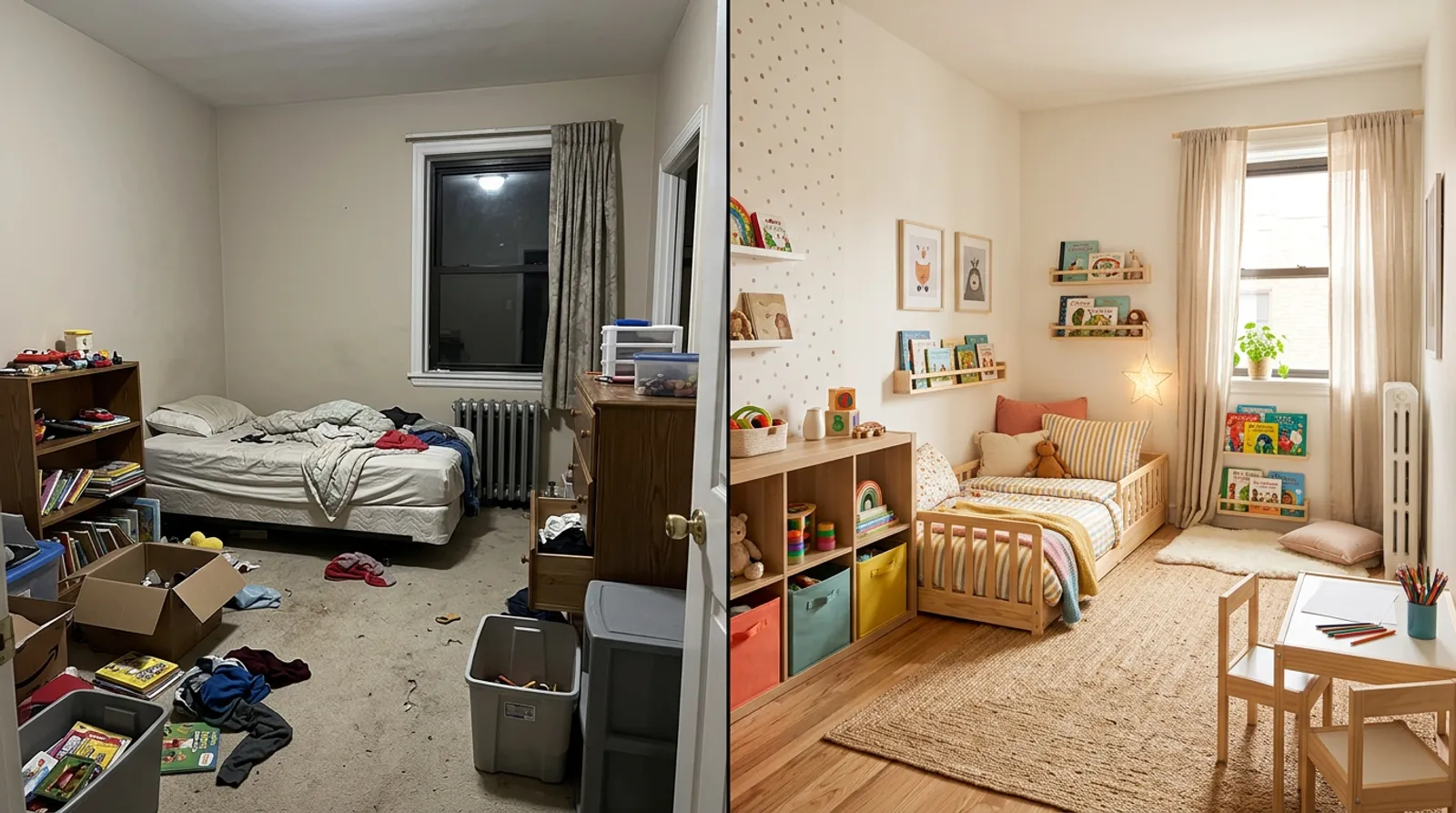 Design idea: a kids room redesigned
A well-designed kids room plays on three levels. First, sleep: rest quality depends directly on light, colors and the visual calm of the room. Second, autonomy: when storage is at child height, your child learns to tidy alone, pick their own clothes and organize their games. Third, imagination: this is where they build their games, read their first books and host their friends.
A good kids room evolves with the child without being torn apart every two years. An evolving bed replaces the cot, low storage stays valid until 8 to 10 years old, and a neutral palette lets you swap accessories (cushions, posters, stickers) with changing tastes without repainting the walls.
Common mistakes in a kids room
Many failed kids rooms fall into the same traps:
- Overloading with themes: princesses everywhere, dinosaurs everywhere, superheroes everywhere. At 4 the theme delights, at 7 it is dated and expensive to replace (wallpaper, sheets, curtains, matching rug).
- Oversaturated colors: bright red, neon orange, electric yellow. These colors stimulate and prevent sleep. A candy pink or royal blue room can literally hinder falling asleep.
- Furniture not scaled to the child: a too-tall desk leads to bad posture, out-of-reach shelves kill autonomy, a low bed will not evolve. Everything must be thought by age.
- Stuffed animals on the bed: 15 plush toys on the pillow is cute in photos but bad for sleep. They take space, gather dust and stimulate visually at bedtime.
- No category storage: everything piled in one large chest. The child does not know what they own, does not tidy and ends up emptying the chest every time to find one specific toy.
- Strong wall paint that is hard to change: a wall painted canary yellow at 3 becomes a nightmare at 9. Removable stickers and posters are far smarter.
Styles that work best for a kids room
The right style depends on the child's age, the room size and how long you want the decoration to last. Here are the looks that work best:
- The bohemian style bets on soft colors (terracotta, sand, sage green), natural textiles (Berber rug, macrame canopy) and artisanal accessories. The warmest and most evolving option.
- The Scandinavian style is unbeatable for a playful room without clutter. Light wood, neutral palette, a few pastel touches and a cozy reading corner: the most durable base.
- The Japandi style is perfect to support quality sleep. Visual calm, clean lines, natural materials: your child falls asleep more easily in this environment.
- The minimalist style is the option that lasts the longest. No theme, no marked color, just beautifully functional objects that go from 3 to 12 years old unchanged.
- The contemporary style plays on modular furniture (transformable bed, height-adjustable desk, evolving storage). Ideal if you want to optimize the budget over 10 years.
Color palette and materials
For a kids room, favor a soft palette that does not disturb sleep:
- Dominant colors: off-white, beige, very light gray, natural wood. These neutral tones soothe and let playful decoration (posters, cushions, plush toys) stand out.
- Accent touches: soft pastels (powder pink, sky blue, mint green, straw yellow), light terracotta, sage green. Never neon or saturated colors.
- Materials: light wood (oak, pine, beech) for the bed, desk and storage, organic cotton for sheets and cushions, wool or jute for the rug, matte black metal for hooks and structures.
Avoid PVC, glossy melamine and synthetic textiles that load the room with volatile organic compounds. A child spends 10 to 12 hours a day in this room; air quality matters.
Lighting: night light and reading zone
In a kids room, lighting must serve three precise moments:
- Main light: a diffuse ceiling fixture, ideally with a dimmer, for play time and the end-of-day tidying. Warm bulb mandatory (2700 K).
- Soft night light: essential up to 6 or 7 years old. A small adjustable lamp or a warm LED night light placed on the floor near the bed. It reassures without preventing falling asleep.
- Reading zone lamp: a soft cushion in a corner, an accessible book shelf and a small adjustable lamp. This is the detail that turns the room into a cocoon and gives the taste for reading.
Ban cold fairy lights and blue LEDs that disrupt melatonin. Favor warm bulbs (2700 K maximum) and cut all bright screens 1 hour before bedtime.
Essential furniture
A functional kids room relies on 5 to 6 pieces, no more:
- An age-adapted bed: cot up to 2 years, evolving bed from 0 to 6 years, standard or loft bed from 6 to 7 years.
- Low, accessible storage: 80 cm height maximum so the child tidies their toys alone and picks their clothes.
- A scaled desk: from 5 to 6 years, a height-adjustable desk lasts through adolescence.
- A floor play zone: thick washable rug, large enough to spread Lego or set up a car circuit.
- A book shelf: at child height, books displayed face-out (Montessori method) to encourage reading.
- A magnetic wall or chalkboard: a free-expression zone that replaces drawings on the white walls.
7 concrete tips to nail your kids room
- Pick an evolving bed: a bed that grows from 0 to 6 years amortizes the investment and avoids buying everything again at each stage.
- Place all storage at child height: 80 cm maximum. The child tidies alone, picks their clothes, becomes autonomous.
- Install a magnetic wall or chalkboard: a free-expression zone that avoids drawings on the wallpaper and channels creativity.
- Create a floor play zone: thick washable rug, large enough. This is where 80 % of play happens.
- Adopt a pastel or neutral palette: no neon, no saturation. Bright colors stimulate and disturb falling asleep.
- Favor removable stickers and posters: rather than a strong wall paint that you will repaint in 3 years, go for decorative elements you can change in 5 minutes.
- Plan a cozy reading zone: a soft cushion, a small warm lamp, an accessible book shelf. This is the detail that turns the room into a refuge.
Try your kids room on Shopia
Reading a guide is one thing; seeing the result on your child's bedroom is another. With Shopia, you upload a photo of the current room and our tool delivers a decorated rendering in a few minutes. You can test several styles (Scandinavian, Japandi, bohemian), compare before and after, fine-tune the furniture and find similar products online to order.
Frequently asked questions
How should a kids room differ from age 0 to 3 versus 3 to 6?
From 0 to 3, the room is mostly about sleep and care: crib, changing dresser (around 32 x 40 inches with a removable top), nursing chair, soft colors (greige, dusty pink, soft mint). From 3 to 6, the child plays and invents: toddler bed 36 x 75 inches, reading nook with a teepee or canopy, chalkboard or magnetic wall, palette that can shift to brighter tones. Plan ahead: a changing dresser that converts into a regular dresser and a crib that converts into a toddler bed save $700 to $1,200 over three years.
Painted wall or posters: which works better?
A wall painted in a confident color (sage green, teal, soft terracotta) gives the room character without dating it, and stays neutral when the kid changes obsessions every six months. Themed stickers and posters (princess, superhero, dinosaur) are riskier: stickers are hard to remove cleanly and themes go stale fast. Middle ground: one accent wall plus a large frame with a swappable print as the child grows. Expect $50 to $100 for a kid-safe paint can (low VOC, certified for nurseries).
Toys on display or hidden: which storage strategy wins?
Mix both. Hide about 70 percent in matching bins (woven baskets, fabric cubes, IKEA Kallax inserts) to calm the room visually and make tidying easier for the child. Keep 30 percent visible on a low shelf at kid height (books displayed face out, chosen plush toys, nice wooden pieces). Sorting rule: any toy untouched in 3 months goes to the attic on rotation, any toy with missing pieces gets donated. You cut visual clutter in half without throwing anything away.
Related articles

Bedroom ideas: design a restful, restorative space
Everything about bedroom decoration: palette, furniture, lighting, styles that work and 7 tips to create a sleep sanctuary.

Living room ideas: design a warm, welcoming space
Everything about living room decoration: palette, furniture, lighting, styles that work and 7 tips for a warm, inviting space.

Bohemian style: a warm, free-spirited interior
Everything about Bohemian style: terracotta, macramé, rattan, ethnic textiles and 7 tips for a warm, free-spirited interior.