

Table of contents
- Why your home office decoration matters
- Common mistakes in a home office
- Styles that work best for a home office
- Color palette and materials
- Lighting: the rule of 3 sources
- Essential furniture
- 7 concrete tips to nail your home office
- The anti-fatigue measurements worth memorizing
- Try your home office on Shopia
Home office ideas: a productive workspace at home
The home office has become a central room since the post-2020 shift to remote work. Whether you spend a few hours a week or your entire workweek there, the quality of this space directly affects your focus, your health and your mood. A poorly thought-out office tires the back, strains the eyes, and makes you want to flee at the first morning meeting.
In this guide, we go through everything that truly matters when decorating a home office: ergonomics, lighting, storage, the styles that work, and 7 concrete tips to transform the space. At the end, you will be able to test a new layout directly on a photo of your office with Shopia.
Why your home office decoration matters
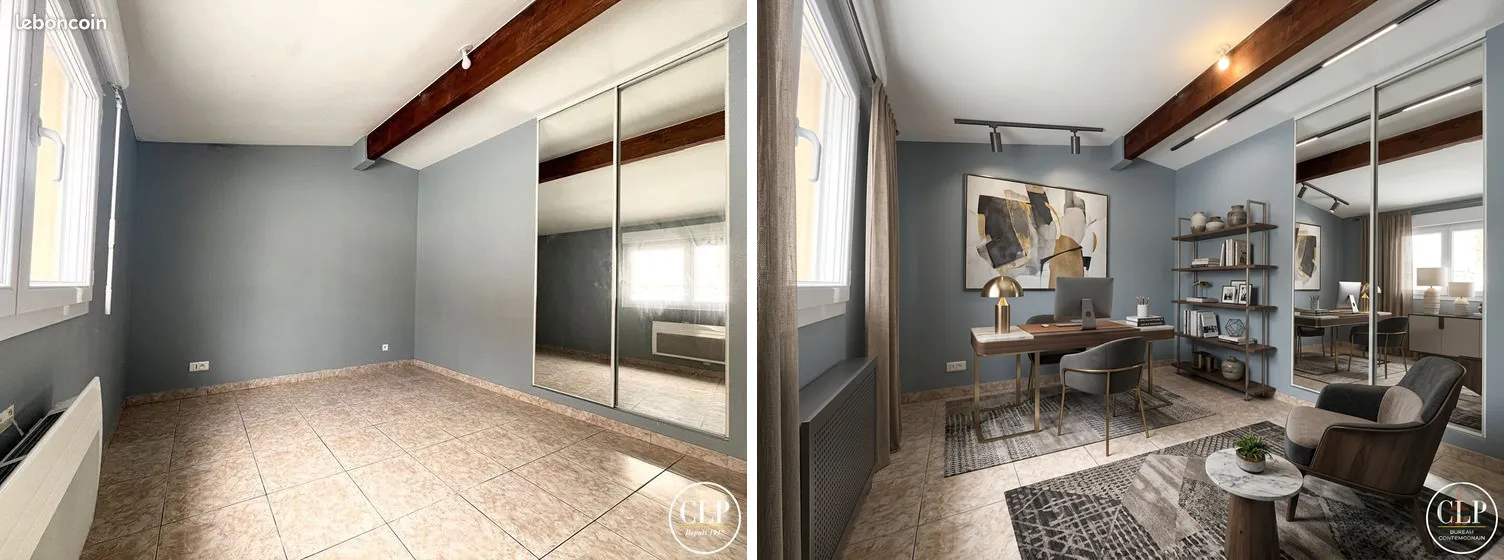 Design idea: a room transformed
A home office is not just another room. It is a productivity space, but also a place that shapes your mental state for several hours a day. Three reasons to give it the same care as your living room.
- Physical health: a bad chair and a poorly positioned screen guarantee chronic back pain, stiff necks and eye strain. Layout is not a cosmetic detail, it is prevention.
- Focus: a cluttered, badly lit or over-stimulating space scatters attention. A well-designed office creates the mental frame that helps you drop into work.
- Work-life separation: a corner of the dining table blurs the lines. A real office, even a small one, tells your brain when to start working and when to switch off.
Well designed, your office becomes a daily ally. Poorly thought out, it drains your energy without you understanding why.
Common mistakes in a home office
Before we talk styles and colors, here are the classic traps that weigh down a workspace.
- The desk facing a blank white wall: no visual stimulation, the eyes hit the partition every thirty seconds. A frame, a shelf, a plant: you need at least one anchor point.
- A non-ergonomic chair: a kitchen stool, a dining chair, a lounge armchair. Anything but a real office chair. Result: back pain within two weeks.
- Exposed cables: the octopus of wires hanging under the desk pollutes the eye and distracts. It is a small detail with a big impact.
- Lighting too strong or frontal: a pendant directly above the screen that reflects on the panel, and eye fatigue is guaranteed.
- No separation between work and rest zones: a desk at the foot of the bed in the bedroom is the classic remote work mistake. Your brain never truly disconnects.
Spotting these mistakes at home is already half the work.
Styles that work best for a home office
Not all styles fit a workspace. Here are the five that work particularly well.
- The contemporary style offers modular furniture, clean lines and mixed materials that adapt to any configuration.
- The Scandinavian style leans on natural light and light wood, ideal for a room where you spend many hours.
- The industrial style brings character with black metal, raw wood and exposed bulbs, perfect for loft lovers.
- The minimalist style removes every visual distraction, a good fit if you work on subjects that demand deep concentration.
- The Japandi style blends zen and function, perfect for an office that must also soothe you.
The choice depends on your temperament: need for warmth, structure, calm or character.
Color palette and materials
A home office benefits from avoiding chromatic extremes. Bright red, saturated yellow or pure black tire the eye quickly. Aim for neutral bases with one accent touch.
- Dominant colors: off-white, light gray, beige, sage green. Soothing tones that do not saturate the retina.
- Accent touches: a deep blue, a terracotta or a forest green on one wall, one piece of furniture or the accessories.
- Materials: light wood for the work surface, matte black metal or brushed brass for the legs, natural textiles (linen, cotton) for curtains and cushions.
Avoid glossy surfaces (lacquered glass, white plastic, polished metal) that multiply reflections on your screen.
Lighting: the rule of 3 sources
A home office demands careful lighting. The baseline rule: at least three light sources, with absolute priority on task lighting.
- General light: a pendant or diffused ceiling light, never directly above the screen, slightly offset to avoid reflections.
- Task lighting: an adjustable desk lamp with an articulated arm, placed opposite your writing hand (on the left if you are right-handed). This is the most important light in the room.
- Ambient light: a wall sconce, a corner floor lamp or a soft string light on a shelf, for late afternoons when natural light fades.
If possible, place your desk facing a window or perpendicular to it. A window behind you causes screen reflections; a window directly in front blinds you. The ideal position is side light.
Essential furniture
Five pieces structure a functional home office.
- The work surface: at least 120 cm wide and 60 cm deep, at 73-75 cm in height. Solid wood, oak-veneered MDF, or a height-adjustable top to alternate sitting and standing.
- The ergonomic chair: with adjustable armrests, variable seat height, lumbar support. This is not an optional expense, it is your health over the next ten years.
- A monitor stand: to bring the screen to eye level, the top of the panel at the height of your gaze. Avoids the forward head tilt that wrecks the neck.
- Closed storage: shelves with doors, a rolling drawer unit, vertical file holders. The goal is to hide clutter and free up the visual field.
- A green plant: pothos, snake plant, ficus. Beyond decoration, greenery humidifies the dry air of a heated or air-conditioned office.
7 concrete tips to nail your home office
- Invest in a real ergonomic chair with adjustable armrests. This is non-negotiable, it is your health for the next ten years.
- Place the desk facing a window or perpendicular, never with your back to it. Side light, not frontal light that blinds the screen.
- Raise your screen with a stand or a stack of books. The top of the panel should be at eye level.
- Hide the cables with a tray under the desk, a cable grommet or Velcro ties. Ten euros, a radical change.
- Multiply closed storage: drawers, shelves with doors, file holders. Everything visually scattered distracts you.
- Add a green plant: it humidifies dry air, oxygenates the room and gives the eyes a place to rest.
- Take care of task lighting: an adjustable desk lamp, opposite your writing hand, warm 2700 K bulb. The centerpiece of the room.
The anti-fatigue measurements worth memorizing
If you get a headache by 4pm without knowing why, the cause is often a few badly set centimeters. Here are the exact numbers that separate a smooth day from a sore evening.
- Desk top height: 72 to 75 cm. Below that you raise your shoulders (arms too low); above it you bend your wrists (arms lifted). The reference: elbows at 90° when your hands rest on the keyboard, wrists straight.
- Seat height: 45 to 50 cm from the floor for a standard desk. Your feet must be flat on the floor and your thighs horizontal. If your feet dangle, add a footrest rather than dropping the seat below the screen.
- Screen distance: 50 to 70 cm from your eyes. Quick test: stretch your arm out; if you touch the panel, it is too close. The top edge of the screen sits at eye level, with a slight backward tilt of 10 to 15°.
- Lumbar support. The backrest should cradle the lower back, not just the shoulder blades.
One trick fixes 80% of posture problems: a 15 euro monitor stand to lift the panel without stacking wobbly books.
Keep the 20-20-20 rule in mind too: every 20 minutes, look at a point 6 meters (20 feet) away for 20 seconds. Your eyes get a rest, and end-of-day fatigue drops noticeably.
Try your home office on Shopia
Reading a guide is one thing; seeing the result on your own room is another. With Shopia, you upload a photo of your current office, you pick a style and a budget, and our tool delivers a rendering in a few minutes. You can then compare before and after, fine-tune the furniture and find similar products online to take action.
Frequently asked questions
How do you fit a home office in a small space or a bedroom?
Pick a wall-mounted fold-down desk or a slim console (12 to 16 inches deep) to keep the floor clear. Place it near a window, mount storage on the wall above, and use a foldable ergonomic chair you can tuck away after work. If the desk lives in the bedroom, set a low bookshelf or a screen behind the monitor to create a visual break between work zone and sleep zone. Budget around $350 to $700 for a minimal but well-thought setup.
What lighting setup prevents eye strain in a home office?
The rule is three light sources. A diffuse ceiling light at 3000K to 4000K for the ambient base, an articulated desk lamp 20 inches from the screen placed on the side opposite your writing hand, and ideally natural light coming in perpendicular to the screen (never behind or in front, which causes glare and reflections). Avoid cool bulbs above 5000K, which tire the eyes after a couple of hours of screen work.
What is the best wall color for a home office?
For focus, go with soft blue, sage green or warm gray. These tones calm the nervous system without making you drowsy. Avoid bright red and saturated orange, which overstimulate, and pure white, which reflects screen glare. If you take video calls with clients, paint the wall behind you a neutral shade (greige, off-white, soft taupe) for a professional backdrop without distraction.
Related articles

Bedroom ideas: design a restful, restorative space
Everything about bedroom decoration: palette, furniture, lighting, styles that work and 7 tips to create a sleep sanctuary.

Living room ideas: design a warm, welcoming space
Everything about living room decoration: palette, furniture, lighting, styles that work and 7 tips for a warm, inviting space.

Contemporary style: a modern, evolving interior
Everything about Contemporary style: current design, neutral palette, noble materials and 7 tips for an evolving interior.