

Table of contents
Classic style: timeless French elegance
The Classic style is the embodiment of French elegance. Inherited from grand Parisian apartments of the 19th century and aristocratic townhouses, it combines mouldings, vintage parquet, period furniture and noble fabrics to compose interiors that never go out of fashion. If you dream of a refined, bourgeois atmosphere where every room tells a story, the Classic style is most likely for you.
In this guide, we cover everything you need to know to nail a Classic decoration: its origin, its color palette, the materials that make the difference, the pitfalls to avoid, and concrete tips to transform your living room, dining room or bedroom. At the end, you will be able to test this style directly on a photo of your room with Shopia.
Origin of the Classic style
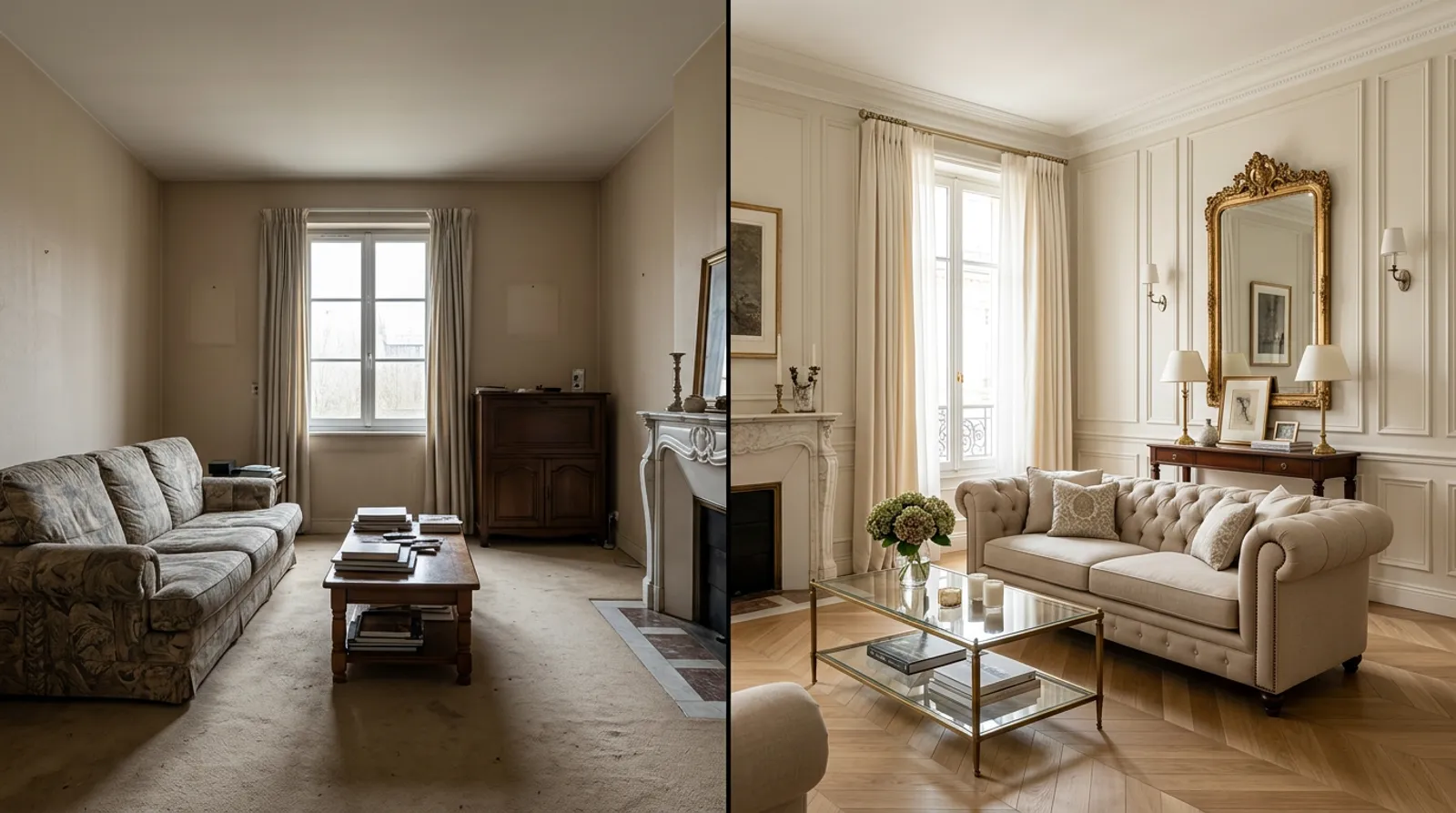 Design idea: a living room restyled in classic style
The French Classic style is rooted in the Parisian architecture of the 17th to 19th centuries. Its first great expression came in the noble apartments under Louis XIV, Louis XV and Louis XVI, where symmetry, carved ornament and precious materials became the signature of state elegance. But it was with the major works of Baron Haussmann, between 1853 and 1870, that the Classic style entered bourgeois interiors: cut-stone facades, high ceilings, plaster mouldings, parquet laid in herringbone or Versailles patterns, and a marble fireplace in every reception room.
Three principles still structure this aesthetic today:
- Symmetry: everything is balanced, two armchairs framing a fireplace, two lamps placed in mirror on a console.
- Ornament: mouldings, ceiling rosettes, discreet gilding, marquetry. Nothing is ever left raw.
- Noble materials: marble, solid wood, velvet, silk. Quality always comes before quantity.
This tradition still feeds contemporary French decoration and remains the benchmark whenever timeless elegance is the goal.
And this style, in your room?
18 free credits on signup. No credit card needed.
See this style in my roomClassic color palette
A Classic decoration relies on a muted, deep, refined palette that lifts the natural light pouring through high windows.
- Dominant colors: off-white, pearl gray, rosy beige. Walls serve as a neutral canvas that highlights furniture and artwork.
- Color accents: Gustavian blue, empire green, deep burgundy, imperial yellow. Often used on a single wall panel or as velvet on an armchair.
- Metallic accents: aged gold, patinated brass, bronze. Never showroom-shiny, always softened by time.
Avoid overly modern colors (bright turquoise, fuchsia, apple green) or industrial matte blacks: they break the patina and the soul of the style.
Materials and textures
The Classic style celebrates noble, durable, patinated materials. The idea is not to find new pieces that imitate the old, but rather to source and invest in items that gain value over time.
- Solid wood: oak, walnut, mahogany. Often patinated, waxed, sometimes inlaid. Vintage parquet in herringbone or Versailles pattern remains the absolute signature.
- Marble: fireplaces, consoles, chest tops. Carrara white, gold-veined Portor black, nuanced Sarrancolin remain the most coveted.
- Noble fabrics: deep velvet, damask silk, heavy linen, brocade. On pinch-pleat curtains, bergère armchairs, tufted headboards.
- Worked metals: brass, bronze, copper. For door handles, chandeliers, table legs.
Surfaces are carved, sculpted, sometimes gold-leafed. A piece sourced at a flea market beats a factory-made item every time, even an expensive one.
Characteristics of Classic layouts
Beyond colors and materials, a Classic interior is recognizable through several highly codified layout choices.
Symmetry and balance
Symmetry is the golden rule. Two identical armchairs on either side of a fireplace, two lamps mirrored on a sideboard, two paintings flanking a sofa. This balance instantly creates a feeling of calm and order, without ever feeling rigid as long as accessories add a bit of fantasy.
High ceilings with mouldings
Plaster cornices, rosettes around chandeliers, mouldings on doors: these architectural ornaments are the signature of the French Classic style. If your home has them, highlight them (off-white paint, grazing light). If not, you can install them on a reasonable budget to transform an ordinary room.
Fireplace and vintage parquet
A marble fireplace, even purely decorative, structures an entire living room. Parquet in herringbone or Versailles pattern signs the authenticity of a successful Classic interior. If your floor is less noble, English-laid oak planks remain perfectly acceptable.
Period furniture and noble fabrics
A Louis XVI bergère, an inlaid console, a trumeau mirror above the fireplace, a crystal chandelier, an Aubusson or Savonnerie rug, a Medici vase on the console. You do not have to own all of it: one or two signature pieces are enough to imprint the Classic character.
7 concrete tips to nail a Classic decoration
- Paint walls in off-white or pearl gray, never pure white. The nuance reveals the mouldings and softens the light.
- Invest in a hero piece: a trumeau mirror, an inlaid console, a bergère armchair. One alone defines the whole room.
- Source from flea markets or auctions rather than buying new faux-antiques. Patina cannot be manufactured.
- Hang pinch-pleat curtains in heavy linen or velvet, from ceiling to floor. This is what instantly delivers Classic presence.
- Add a vintage rug: Aubusson, Savonnerie, or an Oriental kilim. It warms the floor and anchors the furniture.
- Pick a chandelier: crystal, gilded bronze, or with drops. A Classic ceiling is to be looked at, not hidden.
- Keep trinkets in check: three curated objects per surface, chosen with love. Overload kills elegance.
Who is the Classic style ideal for?
The Classic style works particularly well in certain contexts:
- Haussmann apartments and 19th-century buildings: existing architecture already does half the work.
- Bourgeois family homes: large rooms, high ceilings, original parquet.
- Lovers of French elegance: those who prefer refinement to passing trends.
- Families with inherited pieces: Classic style magnificently showcases heirloom furniture and artworks.
If you live in an industrial loft or a new build with no mouldings, the pure Classic style can feel forced. Look instead at a Classic-Contemporary marriage that pairs antique pieces with modern lines, or the Boho chic style, which shares the love for noble materials with more freedom.
Common mistakes to avoid
- Overloading with trinkets: Classic is not a cabinet of curiosities. Three carefully chosen objects per shelf, maximum.
- Cheap imitation furniture: a fake Louis XV in MDF instantly kills the effect. One real antique piece is better than a whole room of copies.
- Mixing too many periods: Louis XV, Louis XVI, Empire and Napoleon III in the same room is too much. Stick to two compatible periods at most.
- All-beige with no relief: without an accent color, a noble fabric, or any patina, Classic turns into a soulless hotel lobby.
Test the Classic style on your room
Reading a guide is one thing; seeing the result on your own room is another. With Shopia, you upload a photo of your living room, dining room or bedroom, and our tool delivers a Classic rendering in a few minutes. You can then compare before and after, fine-tune the furniture, and even find similar products online.
Frequently asked questions
What is the difference between Classic and Haussmann style?
Haussmann refers to an architectural frame: the Parisian buildings constructed between 1853 and 1870 under Baron Haussmann (cut-stone facades, high ceilings, plaster mouldings, herringbone parquet, marble fireplaces). Classic, by contrast, is a decorative style that can live inside those apartments but also in a suburban house or a recent build. In short: Haussmann is the container, Classic is the content.
How do you mix antique and modern furniture in a Classic interior?
The two-thirds rule works well: two thirds Classic pieces (Chesterfield sofa, Louis XVI console, gilded mirror) and one third contemporary pieces (designer pendant, abstract painting, sleek marble coffee table). Avoid a 50/50 split that creates visual tension. Keep a single metallic line (patinated brass OR bronze, never both) to bridge the periods.
Can Classic style work with a low ceiling?
Yes, provided you adapt the codes. Drop heavy plaster mouldings (cornices over 10 cm or 4 inches) and large crystal chandeliers that crush the room. Choose thin cornices (3 to 5 cm), wall sconces instead of a central chandelier, a light parquet (oiled blonde oak) and bright wall colors (off-white, pearl gray). A tall mirror above the fireplace remains a strong ally to gain perceived height.
And this style, in your room?
18 free credits on signup. No credit card needed.
See this style in my roomRelated articles

What Is Provençal Style? Colors, Materials and Decor Tips
What Provençal style is and how to get it: lavender, ochre, wrought iron, terracotta floors and 7 tips to bring the South of France home.

Contemporary style: a modern, evolving interior
Everything about Contemporary style: current design, neutral palette, noble materials and 7 tips for an evolving interior.