

Table of contents
Shelf height and how to style your shelves
You hung some shelves and, a year later, they gather dust instead of being useful. The culprit is almost always the same: they sit too high or are badly spaced. Your eye spots a failed shelf in under three seconds, without knowing why. The good news is that there are precise usable heights and a simple styling method that turn a useful shelf into a beautiful one. It all comes down to a few measurements you can check before you even drill.
In this guide you will learn at what height to hang each shelf, how much space to leave between them depending on what you store, how to compose without overcrowding, and which objects genuinely break the look.
Why your shelves feel useless
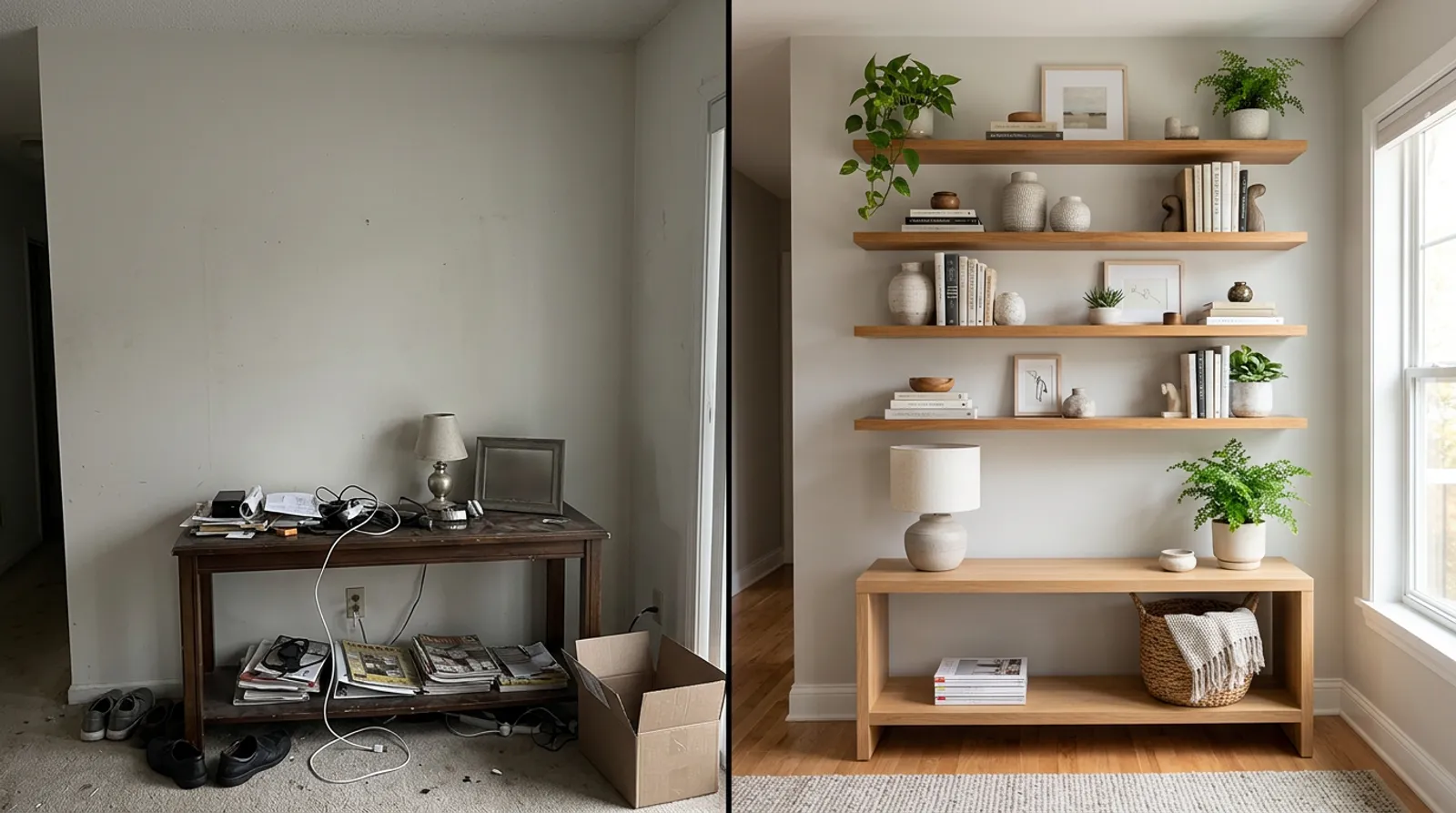 Design idea: shelves hung at the right height and styled
Four signals give away a failed shelf, and your brain catches them instantly. Above 180 cm it is a dead zone: unreachable without a step stool, so nothing ever goes up there. Too far apart, shelves look empty and out of proportion. Too close, objects get jammed and air is missing. Badly composed, they look either overloaded or deserted, with no balance at all.
The simplest test before drilling: raise your arm. If reaching the target height takes effort, it is too high for daily use.
The right usable heights
The main shelf, the one you use most, sits at eye level, between 140 and 160 cm. This is the rule that outranks all others. Here is the full breakdown of a column:
- First shelf: 80 to 100 cm from the floor, for easy access.
- Main shelf: 140 to 160 cm, at eye level.
- High shelf: 160 to 180 cm, for occasional use.
- Above 180 cm: dead zone, to avoid absolutely.
A typical living room or office setup, with three shelves: the first at 90 cm for daily access, the second at 150 cm as the main shelf, the third at 180 cm for rarely touched decor.
The space to leave between shelves
The gap between two shelves depends on what you store, and it never drops below 20 cm. The taller the contents, the more air you need to take them out without forcing:
- Paperbacks: 25 cm, the standard height.
- Large books: 30 to 35 cm, to grab them without jamming.
- Dishware and glasses: 30 to 35 cm, to stack with ease.
- Decorative objects: 30 to 35 cm, for real visual breathing room.
- Plants and vases: 35 to 40 cm, for height and growth.
For a mix of books and objects, 30 cm is the safe value. Above 40 cm, you waste space and break the proportions.
Matching the height to each room
Each room has its use, so its ideal height. In the living room, the main shelf stays at 140 to 160 cm with 30 to 35 cm between levels. In the office, drop the main shelf to 100 to 120 cm so it works seated or standing, with 25 to 30 cm between shelves and archives at 160 cm maximum. In the kitchen, the first shelf sits at 140 to 150 cm to keep daily dishware within reach, never above 170 cm for safety. In the bedroom, count on 120 to 140 cm for folded clothes, and 160 cm maximum above the bed. In the bathroom, place the first at 100 to 120 cm with 20 to 25 cm between levels for small bottles.
The two thirds useful, one third decor rule
A balanced shelf alternates the functional and the decorative without overdoing either. The rule: on each shelf, two thirds useful content (books, dishware, storage boxes) and one third decor (vases, frames, plants). Too much useful content turns into clutter, too much decor looks like an unlived showroom. For the composition, vary the heights (books standing, books lying flat, objects), let it breathe rather than packing it full, group in threes or fives, and keep a single focal point per shelf.
How to style without overcrowding
Styling rests on a few simple principles. First, the 60 to 70 percent rule: a styled shelf is never full, keep 30 to 40 percent empty between and around objects to create that gallery effect. Next, odd groupings: group in threes or fives, never an even number that looks too static. Vary the heights with a small object (15 to 20 cm), a medium one (25 to 30 cm) and a large one (35 to 40 cm), alternating books standing, books lying flat and objects.
A group of three works almost anywhere: a large 30 cm vase, a 20 cm stack of books, a 10 cm candle, arranged in an invisible triangle with 5 to 10 cm between them. To add movement, follow an invisible line: tall object on the left, medium in the center, low on the right. Avoid the flat line where everything sits at the same height. Finally, play with depth by shifting objects forward or back rather than pushing everything to the wall.
To go further on the wall art above your shelves, see our gallery wall guide, and to pick the right object size, our article on decor objects size.
Colors, materials and objects to choose
Keep three colors maximum across the whole shelf, for example white, wood and terracotta, or white, black and sage green. Beyond that, the eye saturates. Split them into dominant, secondary and accent, and repeat them across every level. Favor natural materials that age well: handmade ceramic, solid wood, glass, stone, linen, matte metal, rattan. Mix textures (smooth and rough, matte and glossy) to avoid monotony.
For objects, give plenty of room to nice books (40 to 50 percent of the composition), vases of varied heights (15, 25, 35 cm), one or two plants maximum and one strong sculptural object. On the other hand, some objects break the look cleanly: souvenir trinkets, figurines, objects with slogans, more than three photo frames, visible plastic and exposed cables.
Test your heights and styling on your room
Reading the right heights is a start; seeing them applied on your own wall is more convincing. With Shopia, you photograph your room, pick a style and a layout, and get a realistic render in a few minutes. You can compare before and after, try several shelf compositions and check the balance before drilling a single hole.
Frequently asked questions
At what height should I hang a wall shelf?
The shelf you use most should sit at eye level, between 140 and 160 cm from the floor. The first shelf in a column goes lower, between 80 and 100 cm, so it stays easy to reach. A high shelf for occasional use can go up to 160 to 180 cm. Above 180 cm it becomes a dead zone: unreachable without a stool, it just gathers dust. Before you drill, raise your arm: if reaching the target height is a strain, it is too high.
How much space should I leave between two shelves?
The gap depends on what you store, and it never drops below 20 cm. Allow 25 cm for paperbacks, 30 to 35 cm for large books, dishware or decorative objects, and 35 to 40 cm for plants and vases that need height. Too tight and objects get jammed and look crammed. Too wide, above 40 cm, and the space is wasted with broken proportions. For a mix of books and objects, 30 cm is a safe value.
How do I decorate a shelf without overcrowding it?
The core rule is to never fill it to 100 percent: aim for 60 to 70 percent of the space and leave 30 to 40 percent empty so the composition can breathe. Group objects in threes or fives, never in even numbers, and vary heights with a small, a medium and a large piece. Keep three colors maximum across the shelf and pick one focal point per shelf, a nice object placed at the one third or two thirds mark. Splitting the shelf into two thirds useful and one third decorative keeps it both functional and good looking.
Related articles

How to create a gallery wall
The method to compose a structured gallery wall: invisible grid, 5 cm between frames, an anchor point and paper templates before you drill.

What size vases and decor objects to choose
The simple rule for choosing the height of your vases and decor objects: one third of the furniture height, groups of three, and the right dimensions per room.

Living room ideas: design a warm, welcoming space
Everything about living room decoration: palette, furniture, lighting, styles that work and 7 tips for a warm, inviting space.