

Table of contents
- Why the order matters
- Step 1: declutter and reposition
- Step 2: lay the rug
- Step 3: set the lighting
- Step 4: hang the curtains
- Step 5: choose the main piece
- Step 6: add the secondary furniture
- Step 7: finish with textiles and decor
- The method applied room by room
- The sequencing mistakes to avoid
- The 3 golden rules to remember
- Test the order on your room
What order to furnish a room in
The number one decorating mistake is buying furniture before laying the bases. You fall for a sofa, install it, and find out too late that it is too big, badly matched, or clashes with everything else. Yet there is a sequence that works, from the first action to the last, and it stops you wasting money. The principle is simple: each step validates the next. Skip a step, and you risk starting over.
In this guide you will see why the order matters, the 7 steps to follow in the right sequence, why the sofa comes last, and how to apply the method room by room.
Why the order matters
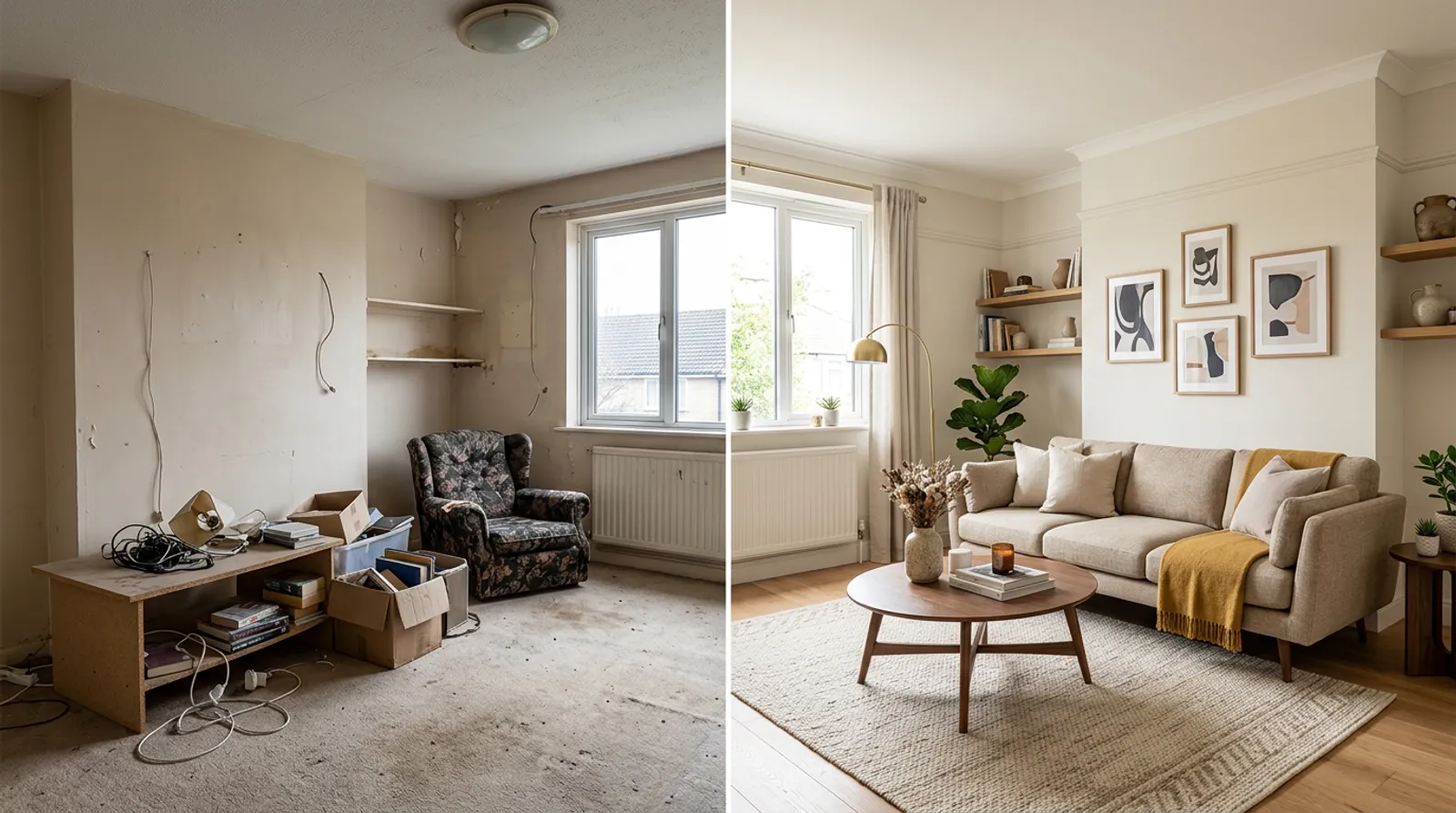 Design idea: a room furnished in the right order
A room is built like a house: you lay the foundations before the walls. Here, the foundations are invisible: the rug, the lighting and the curtains define the mood and the proportions before a single large piece arrives. The main piece then slots into a frame already in place, and the decor only finishes it off. Decor never makes up for a bad layout: it does not rescue anything, it completes.
Following the order also protects your budget. You spend the right amounts at the right moment, and you never buy a large piece blind. Each step sits in a clear price range, and knowing where the money goes saves you from regretting an impulse buy a few weeks later.
Step 1: declutter and reposition
This is the free step and the most rewarding. Empty the room, remove what is useless, broken or in the way. Then reposition the pieces you keep, testing two or three configurations. The impact is huge for zero cost. This is the base to lay before spending a single euro, and the only way to see the room's real potential once it is clear of clutter.
Step 2: lay the rug
The rug frames the space and defines your color palette. It is what sets the proportions: a rug that is too small unbalances the whole room. Choose it before the sofa, because it is your reference for everything else. It is also your color anchor: picking your tones with no concrete support means working in the dark.
Step 3: set the lighting
Plan for 2 to 3 sources: a floor lamp, a table lamp, and a string of lights or a wall sconce. Light creates the mood. A single ceiling light gives a cold, flat atmosphere. Think in layers: high, medium and low light. These three levels are enough to warm up any room.
Step 4: hang the curtains
Always from floor to ceiling: this is what visually enlarges the room. Pick a solid color from the rug's palette, never a pattern that competes. Without curtains, a room looks bare even when full of furniture. This is the last invisible base before the big purchases.
Step 5: choose the main piece
Sofa in the living room, bed in the bedroom, table in the dining room: now it arrives. At this stage you know exactly what size, color and style you need, because the bases are in place. The rule: one good piece beats five mediocre ones. This is where you invest the most.
Step 6: add the secondary furniture
Coffee table, TV unit, shelves, sideboard: these are the complements. Second-hand is strongly recommended. On resale platforms you can find design furniture up to 60% cheaper. Match them to the main piece through material or color, to keep real coherence.
Step 7: finish with textiles and decor
Cushions, throw, frames, plants, candles: this is the final touch. Keep it to 3 cushions maximum, coordinated rather than identically matched. The throw ties the sofa to the rug. Decor always comes last: it does not rescue a bad layout, it crowns it.
To go further, see our guide to home storage ideas and the 60-30-10 rule that helps you balance colors across these steps.
The method applied room by room
The logic does not change, only the pieces do:
- Living room: rug, lamps, curtains, sofa, coffee table, decor.
- Bedroom: rug, bedside lamps, curtains, bed, linens, decor.
- Office: lighting, storage, desk, chair, accessories.
- Entryway: mirror, hooks or storage, lighting, rug, wall decor.
The sequencing mistakes to avoid
- Buying the sofa first, without knowing its palette or proportions.
- Decorating before you have the rug and the lighting, so without a base.
- Buying everything the same day in the same store, which locks the style.
- Choosing colors with no support, when the rug is your reference.
- Adding furniture without decluttering first.
The 3 golden rules to remember
- Declutter before you spend. The free step first.
- Rug, lighting, curtains, sofa. Always in this order.
- Decor never rescues a bad layout.
Test the order on your room
Reading the sequence is a start; seeing it applied to your own room is more convincing. With Shopia, you photograph your room, pick a style, and get a realistic render in a few minutes. You can compare before and after, try several layouts and visualize the result before buying anything.
Frequently asked questions
Where do I start when furnishing a room from scratch?
Start by decluttering and repositioning, the free step that changes everything. Empty the room, remove what is broken or useless, then test two or three layouts with the pieces you keep. Next, lay the invisible bases in this order: the rug, the lighting, then the curtains. Only after that do you choose the main piece, the secondary furniture, and finally the decor. This order stops you buying a sofa that fits neither the size nor the palette of the room.
Why choose the sofa last and not first?
Because the sofa is the most expensive purchase and the hardest to return. If you buy it first, you do not yet know the color palette, the proportions set by the rug, or the mood created by the lighting. By laying the rug, the lighting and the curtains first, you know exactly what size, color and style of main piece you need. It feels counterintuitive, but it is what prevents the most costly mistakes.
What order should I follow for a bedroom or a living room?
The logic stays the same everywhere: bases first, the large piece next, decor at the end. For a living room: rug, lamps, curtains, sofa, coffee table, then decor. For a bedroom: rug, bedside lamps, curtains, bed, linens, then decor. For an office: lighting, storage, desk, chair, accessories. For an entryway: mirror, hooks or storage, lighting, rug, wall decor.
Related articles

How to optimize storage at home
The ratio method for a home that is both tidy and beautiful: 70% closed, 30% open, never more than 60% full.

How to combine colors at home (the 60-30-10 rule)
The 60-30-10 rule explained simply: 60% dominant color, 30% secondary, 10% accent. The decorator's method to harmonize any room without buying everything new.

Living room ideas: design a warm, welcoming space
Everything about living room decoration: palette, furniture, lighting, styles that work and 7 tips for a warm, inviting space.