

Table of contents
How to optimize storage at home
There are two traps when you tidy up. Either everything is hidden and the room looks empty, cold, without personality. Or everything is on display and it is permanent clutter. Good storage is not about hiding everything or showing everything: it is about ratios. Once you understand these proportions, you get a home that is both tidy AND beautiful, without buying a single new piece of furniture.
In this guide, you will discover the right split between closed and open, the triangle rule for your shelves, why you should never fill past 60%, how to choose your baskets and boxes, and the mistakes that ruin all your efforts.
The 70/30 rule: closed versus open
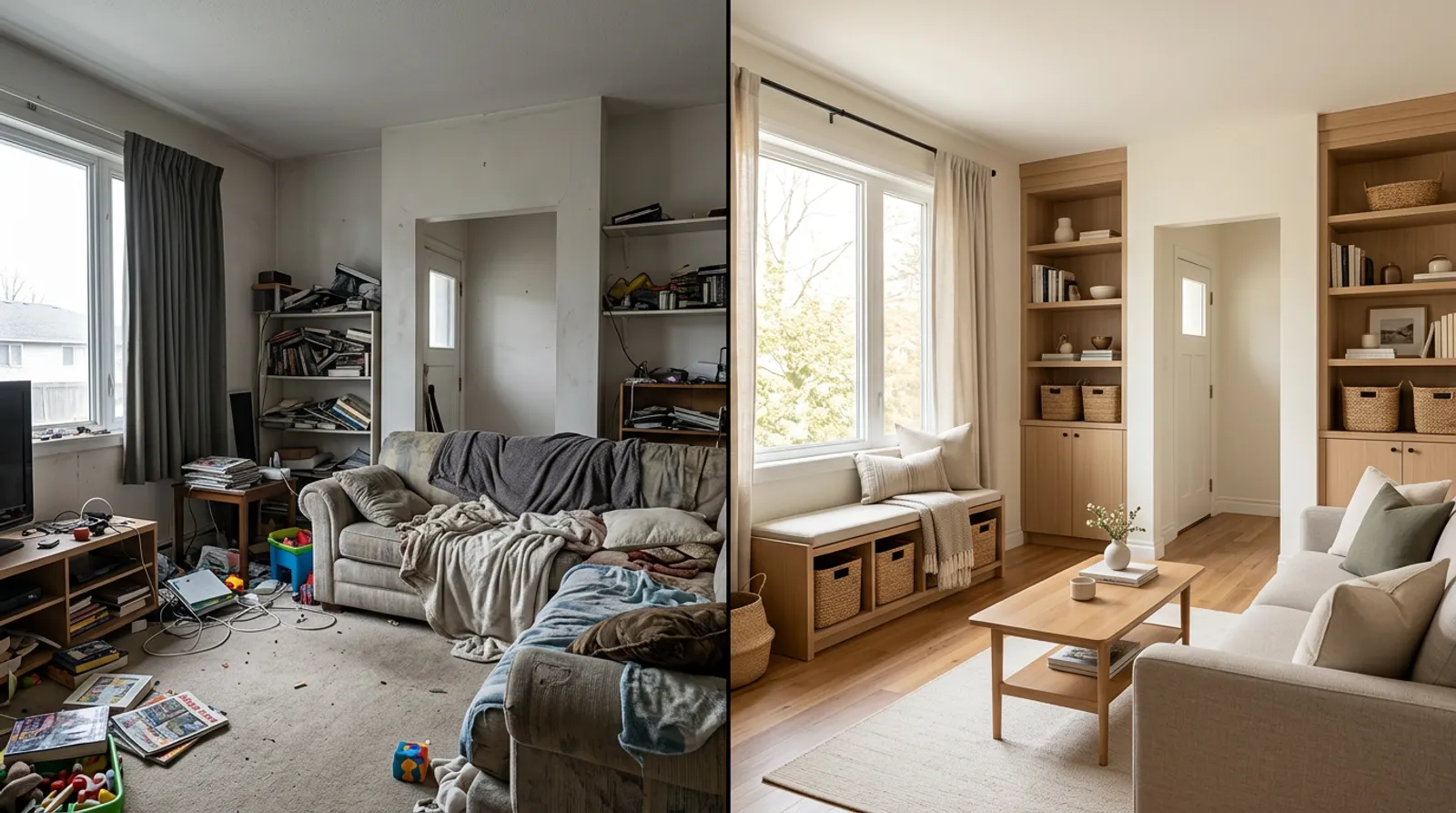 Design idea: a room with clutter solved by smart storage
The starting point of an ordered home is the split between closed and open storage. The proportion that works: 70% closed, 30% open.
- 70% closed: cabinets, drawers, units. This is where everything that is not nice to look at goes, the functional everyday stuff.
- 30% open: shelves, niches. This is the showcase for your nicest objects, the ones you enjoy seeing.
If you hesitate about an object, put it away. Empty space is always more pleasant to the eye than mess. This is the golden rule that decides for you in doubtful cases.
The triangle rule for your shelves
A well-composed shelf is not improvised, but it follows a simple logic: the triangle. On each shelf, place one tall object, one medium object and one short object. This difference in height creates movement and depth.
Work in groups of three objects, never lined up at the same height. Three objects form a natural composition that the eye finds balanced. Above all, leave empty space between the groups: empty space is not wasted space, it is part of the decor and it highlights what you display.
To go further on vertical composition, see our guide on the right shelf height.
Never fill past 60%
This is probably the most counterintuitive rule: a shelf should never be more than 60% full. Beyond that, you get a visual Tetris effect, where every square inch is occupied and nothing stands out anymore.
The 40% of empty space is what separates successful storage from a pile-up. It gives air to each object and makes the whole thing readable. Apply exactly the same rule to kitchen and bathroom countertops: a counter cleared to 60% instantly looks cleaner and bigger.
The quickest test to convince yourself: remove 40% of what sits on your shelves and note the difference. The room breathes at once.
Baskets and boxes: coherence first
Baskets and boxes are your best allies for hiding the functional while staying decorative. But their effectiveness rests on a single rule: coherence.
- Wicker and rattan for the living room and bedroom: natural, warm materials that blend into the decor.
- Linen and fabric for the inside of cabinets: soft, light, perfect for compartmentalizing.
- Same color or same material per zone: this is what creates visual unity.
Five baskets in five different colors, and your storage becomes mess again, even neatly organized. Pick one family of materials per space and stick to it.
Room by room: where to apply these ratios
These proportions work in every room, but each one has its priorities.
- Living room: lean on the 30% open to display your beautiful objects, and hide the technical stuff (boxes, cables, remotes) in the 70% closed. Wicker baskets on the floor for throws.
- Bedroom: favor closed storage for a calming atmosphere, with a few open niches arranged in a triangle. Linens in fabric boxes under the bed.
- Kitchen and bathroom: the 60% rule on countertops changes everything. Clear them, store the everyday in the units, leave out only the essentials.
For the bedroom in particular, our bedroom decorating ideas show how to pair discreet storage with a restful mood.
The mistakes that kill storage
- Filling every square inch of shelf: that is the visual Tetris, heavy and suffocating.
- Storing and closing everything: the room becomes empty and lifeless.
- Lining up every object at the same height: the effect is monotonous, flat.
- Mixing baskets in five different colors: the inconsistency jumps out.
- Not defining any groups: organized clutter is still clutter.
The 3 golden rules to remember
- 70% closed, 30% open. Not the other way around: hide the functional, display the beautiful.
- Groups of 3 objects in a triangle, with empty space between. Never everything at the same height.
- 60% maximum fill. The 40% of empty space makes all the difference.
Test your storage on your room
Reading these ratios is a start; seeing them applied to your own room is far more convincing. With Shopia, you photograph your room, pick the organization you like, and get a realistic render in a few minutes. You can compare before and after, try a cleaner living room or a better structured bedroom, and visualize the result before moving a single piece of furniture.
Frequently asked questions
How do I tidy a room without making it look empty?
The right balance is 70% closed storage and 30% open storage. Anything that is not pretty (papers, cables, products, everyday dishes) goes into cabinets, drawers and units. Your nicest objects stay visible on shelves and in niches. A room where everything is hidden feels cold and lifeless, while a room where everything is on display looks cluttered. Keeping 30% of beautiful objects visible avoids the empty effect.
Should I fill a shelf completely?
No, never go past 60% full. A shelf packed to the edge creates a visual Tetris effect that is heavy and tiring for the eye. The 40% of empty space makes all the difference: it lets each object breathe and highlights what you keep. The same rule applies to kitchen and bathroom countertops. If you test only one thing, remove 40% of what sits on your shelves and watch the result.
How should I arrange objects on a shelf?
Use the triangle rule: on each shelf, place one tall object, one medium and one short. Work in groups of three objects rather than one piece at a time. Avoid lining everything up at the same height, which looks monotonous. Leave empty space between the groups, because empty space is part of the decor. This simple arrangement turns a crowded shelf into a balanced composition.
Related articles

How to design a 5 m² walk-in closet
The exact plan to turn 5 m² into an open walk-in closet: zones, rail heights, shelf depths and a layout that works.

Shelf height and how to style your shelves
The right heights to hang your shelves and a simple method to style them without clutter, with concrete measurements in centimeters.

Bedroom ideas: design a restful, restorative space
Everything about bedroom decoration: palette, furniture, lighting, styles that work and 7 tips to create a sleep sanctuary.