

Table of contents
The perfect living room checklist
Your living room feels off but you cannot say why. Everything is there, the furniture, the sofa, the coffee table, and yet the room looks cluttered, cold or awkwardly arranged. Most of the time the problem is not the objects themselves but their layout. A few simple rules, checked one by one, are enough to fix the essentials.
This checklist puts your living room under the microscope, point by point. You will review where your furniture sits, how you move through the room, the lighting, the number of pieces and the focal point. These are the checks people skip the most, and yet the ones that change everything. By the end, you will know exactly what to fix before you call it done.
Pull furniture away from the walls
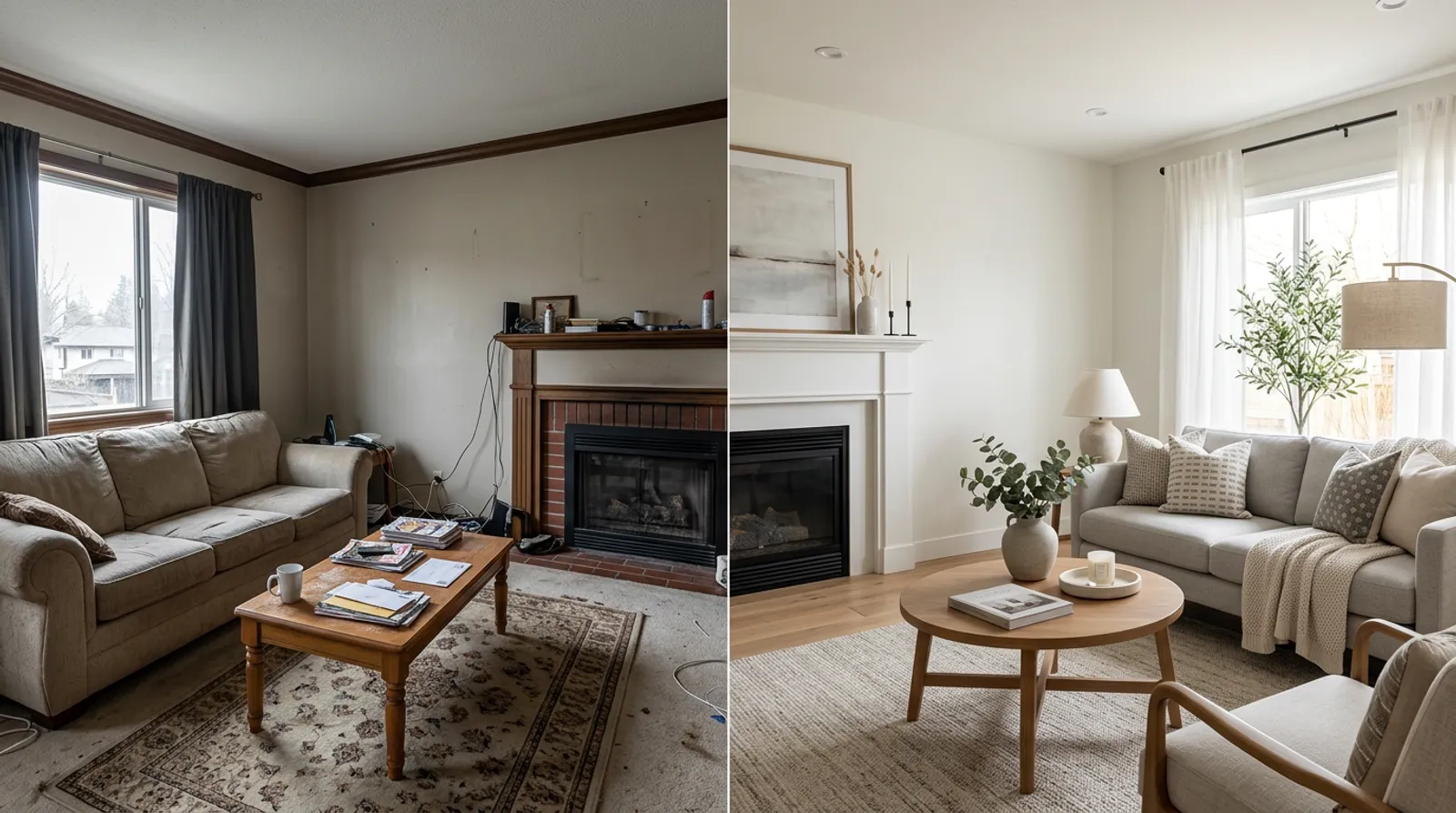 Design idea: a living room finished down to the last detail
The first mistake is pushing every piece of furniture against the walls. People think it saves space, but the result is the opposite: when every piece touches the walls, the room looks smaller and frozen. Pull each piece 15 to 20 cm away from the wall. This small gap visually enlarges the space and lets air move around the seating. It is one of the simplest moves, and one of the most effective, to change the feel of a room without buying anything.
What to check in your living room:
- The sofa is slightly detached from the wall, not flat against it.
- The armchairs are not lined up tight against the partitions.
- Low furniture keeps a small gap behind it.
Check the flow
You should be able to cross a living room without weaving between the furniture. The rule is simple: 80 cm minimum of clearance everywhere, no exception. Below that, the room turns into an obstacle course where you bump and squeeze through.
Test it by walking around the room:
- You go from the sofa to the door without going around a piece of furniture: you are good.
- You have to turn sideways or step over the coffee table: the path is too narrow.
- Every daily route (to the window, to the hallway, to the sofa) stays at least 80 cm wide.
Layer your light sources
A single central light is one of the most common mistakes. One ceiling light alone flattens the room and makes it cold as soon as the sun sets. Aim for at least three light sources, each with its own role:
- Ceiling light: the general light that fills the whole room.
- Floor lamp: the mood light, soft and warm.
- Reading lamp: the focused light, near the sofa or the reading chair.
By layering these three levels, you adjust the atmosphere to the moment: bright during the day, dimmed at night. To go further, see our home lighting guide.
Prefer a few large pieces
Ten small pieces of furniture clutter a room; three large ones let it breathe. Multiplying small pieces (side tables, poufs, low shelves) saturates the eye and gives a sense of disorder, even when everything is tidy. A few well-chosen pieces, on the other hand, set clear landmarks and let the eye rest.
To lighten your living room:
- Replace several small storage units with one coherent large piece.
- Limit the number of side tables and scattered small seats.
- Keep the pieces that structure the space, remove the ones that saturate it.
This proportion logic ties into the 60-30-10 rule, which helps balance the colors and volumes of a single room.
Create a focal point
A living room with no focal point lacks direction: the eye does not know where to land. Create one strong focal point, but only one, to anchor the room. Several options work:
- A colored accent wall that draws the eye.
- A large piece of art placed or hung in full view.
- A wall bookcase that structures an entire wall.
Pick one and let the rest of the decor revolve around it. If everything shouts at once, nothing stands out.
The method to start from scratch
When a living room feels beyond saving, the most effective approach is to redo everything in order. Follow these five golden rules:
- Empty the living room completely. Then put back only the essentials.
- Pull the furniture away from the walls. 15 to 20 cm everywhere.
- Keep 80 cm of clearance. Everywhere, no exception.
- Add at least two light sources. On top of the ceiling light.
- Create a focal point. Just one, but a strong one.
Starting from an empty space, you immediately see what is truly useful and what was only cluttering the room.
The final checklist before you call it done
Before you consider your living room finished, run through each point again:
- Furniture pulled 15 to 20 cm away from the walls.
- 80 cm of clear passage everywhere.
- At least three light sources, at different levels.
- Few pieces, but pieces that matter.
- One single, deliberate focal point.
If every box is ticked, your living room is ready. If one is missing, you now know where to start. For more inspiration, browse our living room ideas.
Test your living room with Shopia
Reading a checklist is a start; seeing the result on your own living room is more convincing. With Shopia, you photograph your room, choose what you want to change, and get a realistic render in a few minutes. You can compare before and after, move the furniture around, try a new layout and several focal points before touching anything in the real room.
Frequently asked questions
How do I know if my living room is well arranged?
Check four key points. Your furniture sits 15 to 20 cm away from the walls, you have at least 80 cm of clearance everywhere, you have at least three light sources and there is one strong focal point in the room. If one of these is missing, it is often the reason the room feels off. Fix them in order and the whole space regains its balance right away.
Do I really need to pull furniture away from the walls?
Yes, this is one of the most common mistakes. When every piece touches the walls, the room looks smaller and frozen. By pulling furniture 15 to 20 cm away, you visually enlarge the space and let air move around the seating. The sofa does not need to be in the middle of the room, just slightly detached from the wall so it can breathe.
How many light sources does a living room need?
Aim for at least three light sources instead of a single ceiling light. The ceiling light gives the general lighting, a floor lamp creates the mood and a reading lamp adds a focused light near the sofa. A single central light flattens the room and makes it cold at night. By layering several points of light, you get a warm living room you can adjust to the time of day.
Related articles

Living room ideas: design a warm, welcoming space
Everything about living room decoration: palette, furniture, lighting, styles that work and 7 tips for a warm, inviting space.

How to combine colors at home (the 60-30-10 rule)
The 60-30-10 rule explained simply: 60% dominant color, 30% secondary, 10% accent. The decorator's method to harmonize any room without buying everything new.

How to light your home the right way
The complete lighting guide: the 3-source rule per room, exact heights and distances, color temperature in Kelvin, and the lamps worth investing in first.