

Table of contents
- Mistake 1: buying the biggest sofa possible
- Mistake 2: wanting everything to match
- Mistake 3: painting everything white to look bigger
- Mistake 4: thinking decor is expensive
- Mistake 5: chasing trends
- The three decor truths to remember
- The mistakes that kill a room
- The three golden rules to stop getting it wrong
- Test your fixes on your room
Common decorating mistakes to avoid
We often follow decorating rules that do not really exist. You need a big sofa, everything has to match, white makes a room bigger, decor is expensive, you have to chase trends: these received ideas lead to bad purchases and rooms that feel off. The good news is that behind every myth there is a real number and a simple fix. Once you spot these mistakes, you can transform a room without buying everything new.
In this guide you will see the five most common mistakes, the fix for each with the right benchmarks, and the three decor truths that never change. By the end, you will know what to measure before buying and how to avoid the traps that cost money.
Mistake 1: buying the biggest sofa possible
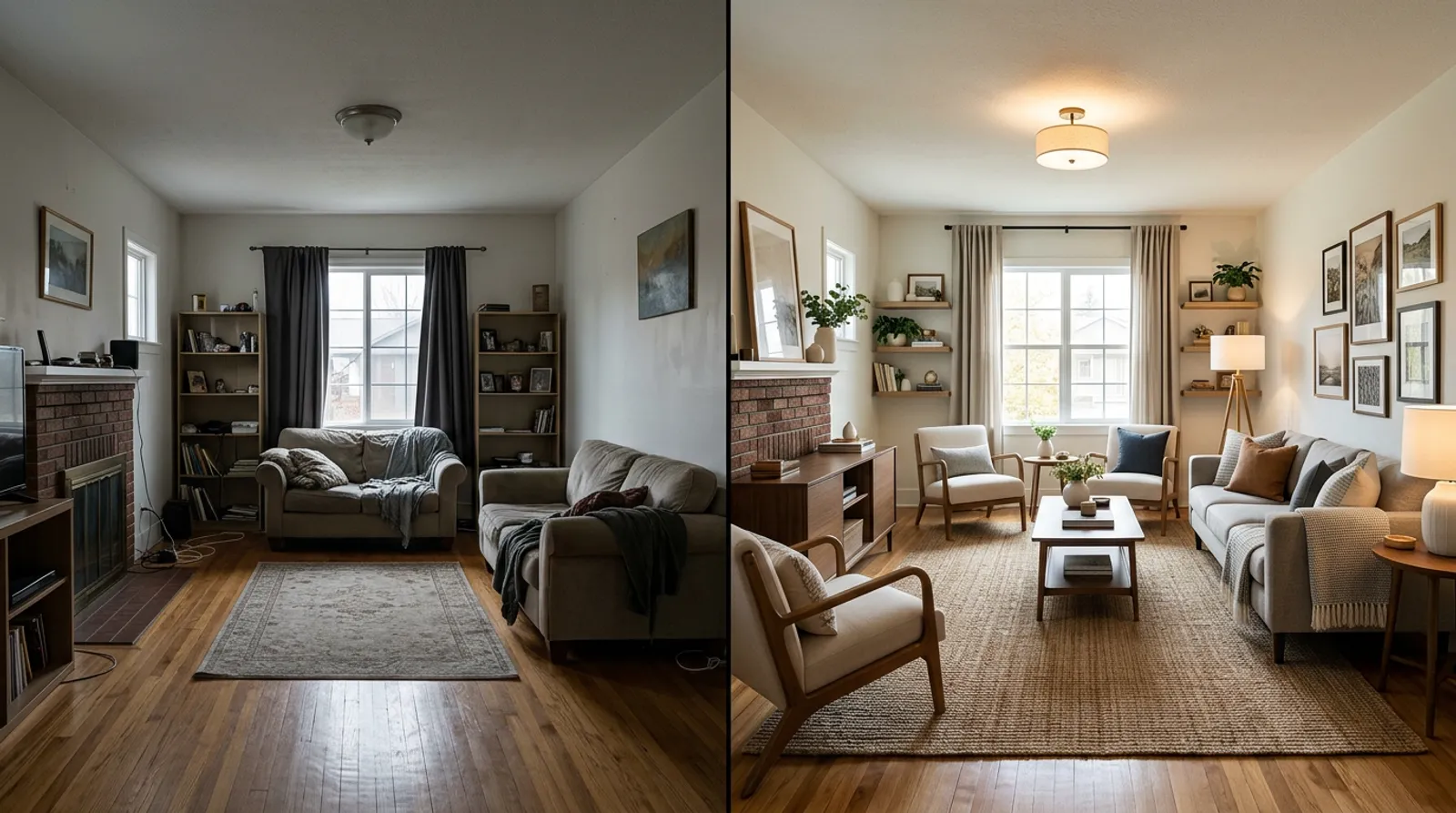 Design idea: a room with common decorating mistakes corrected
This is the number one reflex, and it is wrong. A sofa that is too big crushes the room instead of filling it. The benchmark is simple: a sofa should take up at most two thirds of the wall width. For a 3 meter wall, that means 2 meters of sofa maximum.
The fix: measure your wall, multiply by 0.66, and you get the maximum width. In a living room under 25 square meters, a two-seater (160 to 180 cm) plus an armchair often looks better than a large corner sofa. It also costs less: a two-seater with an armchair runs around 500 to 900 euros, versus 800 to 1500 euros for a corner unit. Cheaper, and better proportioned.
Mistake 2: wanting everything to match
Everything identical is not a home, it is a catalog. Buying everything from the same brand gives an impersonal, slightly cold result. The rule that works: one single through line (a color or a material) plus contrast.
The fix: add one element from a different era or material per room. A vintage wood table with modern white chairs, for example, immediately creates something interesting. It is the mix that gives personality, not uniformity. To go further on dosing your colors, see the 60-30-10 rule.
Mistake 3: painting everything white to look bigger
White everywhere does not make a room bigger. Contrast is what creates depth. The proof: one dark wall with three light walls makes a room feel deeper, while four white walls flatten the space.
The fix: paint the back wall in a darker shade, two tones below the rest. Colors that work well are sage green, blue grey and soft terracotta. You keep the light on the other three walls and gain depth without shrinking the room.
Mistake 4: thinking decor is expensive
The decor that transforms a room is not the most expensive. Proportions are free, and the number one impact is furniture placement. Before reaching for your card, there is already a lot you can do at zero budget.
The fix: rearrange your furniture today. Zero euros, one hour, guaranteed effect. When you want to add purchases, a realistic budget is enough: a rug at 80 euros, two lamps at 60 euros and a throw at 25 euros come to about 165 euros, and that is enough to change a living room. Spending more to make up for bad proportions always costs more in the end.
Mistake 5: chasing trends
Trends change every year. Proportions never do. Following a trend without checking dimensions is the surest way to replace a piece of furniture in two years.
The fix: invest in timeless basics (solid wood, linen, brass, simple shapes) and save on the accents. What lasts is the materials and the right dimensions. A trendy color in a cushion can be swapped for a few euros, a badly sized sofa cannot.
The three decor truths to remember
Once the myths are out of the way, it all comes down to three simple principles:
- Proportions before style: a well-sized piece is always nicer than a beautiful piece that is badly sized.
- Contrast before uniformity: the mix creates personality, the total look creates boredom.
- Placement before budget: rearranging costs zero euros and changes everything, buying without measuring costs money.
Before any purchase, ask yourself in this order: is it the right size, before is it beautiful.
The mistakes that kill a room
Avoid these first, because they come up all the time:
- Buying the biggest sofa possible (the number one reflex).
- Buying everything from the same brand (the catalog effect).
- Painting everything white thinking it enlarges.
- Spending more to make up for bad proportions.
- Following a trend without checking dimensions.
The three golden rules to stop getting it wrong
- Measure first: sofa equals two thirds of the wall, coffee table equals two thirds of the sofa.
- Mix styles: one through line plus contrast, never the total look.
- 165 euros well placed transform a living room (rug, lamps, throw) without buying everything new.
To structure your room from start to finish, also see our essential decorating rules.
Test your fixes on your room
Spotting a mistake on paper is a start; seeing it fixed on your own room is more convincing. With Shopia, you photograph your room, choose a direction, and get a realistic render in a few minutes. You can compare before and after, test a better-sized sofa, a darker back wall or a mix of styles, before moving any furniture or buying anything.
Frequently asked questions
What is the most common decorating mistake?
The most common one is buying the biggest sofa possible, thinking bigger is better. A sofa that is too wide crushes the room and throws everything else off balance. The right measure: a sofa should take up at most two thirds of the wall width. In a living room under 25 square meters, a two-seater (160 to 180 cm) paired with an armchair often looks better than a large corner sofa, and it costs less too.
Does painting everything white really make a room look bigger?
No, that is a stubborn myth. It is not white that makes a room feel bigger, it is contrast that creates depth. A back wall painted in a darker shade (two tones down) makes the room feel like it stretches backward. Colors that work well for that accent wall include sage green, blue grey and soft terracotta.
Do you need to spend a lot to transform a living room?
Not at all. The number one impact in decorating is furniture placement, and rearranging costs nothing. Starting from proportions is free and already changes everything in about an hour. On the buying side, a realistic budget is enough: a rug at 80 euros, two lamps at 60 euros and a throw at 25 euros, around 165 euros, transform a room. Spending more to make up for bad proportions always ends up costing more.
Related articles

The essential decorating rules to know
The proportion rules that make a room work: sofa, table, bed, lighting and colors, with the exact numbers.

How to spot what's wrong with your decor
Your room bothers you and you can't say why? Here is the checklist to find the real problem and the targeted fix.

How to combine colors at home (the 60-30-10 rule)
The 60-30-10 rule explained simply: 60% dominant color, 30% secondary, 10% accent. The decorator's method to harmonize any room without buying everything new.