

Table of contents
- Symptom 1: you bump into furniture
- Symptom 2: the room looks empty despite the furniture
- Symptom 3: the room feels cramped or too small
- Symptom 4: your space feels cold
- Symptom 5: the room feels flat and lifeless
- The self-diagnosis checklist
- The mistakes that make it worse
- The 3 golden rules to remember
- Test your diagnosis on your room
How to spot what's wrong with your decor
You walk into your room and something bothers you, but you cannot put a word on it. The natural reaction is to assume it is a matter of taste, then buy a new object to fill that unease. Most of the time the problem has nothing to do with taste: it is measurable, and it has a precise fix. This guide gives you a self-diagnosis checklist to identify the real symptom before you touch anything.
The basic rule: one symptom, one solution. Do not change everything at once, or you will never know what worked. Always start with the fastest test, then apply the targeted fix.
Symptom 1: you bump into furniture
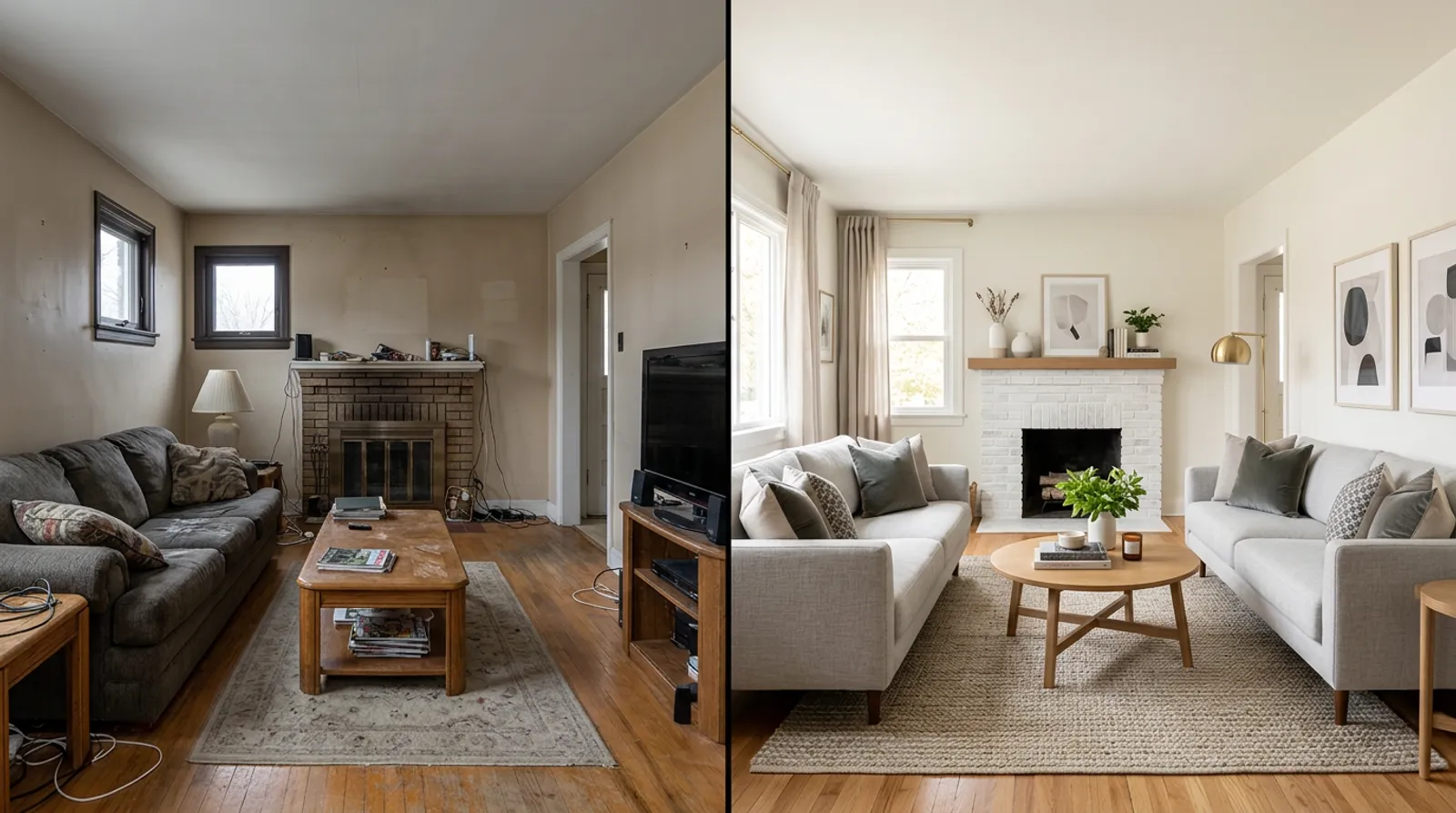 Design idea: a room whose decor problems are fixed
If you bump into things as you move around, the problem is almost always a walkway that is too narrow. The cause: furniture that is too big or badly placed, leaving less than 80 cm to pass.
The test is simple: take a tape measure and check every walkway in the room. Note every one that is under 80 cm. To fix it, pull the piece back, turn it, or replace it with a smaller model. If nothing is possible, remove the piece: a clear path matters more than the decor.
Symptom 2: the room looks empty despite the furniture
A room that feels empty even though it is furnished usually suffers from furniture that is too small for the space. The cause: a piece that covers less than half of the wall behind it.
Compare the width of your sofa to the wall: if it covers less than 50%, it is too small. The lasting solution is to replace it with a model that covers about two thirds of the wall. The fastest and cheapest fix is a rug: a large 200x300 rug instantly anchors the furniture. A rug on its own solves a large share of rooms where the furniture seems to float, so try it before anything else.
Symptom 3: the room feels cramped or too small
On the other side, a room that feels cramped usually has furniture that is too big (more than three quarters of the wall) or simply too many pieces.
Count the furniture: more than five pieces in under 20 m2 is too many. Remove one or two to aim for 30 to 40% of empty space in the room. Empty space is not a flaw, it is what lets the whole room breathe. To prioritize, keep the sofa, the rug and one storage piece, then remove the rest.
Symptom 4: your space feels cold
A cold feeling almost always comes from a lack of textile, a single light on the ceiling and an absence of wood. The flat light of the ceiling fixture makes it worse.
Count the visible textiles: fewer than three, and you have the cause. The fix is three additions: a throw, two cushions and a table lamp to break the single ceiling light. On a modest budget, this trio is enough to turn a cold living room into a cozy space. It is one of the most rewarding fixes, as we explain in our living room ideas.
Symptom 5: the room feels flat and lifeless
A flat room lacks a focal point, suffers from uniform light and keeps the same height everywhere. Nothing catches the eye when you walk in.
The test: as you enter, where does your eye land? If the answer is nowhere, there is no focal point. Create just one: a large piece of art, an arc floor lamp or a tall plant. Then add height, because curtains hung from floor to ceiling make the room look bigger.
The self-diagnosis checklist
Go through your room point by point, in this order:
- Measure the walkways with a tape measure. Anything under 80 cm needs immediate action.
- Compare the sofa to the wall. Under 50% and the room looks empty; over 75% and it feels cramped.
- Count the furniture. More than five pieces in under 20 m2, remove some.
- Count the visible textiles. Fewer than three, the space will feel cold.
- Look for the focal point. If your eye lands nowhere, create one.
The universal quick fix, when you are unsure: a rug, a table lamp and textile solve a large share of rooms for a budget of around 100.
The mistakes that make it worse
- Adding more decor to fill a proportion problem: it piles up without fixing anything.
- Changing everything at once: you can no longer tell what worked.
- Buying before identifying the real problem.
- Confusing "I don't like it" with "it is badly proportioned": these are two different diagnoses.
- Never measuring: this is the trap that leads to all the other mistakes.
The 3 golden rules to remember
- One symptom equals one solution. Do not change everything at once.
- Start with the fastest test: measure the walkways.
- Universal quick fix: a rug, a lamp and textile are often enough to transform a room. To go further, see our essential decorating rules.
Test your diagnosis on your room
Measuring is good; seeing the result before you move a single piece is more convincing. With Shopia, you photograph your room, choose the changes to test, and get a realistic render in a few minutes. You can compare before and after, move or remove a piece, add textile or a focal point, and check that the diagnosis holds before spending anything.
Frequently asked questions
Why does my room bother me when I can't say why?
In most cases it is not a matter of taste but of proportions. A room where you bump into furniture, that looks empty or feels cramped almost always has a measurable problem: walkways too narrow, furniture too small or too many pieces. The instinct is to add more decor to compensate, which makes the imbalance worse. Start by measuring before you judge your space, and you will often find the real cause in a few minutes.
What is the fastest way to diagnose a room that feels off?
Measure your walkways with a tape measure and note any that are under 80 cm. This is the quickest and most revealing test: a walkway that is too narrow explains that crowded feeling before you even look at colors. Next, compare the width of your sofa to the wall behind it. These two measurements alone catch most proportion problems.
How can I warm up a cold-looking room without buying everything new?
Count the visible textiles in the room: if there are fewer than three, you have found the cause. A single ceiling light and the absence of wood make that cold feeling worse. Add a throw, two cushions and a table lamp to break the single ceiling light. This simple trio is enough to turn a cold living room into a welcoming space.
Related articles

Common decorating mistakes to avoid
The most common decorating mistakes and the decor myths to forget, with the right fix for each and the real numbers behind them.

The essential decorating rules to know
The proportion rules that make a room work: sofa, table, bed, lighting and colors, with the exact numbers.

Living room ideas: design a warm, welcoming space
Everything about living room decoration: palette, furniture, lighting, styles that work and 7 tips for a warm, inviting space.