

Table of contents
How to set up your home after moving in
You have just moved in and you are staring at empty rooms with no idea where to start. The temptation is strong to buy everything on box day, or to drop cushions and frames before you even own a sofa. That is exactly what leads to store returns and furniture that will not fit through the door. The good news: there is a simple four-week plan that avoids most mistakes and gives you time to understand your home.
In this guide you will see what to do each week, in what order, and what budget to plan. The core rule fits in one line: measure before you buy, and lay the foundations before the decor.
Week 1: measure and plan
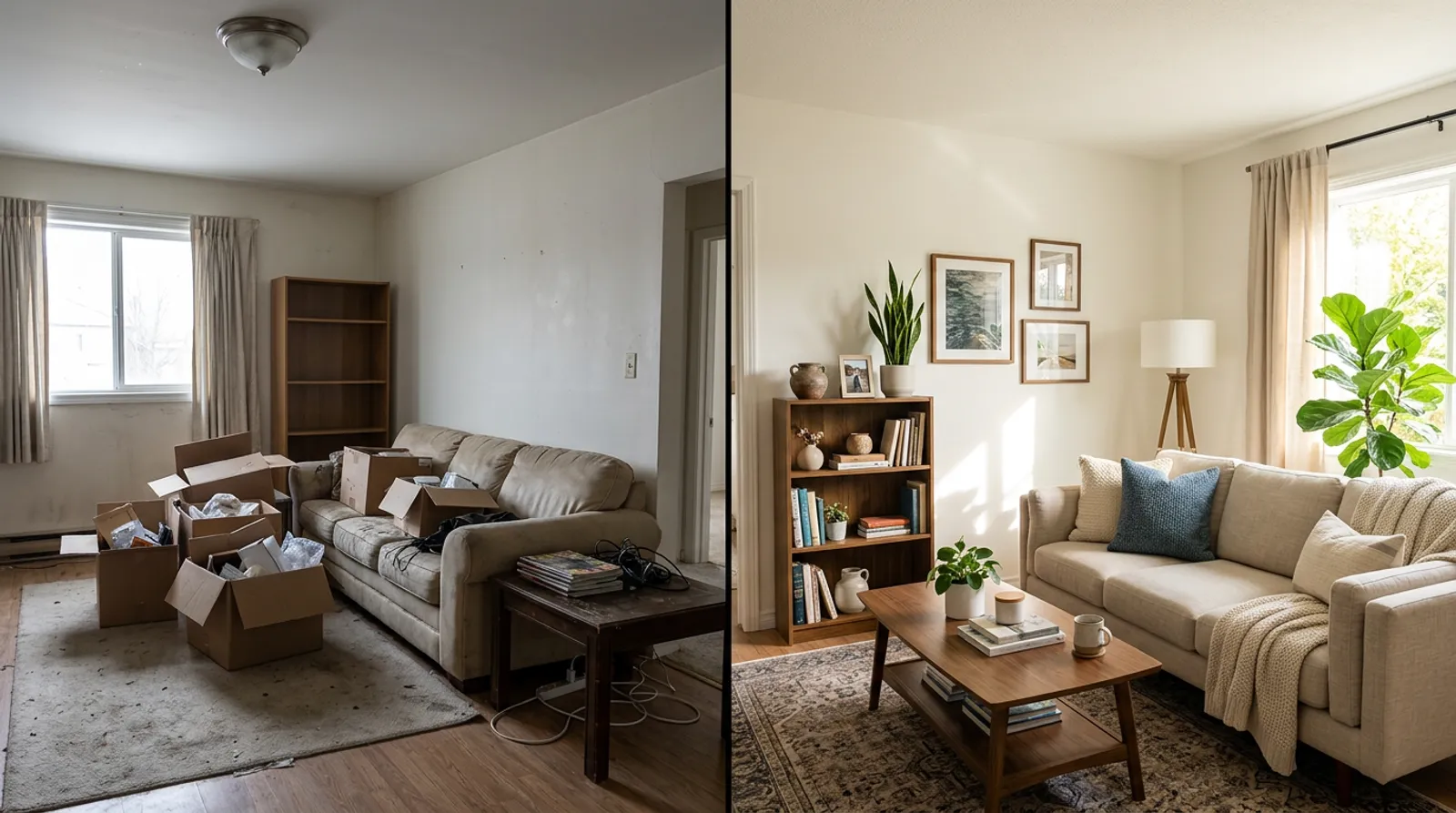 Design idea: a room settled in after a move
The first week is the most important, and it costs nothing. Take a tape measure and record every room: the walls, doors, windows, outlets and radiators. Then draw a floor plan (for example 1 cm on paper for every 20 cm in real life) or use a free floor-plan app.
Decide the place of every piece on the plan, before a single purchase. Also note the width of the entrance door and the staircase: a piece of furniture has to fit through. This step alone prevents the large majority of buying mistakes. If you can, live in the home for a week before ordering: you will understand the flow, the light and the gaps far better than on paper.
Week 2: the key furniture
In the second week, you install the essential furniture, the pieces that structure each room. This is where about half of the budget goes.
- Living room: the sofa takes up roughly two thirds of the wall, with a properly sized rug underneath.
- Bedroom: the bed, the mattress and the headboard, leaving room to move around.
- Dining area: the table, counting about 60 cm per person and keeping enough space to walk around it.
The golden rule of this week: check the dimensions before you order, never after. Buying without measuring is what generates the most returns.
Week 3: lighting and textiles
Once the large furniture is in place, the room comes to life with lighting and textiles. Aim for three levels of light in each room: a high light (ceiling), a medium light (floor lamp, wall light) and a low light (table lamp). This layering warms up the mood far better than a single ceiling fixture.
For curtains, mount the rod 15 to 20 cm above the window and let the fabric drop from top to floor: the room looks taller. In the living room, add a throw and a few cushions (an odd number, mixing materials). In the bedroom, complete the bed with bedding, a throw and cushions. To store things without breaking the harmony, our home storage ideas will help you keep surfaces clear.
Week 4: decor and adjustments
The last week is for the finishing touches, once everything else is in place. Pick an accent wall, often the first wall you see when entering, and create one focal point per room: a large piece of art or a large mirror. Add two or three plants of different heights to bring life.
Above all, adjust. Test, move things, step back. Decor is fine-tuned over the days, once you are really living in the space. Nothing is fixed: this is in fact when your home becomes truly yours.
The order to respect: foundations first, decor last
If there is one thing to remember, it is the order. You move from foundations to finishing touches: rug, then lighting, then furniture, then textiles, and finally decor. Starting with cushions and frames in a still-empty room means you will have to start over. To apply this logic room by room, see our guide on the room furnishing order.
A realistic budget to get started
There is no need to equip everything at once. Here are simple benchmarks:
- Studio or one-bedroom: roughly 1500 to 3000 euros for the living room, bedroom and essentials.
- Two or three-bedroom: roughly 3000 to 5000 euros to bring every room to 80 percent.
The trick that changes everything: about 60 percent new for the key pieces (sofa, bed) and 40 percent second-hand for the rest. That way you furnish the whole home without breaking the bank, and you keep room for the decor.
The 3 golden rules to remember
- Measure before you buy. A tape measure prevents the large majority of expensive mistakes. The floor plan before any purchase is non-negotiable.
- Half of the budget on the sofa and the bed. The rest is easy to find second-hand.
- Not everything at once. Spread it over four weeks, enough time to live in the space and adjust.
The mistakes that ruin everything
- Buying all the furniture on moving day.
- Buying without measuring: it is the number one cause of returns.
- Taking everything from the same store on the same day, with no perspective.
- Starting with decor (cushions, frames) before the furniture.
- Forgetting the walkways: keep at least 80 cm everywhere to move around.
Test your future home on a photo
Picturing an empty room once it is furnished is not easy. With Shopia, you photograph the room as it is, you choose a style and a mood, and you get a realistic render in a few minutes. You can compare before and after, try several layouts and several palettes, and see the sofa or the bed in context before buying anything. A simple way to validate your setup plan with no risk.
Frequently asked questions
Where do I start when setting up a new apartment after moving?
Start by measuring, not by buying. During the first week, record the walls, doors, windows, outlets and radiators of each room, then draw a floor plan and place every piece of furniture on it before ordering anything. This step costs nothing and prevents the large majority of expensive buying mistakes. Living in the home for a week before buying also helps you understand the space.
In what order should I furnish and decorate an empty room?
Follow the order from foundations to finishing touches: first the rug and the lighting, then the key furniture, then the textiles, and finally the decor. In practice, the essential pieces like the sofa and the bed come before cushions, frames and plants. Decorating a room that has no furniture yet is the classic mistake that makes you start over. Keep the small touches for the end, once the structure is in place.
What budget should I plan to set up a home after moving?
For a studio or one-bedroom, count roughly 1500 to 3000 euros for the living room, bedroom and essentials. For a two or three-bedroom, plan closer to 3000 to 5000 euros to bring every room to 80 percent. Half of the budget goes into two pieces: the sofa and the bed. For the rest, second-hand lets you furnish well without breaking the bank.
Related articles

What order to furnish a room in
The exact order to furnish a room from scratch: bases first, sofa last, decor at the very end. The method that stops you buying everything twice.

How to optimize storage at home
The ratio method for a home that is both tidy and beautiful: 70% closed, 30% open, never more than 60% full.

How to combine colors at home (the 60-30-10 rule)
The 60-30-10 rule explained simply: 60% dominant color, 30% secondary, 10% accent. The decorator's method to harmonize any room without buying everything new.