

Table of contents
What size rug for each room
The most common decorating mistake is choosing a rug that is too small. Chairs that slide off the rug, a sofa that floats with no anchor, a room that feels unbalanced without anyone knowing why: it all comes from a badly sized rug. The good news is that rug size comes down to a few simple measurements. In this guide you will find the exact dimensions for each room, where your furniture legs should sit, and the sizing mistakes you absolutely want to avoid.
The basic rule: let the rug extend out
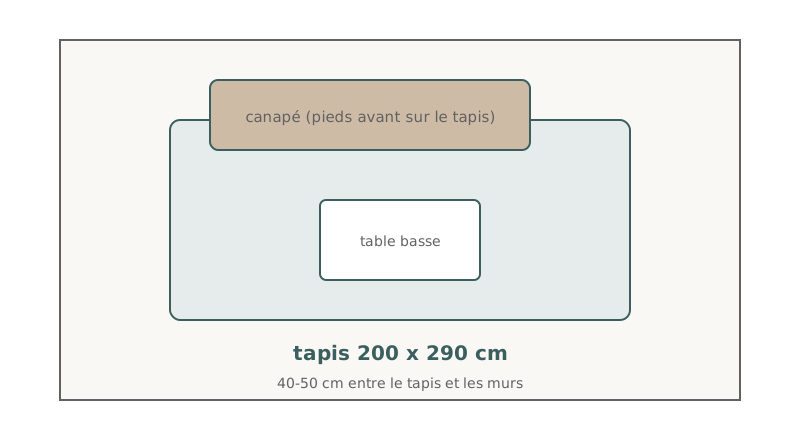 Diagram: the rule at a glance
Whatever the room, a good rug extends out around the furniture rather than hiding underneath it. In a dining room, the golden rule is to extend 60 to 80 cm beyond each side of the table, so chairs stay on the rug even when you pull them out to sit. In a bedroom, the rug extends 60 to 80 cm beyond each side of the bed. And in almost every room, leave 40 to 50 cm of visible floor between the edge of the rug and the walls: a rug that touches the walls creates an 80s wall-to-wall carpet effect and visually shrinks the space.
Rug size for the living room
In the living room, the size depends on the floor area and on how the furniture sits on the rug. Three setups are possible:
- Front legs only (small room under 15 m2): a 160 x 230 cm rug. Only the front legs of the sofa and armchairs sit on the rug, but the coffee table should be fully on it.
- Whole sofa (medium room of 15 to 25 m2): a 200 x 300 cm rug. This is the recommended setup: the entire sofa, the coffee table and the front legs of the armchairs rest on the rug. It anchors the seating area best.
- All the furniture (large room over 25 m2): a 250 x 350 cm rug or more. Sofa, armchairs and coffee table sit fully on it, with 40 to 50 cm left between the edge of the rug and the walls.
Keep the distance between the sofa and the coffee table in mind too: aim for 40 to 50 cm, and the rug should cover that gap, otherwise the two pieces look disconnected.
Rug size for the dining room
Here everything revolves around the table. The rug needs to extend out so chairs never slide into empty floor. For a rectangular table:
- 4 seats (120 x 80 cm): at least 200 x 160 cm.
- 6 seats (160 x 90 cm): at least 240 x 170 cm.
- 6 to 8 seats (180 x 90 cm): at least 260 x 170 cm.
- 8 seats (200 x 100 cm): at least 280 x 200 cm.
- 8 to 10 seats (240 x 100 cm): at least 320 x 200 cm.
For a round table, pick a round rug: 200 cm diameter for 2 to 4 seats (90 to 100 cm table), 240 cm for 4 to 6 seats (120 cm table), 270 cm for 6 to 8 seats (140 to 150 cm table).
Rug size for the bedroom
In the bedroom, the rug dresses the floor around the bed and creates a cozy effect. Three options depending on your budget and space:
- Large rug under the bed (recommended): it extends 60 to 80 cm beyond each side. For a queen bed (160 cm), plan for at least 200 x 300 cm. For a king bed (180 cm), plan for at least 240 x 300 cm. Tip: place the rug under the lower two thirds of the bed, the headboard can sit slightly off the rug.
- Rug under the lower two thirds: a 160 x 230 cm rug for a medium bedroom. It starts mid-bed, extends 50 to 60 cm at the foot and 40 to 50 cm on each side.
- Bedside runners (small budget): two small 60 x 120 cm rugs on each side of the bed. Less harmonious, best kept for small bedrooms with no room for a large rug.
In practice, for a double bed (140 cm), the full option needs 200 x 280 cm and the two-thirds option 160 x 230 cm. For a single bed (90 cm), plan for 140 x 240 cm in the full option.
Rug size for the entryway, office and kitchen
Smaller rooms have their formats too:
- Entryway: a welcome rug of 80 x 150 cm or 90 x 160 cm, covering the main walkway, with 20 to 30 cm left on each side from the walls.
- Office: a rug under the desk and chair of at least 120 x 180 cm. It should extend 50 to 60 cm in front of the desk so a rolling chair stays on it when you push back.
- Kitchen (optional): a 50 x 80 cm rug in front of the sink, 50 x 120 cm in front of the stove, in washable materials like cotton or vinyl.
The quick test to check your rug
No complicated tape measure needed. Pull a chair out from your table as if you were going to sit: if the chair comes off the rug, it is too small. If it stays fully on it, you are good. Same logic in the living room: if the front legs of the sofa do not touch the rug, it is too small. Before buying, measure your table, sofa or bed, add 60 to 80 cm on each side, and tape the outline on the floor to picture the result. To go further on sizing, see our guide to furniture size by room.
The sizing mistakes to avoid
- A rug that is too small, sitting like a stamp in the middle of the room, floating with nothing anchored.
- A rug that touches all the walls, creating the wall-to-wall carpet effect and shrinking the room.
- Several small rugs disconnected in the same room: always prefer one large rug, which anchors the space better.
- A rug under only two legs of the sofa, which makes the whole setup look wobbly.
- A coffee table that spills off the rug, which breaks the anchor of the seating area.
The rule to remember: when in doubt, always go one size up. A slightly oversized rug can be saved with furniture placement, a too-small one never forgives. Choose your rug in step with your other textiles too: see how to choose your curtains for a coherent room.
Test the right rug size on your room
Reading dimensions is useful; seeing them placed in your own room is more convincing. With Shopia, you photograph your room, pick a rug, and get a realistic render in a few minutes. You can compare before and after, try several formats and check that the sofa, table or bed sit properly on it before buying anything.
Frequently asked questions
What size rug for a living room?
It depends on the floor area of your living room. For a small room under 15 m2, go for a 160 x 230 cm rug with the front legs of the sofa on it. For a medium room of 15 to 25 m2, the 200 x 300 cm format works in most cases and lets the whole sofa sit on the rug. For a large room over 25 m2, choose 250 x 350 cm or more, with all the furniture fully on the rug. If the rug touches no furniture at all, it is too small.
Does the rug need to go under the whole sofa?
Not necessarily, you have three options depending on the size of the room. The minimal setup puts only the front legs of the sofa on the rug (160 x 230 cm for a small living room). The recommended setup puts the whole sofa on the rug (200 x 300 cm for a medium room), which anchors the seating area best. In a large room you can place all the furniture on it with a 250 x 350 cm rug. Whatever you pick, the rug should not touch the walls: leave 40 to 50 cm of visible floor.
What size rug under a dining table?
The rug should extend at least 60 cm beyond each side of the table so chairs stay on it even when pulled out, ideally 80 to 90 cm. For a 4-seat table (120 x 80 cm), plan for at least 200 x 160 cm. For 6 seats (160 x 90 cm), go for 240 x 170 cm. For 8 seats (200 x 100 cm), you need 280 x 200 cm. When in doubt between two sizes, always take the larger one.
Related articles

How to choose and hang curtains
Rod height, floor-length drops, the right width for a full drape and quality fabric: the simple method for curtains that look professional.

What size furniture for each room
The right dimensions for every piece (sofa, bed, table, rug) with precise measurements in cm, room by room, so you never buy too big or too small again.

Living room ideas: design a warm, welcoming space
Everything about living room decoration: palette, furniture, lighting, styles that work and 7 tips for a warm, inviting space.