

Table of contents
How high to hang a picture or frame
The mistake almost everyone makes when decorating is hanging pictures too high. A picture placed near the ceiling creates a cold museum effect: the furniture feels disconnected from the walls and the room loses its warmth. It is the most common mistake, and it is also the easiest to fix. There is a single base rule, used by every decorator, and it comes down to one number: 145-150 cm.
In this guide you will see how high to place the center of a frame, what gap to keep above a sofa or a bed, how to build a gallery of several frames, and how to test the result before you drill.
The base rule: center at 145-150 cm
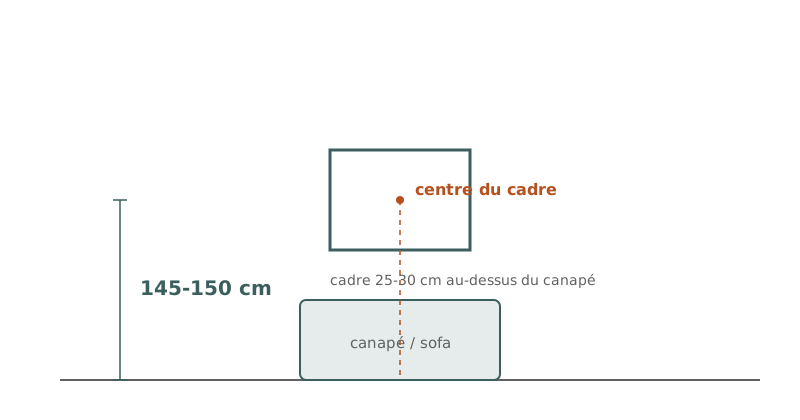 Diagram: the rule at a glance
Remember this one reference: the center of your picture should sit 145-150 cm from the floor. That is the average eye level of a person of average height (around 170 cm), and it is exactly the height used in museums and art galleries. Your gaze should land naturally on the center of the frame, not on the top or the bottom.
The trap to avoid: never measure the height of the nail, always aim for the center of the frame. To work it out, measure the total height of the picture, divide by two, then add that result to the hook height. Example: a picture 60 cm tall has its center 30 cm from the top edge. To place that center at 145 cm, the hook goes at 145 minus 30, which is 115 cm from the floor.
Above the sofa
Above a sofa, two measurements matter. First the height of the center, which stays at 145-150 cm like everywhere else. Adjust slightly depending on the sofa:
- Low sofa (around 70 cm): center at 140-145 cm.
- Standard sofa (around 80 cm): center at 145-150 cm.
- Tall sofa (around 90 cm): center at 150-155 cm.
Then the gap between the furniture and the frame: leave 15 to 25 cm between the top of the sofa and the bottom of the picture. Never less than 10 cm (too stuck), never more than 30 cm (disconnected frame).
For width, the picture should be about two thirds of the sofa width. For a 180 cm sofa, aim for a picture around 120 cm wide. With several frames, it is the total width of the group that should reach those two thirds, and you line up all the centers at the same height.
Above the bed
Above a bed, you apply the same principle as on a bare wall: the center of the picture stays at 145-150 cm from the floor, ignoring the height of the bed. The gap, on the other hand, is measured from the headboard:
- No headboard: center at 145-150 cm.
- Low headboard (80-100 cm): 20 to 30 cm between the top of the headboard and the bottom of the picture.
- Tall headboard (100-120 cm): 25 to 35 cm.
- Very tall headboard (over 120 cm): 30 to 40 cm, and the center can rise to 150-160 cm.
Never push the frame right up against the headboard, the effect becomes suffocating. For a triptych or several frames, line up all the centers at 145-150 cm, allow 5 to 10 cm between frames, and keep a total width equal to two thirds of the bed.
On a bare wall or in a hallway
This is the simplest case: a single picture on a bare wall is centered at 145-150 cm from the floor. You should be able to look at it comfortably without lifting your head. If the picture is large (over 100 cm tall), lower the center slightly to 140-145 cm.
The quick test: stand two meters from the wall. The center of the picture should reach your eye level. If you have to look up, it is too high; if you have to look down, it is too low. In a hallway, where people are often moving, 140 cm is enough.
Building a gallery of several frames
For a gallery of frames in a hallway or staircase, the secret comes down to one imaginary line: line up all the centers at 145-150 cm, not the edges. Frames can be different heights, only the centers count. Allow 10 to 15 cm between frames for an open gallery. On a staircase, follow the slope but keep 145-150 cm from each step.
Before drilling, first lay all your frames on the floor and arrange them until you find the right composition. For a gallery that reads as one block, picture an invisible rectangle around all the frames: it is the center of that rectangle that should sit 145 cm from the floor. Then cut sheets of paper to the exact size of the frames, tape them to the wall with masking tape, and live with them for 24 to 48 hours before hanging for real.
Mirrors, shelves and wall lights
The same logic extends to other wall objects:
- Decorative mirror (living room, bedroom): center at 145-150 cm, like a picture. Functional mirror (entryway, bathroom), where you need to see yourself: center higher, at 160-170 cm.
- Single decorative shelf: center at 145-150 cm. Above a piece of furniture: 40 to 50 cm above it. For a series, keep a regular gap of 30 to 40 cm between each.
- Wall lights: 140 to 160 cm on each side of the bed (seated height), 160 to 180 cm in the living room, 180 to 200 cm in a hallway to clear above head height.
To go further, see our guide to building a gallery wall and our tips on choosing the right mirror size.
The mistakes that break a wall
- Hanging at 180-200 cm, near the ceiling: a cold museum effect guaranteed.
- Leaving more than 30 cm between the sofa and the picture: total disconnection.
- Lining up the edges of frames instead of the centers: a crooked gallery.
- Hanging too low (under 130 cm): you visually bump your head.
- Centering the picture on the wall instead of centering it on the eyes.
- Forgetting the lighting: a picture with no light becomes invisible at night.
Test the height on your room before you drill
Reading the right numbers helps, but seeing the result on your own wall is far more convincing. With Shopia, you photograph your room, pick the layout you like, and get a realistic render in a few minutes. You compare before and after, adjust the height and arrangement of your frames, and confirm the composition before you pick up the drill.
Frequently asked questions
How high should you hang a picture?
The universal rule places the center of the picture 145-150 cm from the floor, the average eye level of a person around 170 cm tall. It is exactly the height used in museums and galleries. It works everywhere: bare wall, living room, bedroom, entryway, hallway. To find it, measure the height of the frame, divide by two, then add that result to the hook height to position it correctly.
How much space should there be between a sofa and a picture?
Leave 15 to 25 cm between the top of the sofa back and the bottom of the picture. Never less than 10 cm, or the frame looks stuck to the furniture. Never more than 30 cm, or it seems to float and disconnect from the sofa. Above a console or sideboard, keep the same 15 to 25 cm gap.
How far apart should multiple frames be?
For a tight composition, allow 5 to 8 cm between each frame, always the same gap, because regularity is what creates harmony. For a more open gallery in a hallway or staircase, go up to 10 to 15 cm. In every case, line up the centers of the frames on a single line at 145-150 cm, not the top or bottom edges, even if the frames are different sizes.
Related articles

How to create a gallery wall
The method to compose a structured gallery wall: invisible grid, 5 cm between frames, an anchor point and paper templates before you drill.

What size mirror to choose and where to hang it
The right mirror size and the right height, room by room: width, placement above a console, eye level, without getting it wrong.

Living room ideas: design a warm, welcoming space
Everything about living room decoration: palette, furniture, lighting, styles that work and 7 tips for a warm, inviting space.