

Table of contents
Decorative cushions: what sizes and how many
Cushions that are too small, all the same, lined up in pairs: it is the most common decorating mistake, and the one that makes a sofa look both empty and cheap. Yet a few well-chosen cushions transform a room faster than any piece of furniture. The trick is knowing the right sizes in centimeters, the right number and the combinations that actually work.
In this guide you will see the exact sizes by sofa type, why the number should always be odd, how to mix sizes, materials and patterns, and what budget to plan for each setup.
The minimum size: 45x45 cm, never less
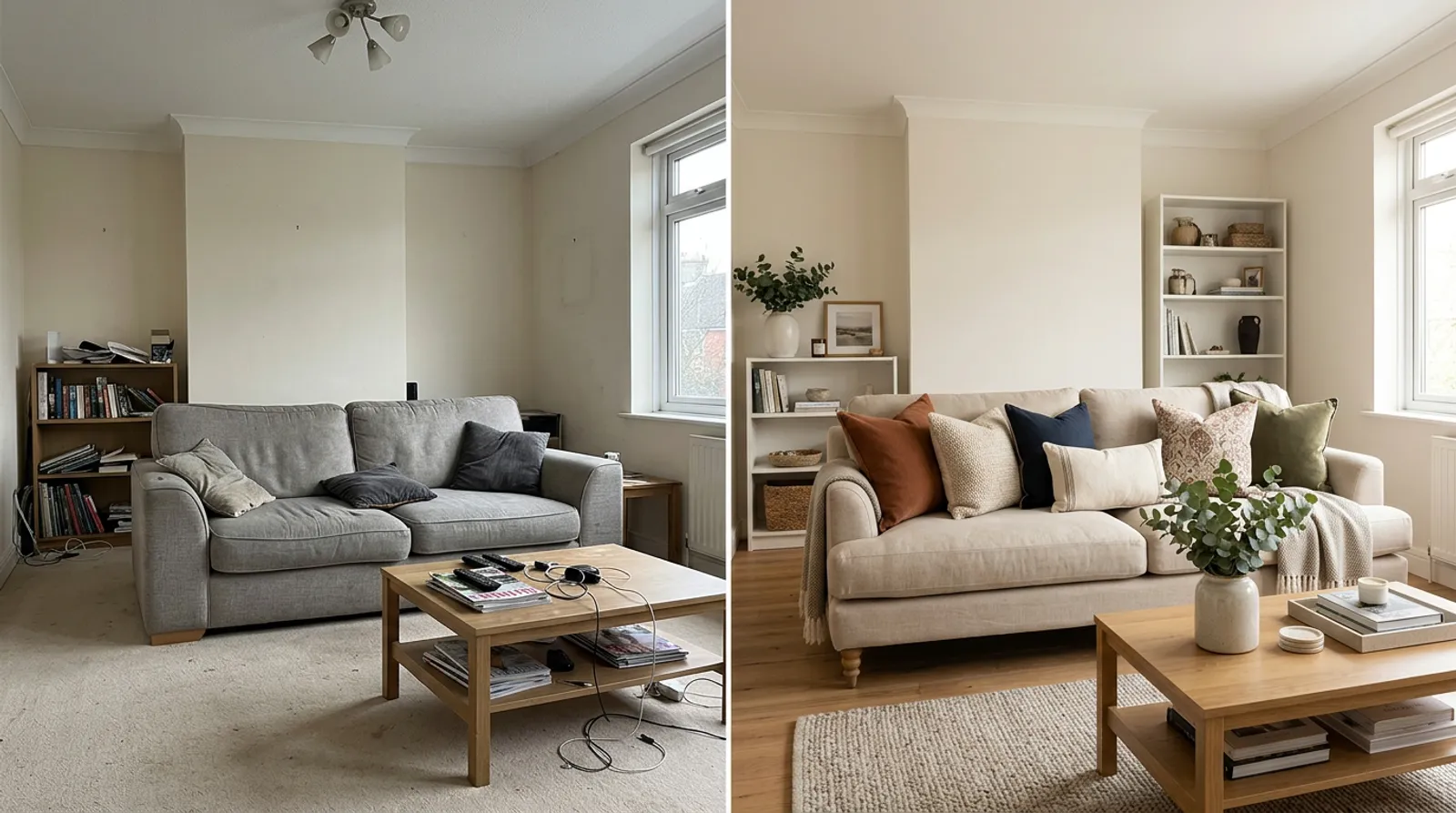 Design idea: a sofa styled with the right decorative cushions
The first rule is a matter of centimeters. Below 45x45 cm, a cushion looks puny and instantly reads as cheap. The reflex of buying 40x40 is the most frequent error: those cushions get lost on the seat and dress nothing up.
So treat 45x45 cm as the absolute floor, then size up depending on the sofa. The larger the sofa, the larger the cushions need to be to stay in proportion. A 2-seater is happy with 45x45 and 50x50, while a corner sofa calls for 55x55 and 60x60 so the cushions are not swallowed by the mass of the seat.
The pro trick for a plump, well-stuffed result is overstuffing: slip a 45x45 cover onto a 50x50 cushion. The cover stays taut, the cushion compresses slightly, and you get the rounded, full look of showroom cushions, where a same-size cover would sag flat after a few days.
The right number: always odd
The number of cushions matters as much as their size. The rule is simple: always an odd number, 3, 5 or 7. An even number (2, 4 or 6) creates a stiff symmetry and a visual imbalance, while an odd number looks more natural and more harmonious. It is the same logic as flower bouquets or object groupings: the eye likes a central point that does not split in two.
The right count depends on the sofa:
- 2-seater sofa: 3 cushions.
- 3-seater sofa: 5 cushions.
- Corner sofa: 7 cushions.
- Bed (hotel look): 3 decorative cushions, stood upright in front of the pillows.
2-seater sofa: 3 cushions
On a 2-seater, aim for 3 cushions mixing two sizes: 2 large at 50x50 cm and 1 medium at 45x45 cm. Mixing two formats is enough to create depth, where three identical cushions would fall flat. Plan a budget of 80 to 120 euros for the set.
3-seater sofa: 5 cushions
A 3-seater needs impact, so larger cushions: 50x50 cm minimum. Go for 5 cushions split across three sizes: 2 XXL at 60x60 cm, 2 large at 50x50 cm and 1 rectangular at 30x50 cm. Place the rectangular one in the center: it is what adds depth and breaks the alignment. Plan a budget of 120 to 180 euros.
Corner sofa: 7 cushions
A corner sofa has a lot of mass to balance, so the cushions go even bigger, around 55x55 cm. Count 7 cushions: 3 XXL at 60x60 cm, 3 large at 50x50 cm and 1 round at Ø50 cm. Spread them across both arms of the corner rather than piling everything on one side. The budget runs between 150 and 250 euros.
Bed: the hotel look in 3 cushions
For a bed that feels like a hotel room, add 3 decorative cushions in 50x50 cm or 65x65 cm, stood upright in front of the pillows. They layer over your sleeping pillows without replacing them. Plan a budget of 60 to 100 euros.
Mixing sizes, materials and patterns
Once the sizes and the number are set, the secret comes down to three variations to combine together:
- Three different sizes: one large, one medium and one rectangular. Cushions that are all the same look monotonous and catalog-like.
- Three different materials: one smooth (cotton), one texture (velvet or linen) and one with volume (knit, boucle). All in the same material is flat and lacks depth.
- The 3-tone rule: 3 colors maximum within the same family, plus 1 contrasting accent, keeping two thirds plain to one third patterned. Patterns everywhere tire the eye.
These three variations work together. Three cushions identical in size, material and color read as a set bought in one block, impersonal and flat. By contrast, a large plain velvet cushion, a medium textured linen one and a rectangular one with a subtle pattern tell a story, even if the sofa itself stays very simple.
For the color side, our 60-30-10 rule helps you place these accents without overloading the room. And to round out the sofa, see also how to choose the right throw blanket size.
The mistakes that ruin it
- Even number (2, 4, 6 cushions): visual imbalance.
- All the same size: monotonous, catalog effect.
- All the same material: no depth at all.
- Patterns everywhere: visual fatigue.
- Cushions too small, under 45 cm: an instantly cheap look.
Test your cushions on your sofa before buying
Picturing 5 cushions of different sizes and materials on your own sofa is not easy. With Shopia, you photograph your room, pick a mood, and get a realistic render in a few minutes. You can compare before and after, try several cushion combinations and adjust the colors before spending a single euro.
Do you sell fabric or home textiles? See how your catalog fits into Shopia and shows up in your customers' homes.
Frequently asked questions
What size cushions should I buy for a sofa?
The minimum size is 45x45 cm: anything smaller looks cheap and leaves the sofa feeling empty. For a 3-seater sofa, start at 50x50 cm for real impact, and go up to 55x55 cm on a corner sofa to balance the larger mass. Always mix at least two different sizes, for example a 50x50 and a 45x45, to create visual depth. A pro trick: putting a 45x45 cover on a 50x50 cushion gives a plump, well-stuffed look.
How many cushions should I put on a sofa?
Always use an odd number: 3, 5 or 7 cushions depending on the size of the sofa. Count 3 cushions for a 2-seater, 5 for a 3-seater and 7 for a corner sofa. An even number (2, 4, 6) creates a stiff symmetry and a visual imbalance. On a bed for a hotel look, plan 3 decorative cushions stood upright in front of the pillows.
How do I combine cushions without it looking off?
Vary three things at once: the sizes (one large, one medium, one rectangular), the materials (one smooth like cotton, one texture like velvet or linen, one with volume like knit) and the colors (3 tones maximum within the same family plus 1 contrasting accent). Keep a ratio of two thirds plain to one third patterned: too many patterns tire the eye. The number one mistake is cushions that are all identical, which gives a flat, catalog-like look.
Related articles

What size throw blanket to choose and how to style it
What size throw blanket to pick for your sofa or bed, in cm, and how to drape it for a cozy look instead of a cheap one.

How to choose and hang curtains
Rod height, floor-length drops, the right width for a full drape and quality fabric: the simple method for curtains that look professional.

How to combine colors at home (the 60-30-10 rule)
The 60-30-10 rule explained simply: 60% dominant color, 30% secondary, 10% accent. The decorator's method to harmonize any room without buying everything new.